
Disclosure: This post about how to teach a dog to drop it contains affiliate links. If you click through and make a purchase, I may earn a commission — at no extra cost to you. I only recommend products and courses I genuinely believe in, and all opinions expressed here are my own.
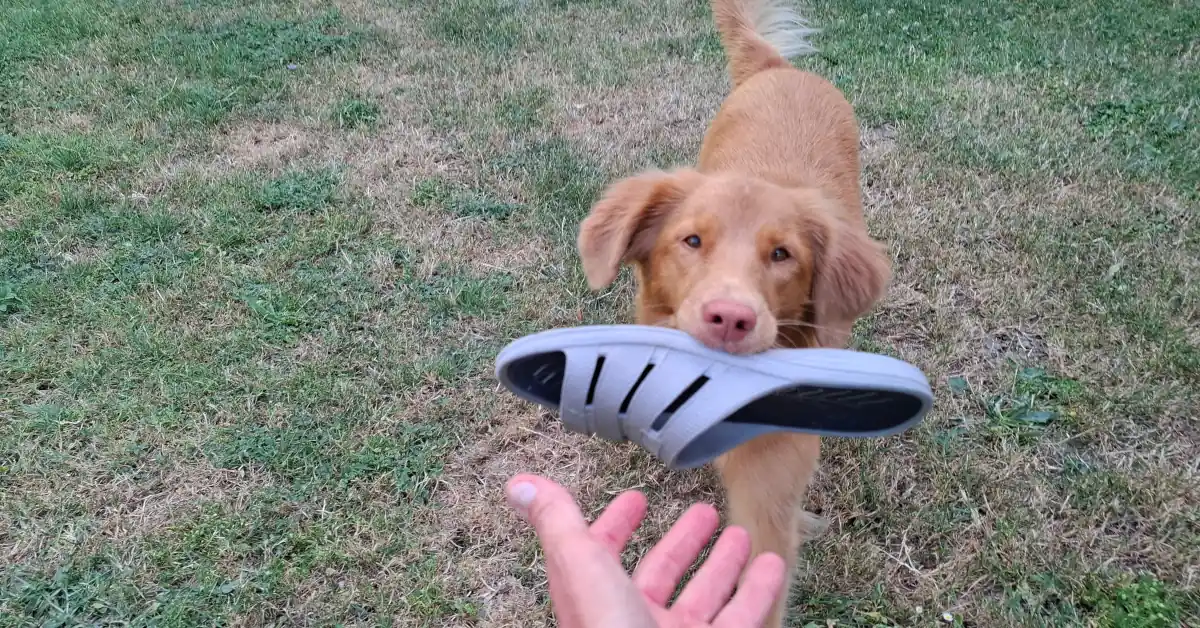
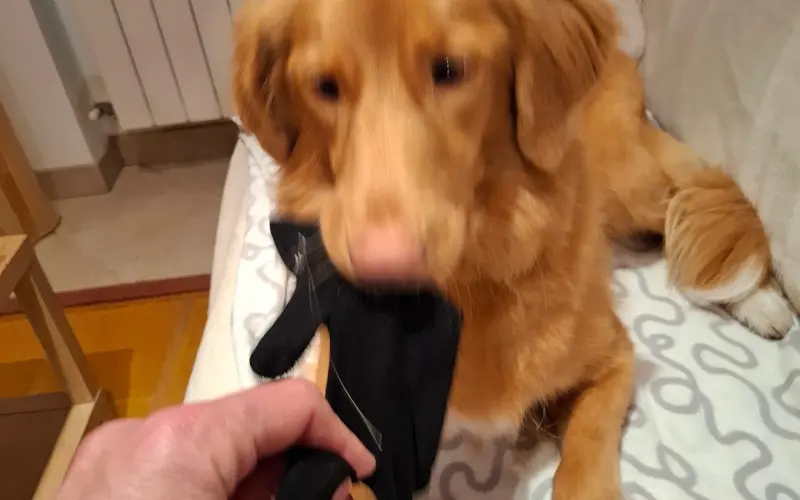
Picture this: your dog has something in his mouth that absolutely should not be there. Maybe it’s a sock, maybe it’s something he found on the sidewalk, maybe it’s the remote control you only put down for a second. Your instinct is to lunge, grab, maybe even raise your voice a little.
I want to stop you right there, because that instinct — as natural as it is — is exactly what makes this problem worse over time.
How to teach a dog to drop it isn’t about overpowering him in the moment. It’s about building a skill. Step by step, so that letting go of something becomes the easiest, most rewarding choice your dog can make.
Once you understand how to do this properly, you’ll never need to chase or pry open a jaw. Or turn a simple object into a tug-of-war that damages trust.
Let’s build that skill together, the right way.
Why Chasing Your Dog Never Works (And Often Backfires)
Here’s something worth understanding before we even start training. When you chase your dog to get something out of his mouth, you’re not solving the problem. You’re creating a game — and an incredibly fun one, from your dog’s point of view.
Think about what chasing actually teaches him.
He grabs something, you react with urgency, you move quickly, maybe your voice goes up an octave. To a dog, this looks exactly like play. So the next time he finds something interesting, he has every reason to grab it again. Because last time, it led to a great game of chase and got him all your attention.
There’s a second, more serious risk too. If you make a habit of forcibly prying objects from your dog’s mouth, you teach him something far less fun. That you are someone who takes things away.
Some dogs respond to this by becoming faster grabbers and swallowers. Others, over time, can develop resource guarding — growling, stiffening, or even snapping when they sense you’re about to take something from them.
That’s a much bigger problem than the sock ever was. And it’s one that often requires the help of a qualified trainer to resolve safely. As the AKC points out, this is exactly why “drop it” can be genuinely lifesaving. It lets you retrieve a dangerous item without ever needing to chase or pry.
So before we get to “how to teach a dog to drop it,” we need to commit to one rule: we never grab, we never chase, and we never pry open a mouth. Everything we do instead is built on trust.
Step One: Become Genuinely Interesting to Your Dog
This might be the most overlooked part of “how to teach a dog to drop it”. And it’s the one I want you to really sit with.
Before your dog will ever let go of something for you, he needs a reason to pay attention to you in the first place. If you’re dull, predictable, or only interesting when you’re upset, your dog has no incentive to check in with you instead of focusing on whatever fascinating thing is currently in his mouth.
So your first job isn’t teaching a word at all. It’s learning to be the more exciting option in the room.
This means using a playful, animated tone. It means moving with energy, showing curiosity, maybe even a little theatrical surprise “Ooh, what’s this?!”. Not a flat, serious voice that signals nothing fun is about to happen.
Dogs read body language and energy far more fluently than they read words, so this part matters more than people expect.
Practice this completely separately from any “drop it” training, just as a daily habit. Get your dog’s attention through play, movement, and an upbeat tone, without asking for anything in return. The more naturally your dog starts checking in with you throughout the day, the easier every other piece of training becomes. Including this one.
One important caution here: don’t overuse this. If you constantly demand your dog’s attention throughout the day, every single interaction starts to feel like a job application. And dogs — just like people — get tired of being tested constantly.
Use these moments intentionally, not compulsively.
Step Two: Teach the Concept Before the Word
Here’s where a lot of people go wrong. They say “drop it” before their dog has any idea what dropping something even gets him. A word with no meaning behind it is just noise.
So we start without any verbal cue at all. The entire first phase of this training is dedicated to one simple message: letting go of this object means something even better is about to happen.
Here’s how to build that understanding
Grab two toys your dog enjoys, as similar to each other as possible — two rope toys, or two rubber chews. Having a matching pair makes the exchange feel seamless rather than like a swap your dog has to think twice about.
Engage your dog with the first toy. Keep your energy playful and inviting. Wiggle it near his face, let him grab it, and allow him a few seconds of real satisfaction holding and chewing on it. This part matters. If he never gets to enjoy having something in his mouth, the whole exercise feels like a setup rather than a game.
Reveal the second toy while he’s still holding the first. Keep it hidden behind your back until this moment, then bring it out with enthusiasm. Wiggle it, get excited about it, make it the most interesting object in the room.
The instant he releases the first toy on his own, mark it warmly — a happy “yes!” or “good boy!” — and immediately let him have the second toy.
Repeat this for just a few minutes. Don’t drag it out; a short, fun, successful session beats a long, repetitive one every time.
What you’re building here is a simple, powerful association: releasing what I have leads to something good, not to the fun ending. This is the entire emotional foundation of “drop it.” It has to be solid before a single word enters the picture.
Step Three: Add the Word — But Only Once the Pattern Is Reliable
Once your dog is consistently and quickly releasing the first toy when you reveal the second one — not occasionally, but reliably, across several sessions — you’re ready to add language.
From this point on, say “drop it” in the exact moment he releases the object, right before you produce the reward. You’re not asking yet — you’re naming what’s already happening.
After enough repetitions of pairing the word with the action, you can start to use “drop it” as an actual request. Say the cue first, then offer the trade.
If your dog hesitates, that’s useful information. It usually means you’ve moved a step too fast, and it’s worth returning to a few sessions without the verbal cue before trying again.
This sequencing matters more than people realize. A command introduced too early, before the underlying behavior is solid, becomes a word your dog learns to ignore. And once a cue loses meaning, it’s far harder to rebuild than it would have been to simply wait a few more days before introducing it.
A small but important rule going forward. Only ever ask for “drop it” when you’re confident you can follow through with a fair, rewarding exchange.
If the cue starts to mean “sometimes good things happen, sometimes I just get robbed,” it will weaken over time. Reliability is what keeps a cue powerful for years, not just for the first few weeks.
How to Teach a Dog to Drop it: What If Your Dog Already Has Something He Won’t Let Go Of?
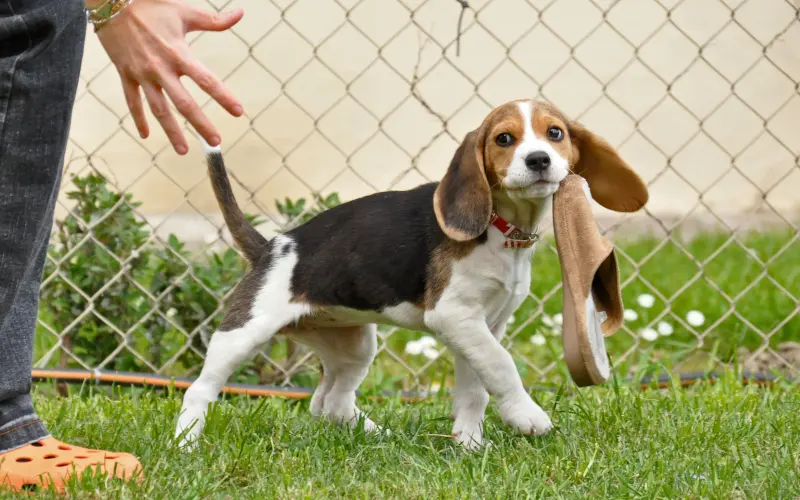
Real life doesn’t wait for a structured training session. If your dog already has something in his mouth that he’s holding onto firmly — and you’re mid-way through teaching this skill — here’s a force-free way to handle it.
Take hold of the object with one hand, calmly, without pulling. Then become completely still.
I mean genuinely statue-like: no talking, no eye contact, no movement. You are now, from your dog’s perspective, the least interesting and least rewarding thing in the room.
This works because most of what makes “holding onto something forbidden” fun for a dog is the reaction it produces. Remove the reaction entirely, and the object stops being interesting. Most dogs will release their grip within a short time once they realize the game has gone quiet.
The exact second he lets go — even just a little — mark it with a warm “yes!”. Then follow through with praise or a trade. This single moment of well-timed reinforcement does more to build the future “drop it” behavior than any lecture about responsibility ever could.
What you want to avoid here is turning into a drill sergeant who deals only in scolding and correction. Most dogs relate to the world through play and curiosity. If we want to reach them effectively, we need to speak their language, not force ours onto them.
Keeping Your Cool Is Not Optional
I want to be very direct about this part. If you lose your temper during this process, you undo the entire foundation you’re building.
The whole mechanism behind “drop it” depends on your dog associating you with good things — calm energy, fair trades, social reward. The moment you introduce frustration, raised voices, or rough handling, you’re teaching him the opposite lesson: that holding onto things tightly is actually a smart, protective strategy around you.
This is genuinely one of the harder parts of dog training to master, especially in the heat of the moment when your dog has just grabbed something you care about. But the dogs who learn “drop it” most reliably are the ones whose owners stayed calm and playful through every single repetition, even the frustrating ones.
How to Teach a Dog to Drop it: Why Short Sessions Beat Long Ones
If there’s one practical tip I’d want you to walk away with, it’s this: train “drop it” — and really, any structured behavior — in sessions of five to ten minutes, no longer.
Dogs learn through focused repetition, not marathon sessions. A short session where your dog is engaged, successful, and rewarded teaches far more than a long one where attention fades and frustration creeps in for both of you. Five focused minutes, once or twice a day, will get you further in a week than a single exhausting thirty-minute session ever could.
This is actually one of the core principles behind how I approach training overall, and it’s something I picked up in even more depth through the K9TI Total Transformation Masterclass, which is built almost entirely around short, structured, distraction-free training sessions that fit into a real, busy life.
If you want a complete framework for this kind of focused training — not just for “drop it,” but for building a genuinely well-mannered, happy dog — I’d recommend checking out their free workshop here: dogalchemy.net/k9ti-free-workshop.
It’s the same approach I use in my own work, and it lines up completely with everything in this post.
How to Teach a Dog to Drop it: A Quick Note on Breed and Individual Differences
While I’ve used examples that apply to dogs of any breed, it’s worth knowing that some dogs are simply more inclined to pick things up and carry them around. Retrievers, for instance, were bred specifically for this. That’s not a flaw to correct; it’s a trait to work with.
If your dog seems to have an unusually strong drive to grab and hold onto objects, the training above still applies — it may just take a few more repetitions, and a slightly higher-value reward, to get the same reliable result. Patience and consistency close that gap over time.
Final Thoughts
Teaching a dog to drop it isn’t about winning a power struggle. It’s about building a clear, fair line of communication: if you let go, something good happens. Every time.
Get that foundation right, and the word itself becomes almost a formality. A simple cue your dog responds to instantly, because he already trusts what comes next. No chasing, no prying, no damaged trust. Just a clean, reliable skill that could one day genuinely keep him safe.
Have you taught your dog to drop it? I’d love to hear what worked for you — or what you’re still working through — in the comments below.