
Disclosure: This post about dog separation anxiety contains affiliate links. If you click through and make a purchase, I may earn a commission — at no extra cost to you. I only recommend products and courses I genuinely believe in, and all opinions expressed here are my own.
You leave for work. Before you even reach the door, your dog is already panting, pacing, glued to your side. The moment it closes behind you, the barking starts. Neighbors complain. Things get chewed. You come home to a dog who looks like he’s been through a crisis — because he has.
If this sounds familiar, you’re dealing with dog separation anxiety. And you’re not alone.
This is one of the most common behavioral issues we encounter as a professional dog trainers, and one of the most emotionally draining for owners. The guilt of leaving, the stress of coming home to destruction, the constant worry — it all adds up.
The good news? It can absolutely get better. The key is understanding what’s really going on, approaching it with the right strategy, and — crucially — giving it the time it needs.
Let’s break it all down.
What Is Dog Separation Anxiety, Really?
Dog separation anxiety is not your dog being dramatic, vindictive, or trying to punish you for leaving. It’s a genuine anxiety disorder — a state of real psychological distress triggered by the absence (or anticipated absence) of the person your dog is most bonded to.
Think of it less like a behavior problem and more like a panic response. When your dog is in that state, he isn’t choosing to bark or chew — he’s reacting from fear, the way a person might during a panic attack. Understanding this distinction matters, because it completely changes how you approach the problem.
It’s also worth noting that not every dog who cries when you leave has full-blown separation anxiety. We’re working on a spectrum here. On one end: dogs who are mildly uncomfortable alone but settle down within a few minutes. On the other: dogs in such acute distress that they’ll injure themselves trying to escape confinement.
Knowing where your dog falls on that spectrum is the first step toward helping them.
How to Recognize Dog Separation Anxiety: The Key Signs
Here are the most common signs to watch for:
- Excessive barking, howling, or whining — especially when you leave or even as you’re getting ready to go
- Destructive behavior — chewing furniture, baseboards, doors, or crate bars
- House soiling in an otherwise house-trained dog
- Panting, drooling, or trembling before or during alone time
- Pacing or restlessness near doors or windows
- Refusing to eat while you’re away (a useful clue — a dog who can eat when alone is coping better than one who can’t)
- Shadowing you from room to room, becoming anxious at even brief visual separation
One important marker of severity: if your dog has ever injured himself trying to escape — broken teeth on crate bars, cuts from scratching at doors, a limb fracture from jumping — treat his anxiety as severe from the start.
⚠️ When You Need to See a Professional First
Before we go any further, I want to be direct about something important.
If your dog’s separation anxiety is severe — if he injures himself, can’t settle at all, or poses a risk to his own safety or your home — please consult a board-certified veterinary behaviorist before starting a training program on your own.
In the United States, look for a Diplomate of the American College of Veterinary Behaviorists (DACVB). In the UK, search for a RCVS-recognized Specialist in Veterinary Behavioural Medicine. These are veterinarians with advanced training in animal behavior who can evaluate whether medication — used alongside behavioral therapy — is the right approach for your dog.
Trying to desensitize a severely anxious dog without professional support can backfire and, in some cases, make the anxiety worse.
The training framework described in this guide is well-suited for mild to moderate cases. But please, know your dog. If something feels beyond your depth, trust that instinct.
Why the Standard Advice About Dog Separation Anxiety Usually Fails
You’ve probably heard something like: “Just ignore him when you leave. Don’t make a big deal of it.”
And you’ve probably discovered it doesn’t work — or made things worse.
Here’s why. Every time a dog in real distress experiences a full panic episode alone, that response gets reinforced. The nervous system learns: being alone = crisis. Repeated exposure without carefully managed conditions doesn’t build tolerance. It builds fear.
What actually works is a combination of two well-established behavioral principles:
counter-conditioning and desensitization.
The Two-Part Solution: Counter-Conditioning + Desensitization
Counter-Conditioning: Changing How Your Dog Feels About Being Alone
Counter-Conditioning means replacing a negative emotional response with a positive one. Right now, your departure triggers anxiety. The goal is to change that association so your leaving predicts something wonderful.
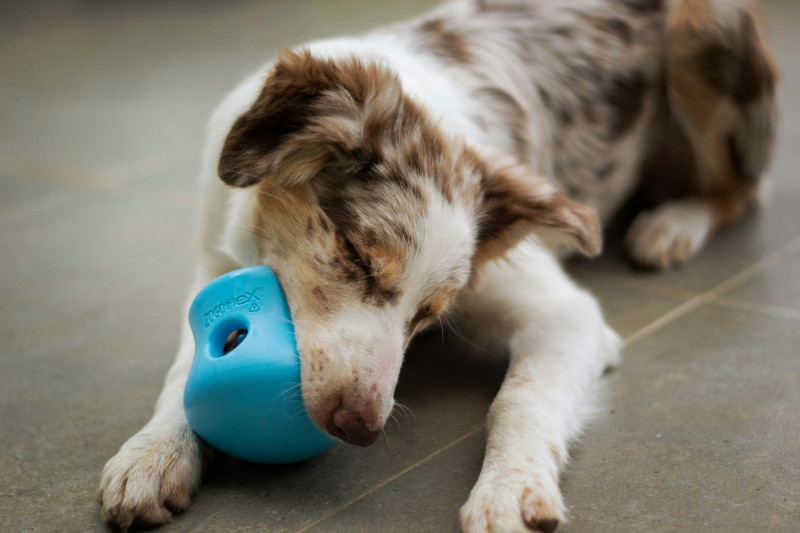
The most effective tool here is high-value food — frozen stuffed Kongs, lick mats, beef cheek chews, bully sticks, anything your dog genuinely loves. The rule: this food appears only during alone time. Not randomly. Not as a general reward. Specifically when you leave — or practice leaving.
Over time, your dog starts connecting your departure with something good arriving, rather than with panic. This is slow work, but it’s the real work.
Desensitization: Building Tolerance in Tiny Steps
Desensitization means exposing your dog to the thing that frightens him — in doses so small that the fear response doesn’t get triggered. The critical word is gradually.
If your dog panics every time you leave for twenty minutes, simply repeating that scenario isn’t training. You’re rehearsing panic. Instead, start with absences measured in seconds. Step outside, close the door, count to five, come back in. Ten seconds. Thirty. Two minutes. Build your way up in increments so small they feel almost absurd — because for a truly anxious dog, that’s exactly the right pace.
A practical trick: use baby gates or room barriers inside your home. Give your dog his frozen chew, step into the next room, potter around, come back. You can practice “separating” from your dog dozens of times per day this way — building positive associations without the full weight of a real departure. Each calm moment your dog spends with you out of sight is a small brick in the foundation of his confidence.
The #1 Thing That Derails Progress: Rushing
I’m going to be honest with you here, because I see this pattern constantly.
The single biggest obstacle owners face with separation anxiety is impatience.
I understand it completely. Life doesn’t pause. You need to get back to work. You’ve been doing this for weeks and feel like nothing is changing. So you push a little harder than you should — leave a little longer, skip a few short sessions in favor of one big test.
And then everything unravels.
Dog separation anxiety is not a simple behavior to “train out.” Your dog isn’t just learning a new skill — he’s relearning how to feel safe. That is a deep cognitive and emotional process. It requires repetition, consistency, and time. The pace must be set by the dog, not by your calendar.
Pushing too far too soon doesn’t just slow progress — it can reset weeks of careful work in a single session. One genuine panic episode can undo a lot.
Here’s what I’ve seen time and again: owners who feel “stuck” for weeks suddenly notice a real shift — not because anything dramatic happened, but because the cumulative weight of calm, patient, successful repetitions finally clicked into place.
Expect this to take weeks. Sometimes months. Celebrate every small win.
Practical Steps to Start Today
Here’s where to begin:
- Find your dog’s current threshold. How long can he be alone before distress kicks in? Note it — then start your training significantly below that point.
- Build a chew toy rotation. Get three or four rubber toys (Kongs, Toppls, or similar) and a couple of lick mats. Fill them with your dog’s regular food mixed with something higher-value — plain wet food, pumpkin puree, Greek yogurt, a little meat. Freeze them in batches so you always have one ready.
- Practice micro-separations daily. Multiple short, successful alone experiences every day beat one long session per week. Use doors and barriers, start with seconds, build slowly.
- Deactivate your departure cues. If your dog already reacts to you picking up your keys or putting on your shoes, start practicing those cues without actually leaving. Keys in hand, sit back down. Shoes on, watch TV. Drain the anxiety from those signals before they become alarms.
- Keep arrivals and departures low-key. Warm, yes. Calm, always. No dramatic goodbyes or excited homecomings — both reinforce the idea that your comings and goings are a bigdeal.
- Set up a camera. You need to see what your dog is doing when you’re gone. Guessing isn’t enough — you need actual data to know whether you’re making progress or pushing too hard.
Want a Structured, Step-by-Step Program?
The framework above will carry you a long way. But if you want expert guidance walking youthrough the full process — covering separation anxiety alongside other behavioral issues — I’d genuinely recommend checking out the free workshop from K9TI.
Their approach is built entirely around positive reinforcement and understanding the dog’s emotional state first, which lines up exactly with everything I’ve described here. It’s a solid starting point whether you’re just beginning or feeling stuck after trying on your own.
Watch the Free K9TI Workshop Here.
We’ve applied these principles in our day-to-day work with clients, and if you’d like, you can read my thoughts here.
You’re Not Failing. Dog Separation Anxiety Is Hard.
One last thing, and I mean this sincerely.
If your dog struggles with separation anxiety, it is not a reflection of how good an owner you are.
Separation anxiety has multiple contributing factors — genetics, early experiences, individual temperament, breed predispositions — most of which you had absolutely no influence over. Some dogs are simply wired to find solitude overwhelming, and no amount of love or good intentions would have prevented that.
What you can control is how you respond to it now. The fact that you’re reading this, looking for real answers, already says a great deal about the kind of owner you are.
Be patient with your dog. And be patient with yourself.
Have You Dealt With Dog Separation Anxiety?
I’d genuinely love to hear from you in the comments below.
Has your dog gone through this? What helped — and what made things worse? Or maybe you’re just starting out and have a question you’d like to ask. Don’t hold back. Every dog’s situation is a little different, and the more we share what we’ve experienced, the more we all learn.
Drop a comment — I read every single one.