
Disclosure: This post about patience with a puppy contains affiliate links. If you click through and make a purchase, I may earn a commission — at no extra cost to you. I only recommend products and courses I genuinely believe in, and all opinions expressed here are my own.
If there’s one piece of advice every new dog owner hears — so often it’s almost lost its meaning — it’s this: be patient with your puppy.
Patience with a puppy is the answer to nearly every question, the remedy for nearly every frustration, the quiet wisdom in the background of every good training session.
And yet, most of us roll our eyes a little when we hear it.
Not because it’s wrong. But because nobody ever explains what it actually means in practice — or why it matters so much more than it sounds.
So let’s talk about it for real.
Patience With a Puppy: Why “Just Be Patient” Is Incomplete Advice
Telling someone to be patient is a little like telling someone to “just relax” when they’re stressed. Technically correct. Not very useful.
Patience isn’t a switch you flip.
It’s a mindset — a way of seeing your puppy and your relationship with them — that shifts everything once you actually develop it. And the reason it’s so hard to develop in the first place has a lot to do with expectations. Unconscious ones, mostly.
Many of us grew up in a culture that treats dogs as subordinates.
Not necessarily through cruelty, but through a certain unspoken assumption: the dog should comply, quickly and quietly, and if it doesn’t, something has gone wrong.
That assumption is almost invisible — absorbed from family, from old-fashioned training shows, from a thousand casual comments — but it shapes how we react when a puppy does exactly what puppies do.
When you release that assumption and replace it with something more honest — this is a living being with his own personality, his own pace, his own way of experiencing the world — patience stops being an effort and starts being a natural response.
That’s the real shift. And everything else flows from there.
What Patience With a Puppy Actually Looks Like
Let me give you two very specific things that patience means when you’re living with a young dog. Not vague ideas — real, practical truths.
1. Results Take Longer Than You Think — And That’s Completely Normal
Here’s something no one puts on the puppy food packaging: progress is not linear.
You spend three days teaching your puppy to go to the bathroom outside. He does it! You’re thrilled. The next morning, he squats on the kitchen floor and looks at you with the innocent eyes of someone who has never heard of outside.
This is not failure. This is puppyhood.
The learning process in young dogs — just like in young children — is not a straight line from ignorance to mastery. It loops and backtracks. It stalls and then leaps forward. A puppy who seems to have forgotten everything he learned last week is not being stubborn. He’s consolidating. He’s integrating. His brain is doing exactly what it should.
Patience here means releasing the timeline (and understanding what your dog actually needs to feel safe and motivated to learn). Not giving up — never giving up — but letting go of the idea that a specific result should arrive by a specific date.
Progress often happens slowly, then suddenly. Your job is to stay consistent long enough to see it.
2. Keeping Your Cool Is Not Just Kindness — It’s Strategy
The second thing patience means is this: never losing your temper with your dog.
I say this not to lecture, but because I’ve seen what happens on both sides of this choice, and the difference is stark.
A dog who lives with a calm, steady person develops confidence. He learns to trust his environment. He tries things, makes mistakes, and tries again — because he’s never afraid that a wrong move will bring chaos down on him.
A dog who lives with someone who shouts, slams things, or physically corrects out of frustration learns something very different. He learns that humans are unpredictable. That the world is not safe. And that staying still and invisible is the smartest option.
This is not the dog you want. And it’s not the relationship you came for when you decided to bring a puppy into your life.
The good news is that keeping your cool gets easier as you understand more about how dogs actually learn.
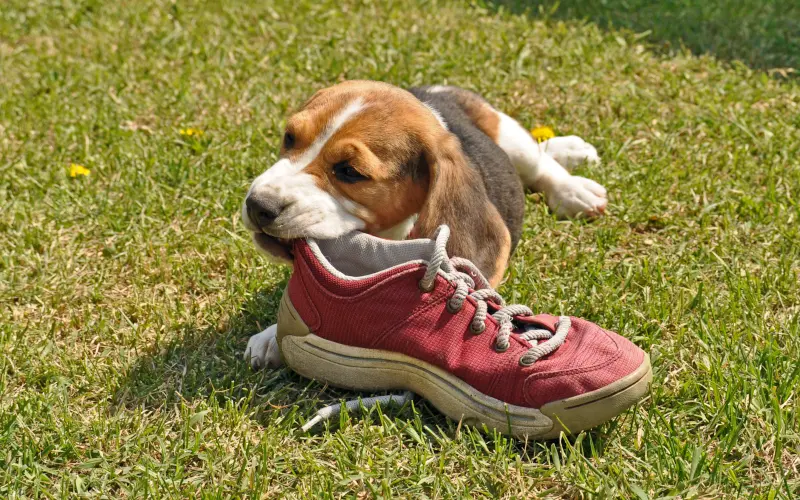
When you know that a puppy who chews your shoes isn’t being spiteful — he’s exploring the world with his mouth, exactly as nature designed him to — it’s much harder to be genuinely angry.
Patience With a Puppy: The Moments That Test You (And What They Really Are)
Here’s the part nobody talks about enough: the specific, maddening, utterly predictable situations that challenge your patience most. And what they look like when you approach them with the right mindset.
The “Of Course, Right Now” Moment
You’ve just sat down to dinner. The food is hot, you’re starving, and your puppy — who has been suspiciously quiet for the past twenty minutes — chooses this precise moment to have an accident in the corner of the room.
The frustrated version of you jumps up, raises your voice, and cleans it up in a fog of irritation.
The patient version of you notices something different: he gave me a sign and I missed it. Next time, I’ll watch more carefully before I sit down. You clean it up without drama, make a mental note, and adjust your routine. No stress for the puppy. A small lesson for you.
The “Feral Energy at the Worst Moment” Moment
You come home after a long walk in the rain. You’re both muddy. You open the door, and before you can do anything, your puppy bolts inside, bounces off the sofa, skids across the hall, and deposits perfect paw prints across your light-colored rug.
Frustrating? Absolutely. Surprising? It shouldn’t be — this is what puppies do when they’re full of energy and excitement.
Patient you takes a breath and thinks: tomorrow, I’ll have a towel at the door. Patient you also notices, with some amusement, that this small dog managed to cover approximately forty square feet in three seconds. That’s actually impressive.
The “Please, Not Tonight” Moment
It’s midnight. Your puppy is crying. Not softly — clearly and insistently, the way only puppies can. You’ve already been up twice. You have work tomorrow.
This is one of the hardest tests, because it hits when your reserves are lowest.
But here’s what patience gives you in this moment: perspective. This phase is temporary.
It has an end date, even if you can’t see it from where you’re standing. Puppies who feel secure in their environment learn to settle. Your consistency right now — your calm, your steadiness — is building that security, night by night.

Patience With a Puppy: The Mindset Shift That Makes All of This Easier
There’s a deeper reason why patience transforms your experience with a puppy, and it goes beyond training tactics.
When you stop expecting a dog to behave like a perfectly programmed machine and start genuinely seeing him as an individual — with his own personality, his own way of engaging with the world, his own sense of humor even — something wonderful happens. The frustrations don’t disappear, but they change texture. They become part of the story instead of evidence that something has gone wrong.
The puppy who woke you up at midnight is the same dog who will, a year from now, press his head against your leg when you’re sad. The one who chewed your favorite book is the same dog who will figure out exactly how to make you laugh at the end of a terrible day.
You’re not managing an inconvenience. You’re building a relationship.
That’s true whether you live in a house with a yard or in an apartment without one — the space matters far less than the quality of your presence.
And the most important ingredient in that relationship — more important than any training technique, any tool, any course — is the quality of your presence. Your calm. Your willingness to show up, again and again, with patience instead of pressure.
If you want a structured way to build on that foundation — to go from surviving puppyhood to genuinely thriving with your dog — I’d encourage you to look at the free workshop by K9TI, which is the starting point for the Total Transformation Masterclass I personally went through and recommend. The mindset and approach in that program align completely with everything I’ve described here. You can find it at dogalchemy.net/k9ti-free-workshop.
A Few Words Before You Get a Puppy
If you’re reading this before bringing a puppy home, I want to say something directly: what I’ve described above is not the exception. It’s the standard experience. Every puppy tests patience. Every single one.
The people who thrive are not the ones who never feel frustrated. They’re the ones who have decided, consciously, that their dog’s learning curve is something to be honored rather than rushed.
If that feels like a commitment you’re genuinely ready for, you’re in good shape.
If it feels like more than you can manage right now, it’s worth being honest with yourself about that — because the puppy deserves someone who can show up for the long game.
Final Thoughts
Patience with a puppy is not about gritting your teeth and enduring. It’s about choosing a way of seeing your dog that makes the hard moments lighter and the good moments more vivid.
It’s the quality that separates training that works from training that frustrates. The quality that separates a relationship built on trust from one built on tension.
And honestly? It’s the quality that makes living with a dog one of the most genuinely enriching things a person can do.
The maddening little creature who is currently chewing on something he absolutely should not be chewing on — he’s counting on you to find that funny rather than infuriating. Most of the time, if you let yourself, you can.
Has patience ever completely changed how you handled a tough moment with your puppy — or your dog? I’d love to hear your story in the comments below.