

Disclosure: This post about living with a dog in an apartment contains affiliate links. If you click through and make a purchase, I may earn a commission — at no extra cost to you. I only recommend products and courses I genuinely believe in, and all opinions expressed here are my own.
Can you have a dog in an apartment — a real, happy, thriving dog — without a backyard, a garden, or even a balcony?
I get this question more often than you’d think, both from clients who are considering getting a dog and from people who already have one and feel a little guilty about their square footage.
My answer is always the same: yes, you absolutely can have a dog in an apartment. And I mean any dog, not just a tiny Chihuahua or a sleepy Basset Hound.
The key has nothing to do with how many rooms you have. It has everything to do with something else entirely — and that’s what this post is about.
Dog in Apartment: The Myth That Needs to Go Away
Here’s something I’ve seen play out dozens of times in my years as a dog trainer: a dog with a massive yard who is anxious, destructive, and frustrated. And right across town, a dog in a two-room apartment who is calm, confident, and deeply connected to his owner.
Space does not make a dog happy. Meeting a dog’s fundamental needs every single day does.
Think about it. A dog left alone in a big garden for eight hours doesn’t “exercise himself.” He sniffs the same spots, barks at passing cars, and waits. He isn’t stimulated — he’s just unsupervised.
Meanwhile, an apartment dog whose owner commits to intentional daily walks, play, training, and quality time together gets something far more valuable: a real relationship and a genuinely enriched life.
I’m not saying a yard is useless. Of course it can be wonderful. But it isn’t a requirement for a happy dog. Commitment is.
What a Dog in an Apartment Actually Needs
Let’s get specific. Whether you live in a studio or a three-bedroom apartment, your dog’s core needs don’t change.
And none of them are about square footage.
Physical Exercise — Done Intentionally
Dogs need to move. That’s non-negotiable, regardless of where they live. For apartment dogs, the walk becomes the centerpiece of daily life — and honestly, that’s not a bad thing.
A morning walk that lets your dog sniff, explore, and decompress does more for his mental health than a whole day wandering alone in a fenced yard.
For an adult dog, a solid morning walk — at least 30 to 45 minutes of real exploration, not a rushed bathroom break — sets the tone for the whole day. Add a shorter outing at lunchtime if possible, and a meaningful evening walk where he gets to socialize or play, and you’ve already covered a huge chunk of what he needs.
This kind of structured, intentional movement is the foundation of a balanced dog in any living situation.
Mental Stimulation — The Underrated Need
Physical exercise alone isn’t enough. Dogs also need to use their brains. Puzzle feeders, training sessions, scent games, interactive play — these are the things that truly tire a dog out. A mentally stimulated dog is a calm dog.
Even five minutes of simple training in your living room — teaching a new behavior, reinforcing an old one, or playing a focus game — burns more energy than a ten-minute backyard loop.
Don’t underestimate this. It’s one of the biggest advantages apartment owners have if they’re willing to use it: you become your dog’s primary source of stimulation, and that deepens your bond in ways a yard simply can’t.
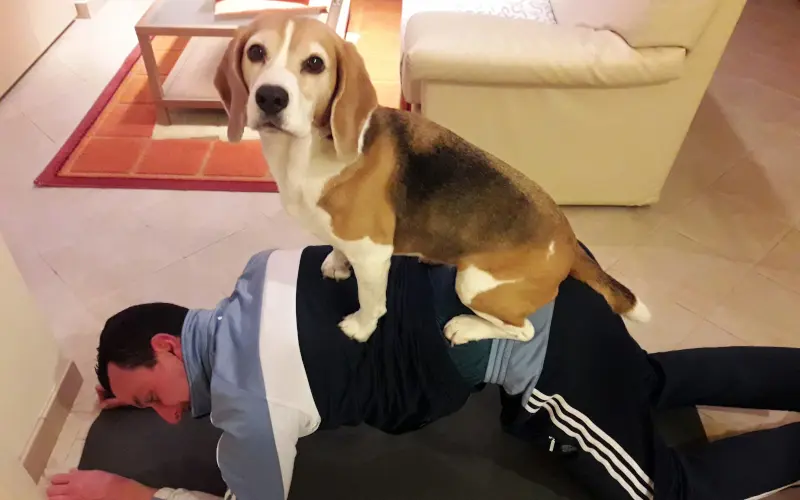
A Space of Their Own
Every dog, no matter the size of the home, needs a personal space — a safe spot that belongs entirely to them. A crate, a bed in a quiet corner, a specific area they can retreat to when the world feels like too much.
This isn’t just comfort — it’s security.
A dog who knows he has his own place to decompress is a more stable, more confident dog overall. And in a small apartment, establishing this space from day one also helps you manage the household in a way that’s clear and respectful for everyone.
(If you want to go deeper on this, I wrote about the power of “confinement” in building a healthy routine)
Boundaries and Structure — Not Rules for Their Own Sake
Living in a small space means it becomes especially important to set some clear, kind boundaries with your dog.
Not because you need to dominate him — that’s an outdated idea that modern behavioral science has long moved past — but because clarity is actually a gift to your dog.
For example: does your dog jump on the bed whenever he wants? In a large house, this might feel minor. In a small apartment where that bed is also your main relaxation space, it can quickly become a source of stress for both of you.
Teach him that your space is your space — that he can join you when invited, and that stepping off is no big deal.
This kind of mutual respect is the foundation of a harmonious shared life, whatever the square footage.
Dog in Apartment: What About Breed and Size?
Here’s where I want to be honest with you, because you deserve a straight answer. Size alone doesn’t determine whether a dog can thrive in an apartment.
I’ve worked with enormous Newfoundlands who were perfectly suited to small-space living because of their calm temperament. And I’ve met tiny Jack Russell Terriers who would have needed a football field and a full-time trainer to be truly happy in a studio.
What matters is the individual dog’s energy level, temperament, and — crucially — your commitment to meeting those specific needs every day.
That said, there are a few practical things worth thinking about when you’re choosing a dog for apartment life. A high-shedding giant breed in a small space means a lot of fur management. A dog with a powerful prey drive and a need for off-leash running will require you to find parks or open spaces consistently. A breed with a strong tendency to vocalize may create friction with neighbors.
None of these are dealbreakers. They’re just things to factor in realistically, so you can set yourself — and your dog — up for success.
A Real Day With a Dog in an Apartment (What It Can Look Like)
Let me paint you a picture.
You live in a two-bedroom apartment. No yard, no balcony. You have a medium-sized adult dog — let’s say a mix of some kind, with moderate energy.
Your morning: you wake up a little earlier than you’d like, and you head out for a real walk. Not just a potty break — a genuine exploration. Your dog sniffs things, you let him lead for stretches, you practice a little loose-leash walking. Thirty-five minutes later, you’re back home. You play for five minutes with his favorite toy, then he gets his breakfast. He settles down. You get ready for work.
Midday: maybe you swing by for a quick outing, or a dog walker covers this for you. Fifteen minutes, just enough to stretch his legs and do his business.
Evening: you come home, and this is the social time. A longer walk, ideally in a place where he can meet other dogs. He plays, he socializes, he burns off what’s left. Dinner when you get back. Then a calm evening, with him settled at your feet or in his spot.
That dog is not deprived. That dog has a rich life.
The Training Connection You Might Be Missing
Here’s the thing I’ve noticed over the years: apartment owners who commit to intentional training almost always end up with better-behaved, more fulfilled dogs than suburban owners who rely on “the yard will tire him out.”
Because training isn’t just about teaching commands. It’s about communication. It’s about your dog learning to navigate the world through you. And that relationship — built through consistent, positive, force-free work — is what transforms a dog who’s just surviving his environment into one who is genuinely thriving in it.
If you want to go deeper on this and build exactly that kind of relationship with your dog, I’d encourage you to take a look at the free workshop offered by K9TI — the same program behind the Total Transformation Masterclass that I personally went through and recommend.
It’s a solid place to start if you want practical, science-backed guidance on building a bond that actually works. You can check it out here: dogalchemy.net/k9ti-free-workshop.
Before You Get a Dog — A Word
If you’re reading this because you’re thinking about getting a dog and you live in an apartment, I want to encourage you. You can absolutely do this.
But I also want to be real with you: a dog requires daily effort. Not occasional effort — daily.
If the idea of two or three intentional outings a day, plus training time and genuine engagement, sounds like more than you can realistically commit to right now, it might be worth waiting until your life has more room for it.
That’s not a criticism — it’s just an honest conversation I’d have with anyone.
But if you’re ready? Then the size of your apartment is the least of your worries. What matters most is the size of your commitment.
Final Thoughts
A dog in an apartment isn’t a compromise. It isn’t a second-best life for a dog who “deserves better.” It’s a different kind of life — one that, done well, is deeply rewarding for both of you.
The dogs I’ve seen thrive most aren’t always the ones with the biggest gardens. They’re the ones whose owners showed up for them, every single day, with intention and love.
That’s what good dog ownership looks like. And that’s something you can absolutely do — no yard required.
Have you been living with a dog in an apartment? If you’d like to let me know what you think, how you handled the situation, or what’s causing you the most trouble, I’d love to read your comment below.