
Disclosure: This post about how catastrophizing makes life harder for an anxious dog owner and their pet, contains affiliate links. If you click through and make a purchase, I may earn a commission — at no extra cost to you. I only recommend products and courses I genuinely believe in, and all opinions expressed here are my own.
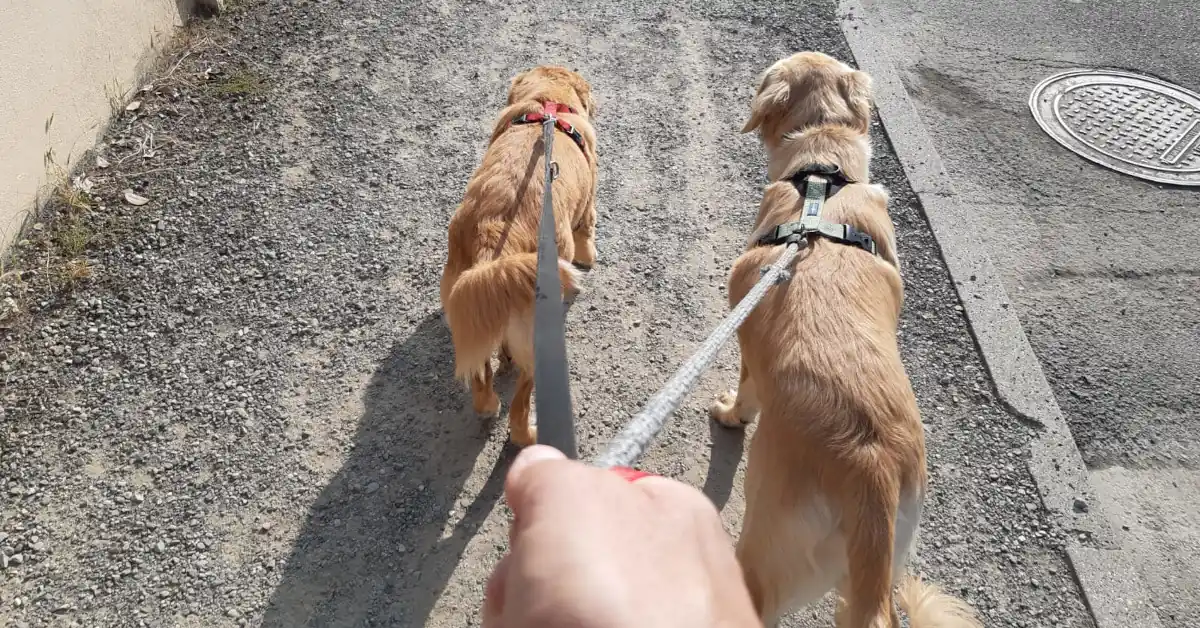
You’re about to leave the house for a walk. Your dog is reactive — not dangerously, but enough that encounters with other dogs can turn tense. And before you’ve even opened the door, a familiar sequence has already begun in your head.
What if there’s a dog around that first corner? What if it’s the one he went after last time? And… What if I can’t get his attention fast enough? What if someone sees and judges me? And…What if this whole walk is a disaster?
By the time you step outside, you’re already braced for the worst. Your shoulders are tight, the grip on the leash is firm. Your breathing is a little shallower than usual. And your dog — who is reading all of this in your body before you’ve said a single word — has already picked up that something worth worrying about is probably coming.
This is catastrophizing. And if you recognize yourself in that description, you’re not alone — and you’re not weak. But understanding what’s happening, and having some practical tools to interrupt it, can change not just your walks, but your entire relationship with your dog.
What Catastrophizing Actually Is
Catastrophizing is a well-documented cognitive distortion — a thinking pattern in which we take a possible negative outcome and treat it not as one of many possibilities, but as the inevitable, unrecoverable conclusion. It’s the mental leap from “this might be difficult” to “this will definitely be terrible, and I won’t be able to handle it.”
It isn’t a character flaw, and it isn’t irrational in its origins. When we’ve had genuinely difficult experiences — a dog fight, an embarrassing moment on a walk, a training session that fell apart — our brain files those memories as threats and becomes hypervigilant for signs that they’re about to repeat. Anticipating the worst feels like preparation. It feels like a form of protection.
The problem is that it doesn’t protect us. It simply moves the suffering earlier in the timeline — and, in the specific case of dog ownership, it actively shapes the outcome we’re dreading.
Why Catastrophizing Is Especially Costly for Dog Owners
Here is the thing that makes this pattern particularly worth understanding for anyone who lives with a dog: your emotional state is not private. Your dog is reading it constantly, in the tension of your muscles, the rhythm of your breathing, the way you hold the leash, the quality of your attention. Long before a challenging situation arrives, your dog has already received a signal about how serious this is — and they respond accordingly.
It becomes a self-sustaining cycle: the owner’s anxiety feeds the dog’s reactivity, which confirms the owner’s worst expectations, which deepens the anxiety before the next outing. The catastrophizing thought doesn’t just predict the outcome — it helps create it.
Research confirms this dynamic. Studies show that owners with higher levels of anxiety have dogs with increased levels of fear-related behaviors, stranger-directed reactivity, and excitability.
This doesn’t mean anxious owners are bad owners — it means the connection between human and dog nervous systems is genuinely real, and working on our own patterns is part of caring for our dogs well.
The Anxious Dog Owner Trap — How It Plays Out
Before looking at solutions, it helps to see the pattern clearly, because it usually unfolds in a predictable sequence.
First comes the anticipatory dread — the spiral that starts before the walk has even begun. Then comes the physical bracing: a tighter grip, a tensed body, scanning the environment for threats rather than being present in it.
The dog picks up these signals and becomes more alert, more aroused, more ready to react. An encounter happens — or almost happens — and regardless of how it actually goes, the memory of the anxiety is filed as evidence that the fear was justified. The cycle deepens.
What makes it particularly hard to break is that catastrophizing also leads to avoidance. We start shortening walks, choosing routes that reduce the chance of encounters, skipping social situations altogether.
In the short term, this feels like relief. In the longer term, it shrinks both our dog’s world and our own, and leaves the underlying anxiety untouched — or worse, reinforced.
As I write about in the post on dog training patience, the state of our own nervous system is one of the most underappreciated variables in how we live with our dogs. Our internal habits of thought are not separate from our training — they are part of it.
Three Practical Tools for an Anxious Dog Owner to Interrupt the Pattern
The good news is that cognitive behavioral therapy — one of the most rigorously researched approaches in modern psychology — offers a set of concrete, practicable tools for exactly this kind of thinking pattern. Adapted to the dog ownership context, they look like this.
Step One — Notice Before It Escalates
The first and most important skill is simply catching the catastrophizing thought before it has fully taken hold. This requires developing the habit of pausing at the first sign of the spiral and naming what’s happening: I’m catastrophizing right now. Not judging it, not arguing with it — just noticing it.
Words that signal catastrophizing in dog ownership contexts tend to sound like: “He always does this.” “This is going to be a disaster.” “She’s never going to get better.” “I can’t handle this.” “Everyone is going to see.” When you hear these words in your internal monologue, that’s the flag. You’ve identified the pattern. Now you can work with it.
For an anxious dog owner, there’s also a physical signal worth learning: the moment you notice your grip tightening on the leash before anything has even happened, that’s often the body expressing a catastrophizing thought before the mind has fully articulated it.
Step Two — Challenge the Thought Honestly
Once you’ve noticed the catastrophizing, the next step is to question it — not dismiss it, but genuinely interrogate it. Catastrophizing thoughts present themselves as facts. They rarely are.
Some questions worth asking: What has actually happened, on average, when we’ve been in this situation before? What’s the most likely outcome — not the worst imaginable one? If something difficult does happen, am I genuinely incapable of managing it, or have I managed things like this before?
The goal isn’t to replace “this will be terrible” with “everything will be wonderful.” That’s just a different kind of distortion.
The goal is honesty. “This might be difficult, and I’ve handled difficult things before” — which the brain is actually able to believe and act from.
Step Three — Replace the Catastrophic Story With a Realistic Plan
The third step is where the practical dog ownership dimension comes in most directly. Once you’ve interrupted the spiral and challenged the thought, replace it with something more useful: not just a calmer internal narrative, but a concrete, grounded plan.
If we encounter another dog, I’ll increase my distance to the other side of the street, ask for attention, and reward calm behavior. I’ve done this before. I know what to do. That specific, rehearsed plan does something that vague reassurance cannot. It gives the brain something to act on rather than something to worry about.
Feeling prepared is genuinely incompatible with catastrophizing, which feeds on a sense of helplessness.
This is also the moment to take one conscious breath before walking toward any situation that activates anxiety. Not as a trick, but as a literal physiological signal to your own nervous system. And through it, to your dog.
A single slow exhale changes the tension in your body in ways your dog will notice before you consciously register the difference.
Building a Different Habit Over Time
These three steps work best when they’re practiced regularly, not just deployed in moments of crisis.
I want to be transparent about something. I’ve been exactly where you are. Early in my career as a dog trainer, I began walking clients’ dogs as well — sometimes five or more dogs at once, animals I barely knew, with very different personalities and triggers.
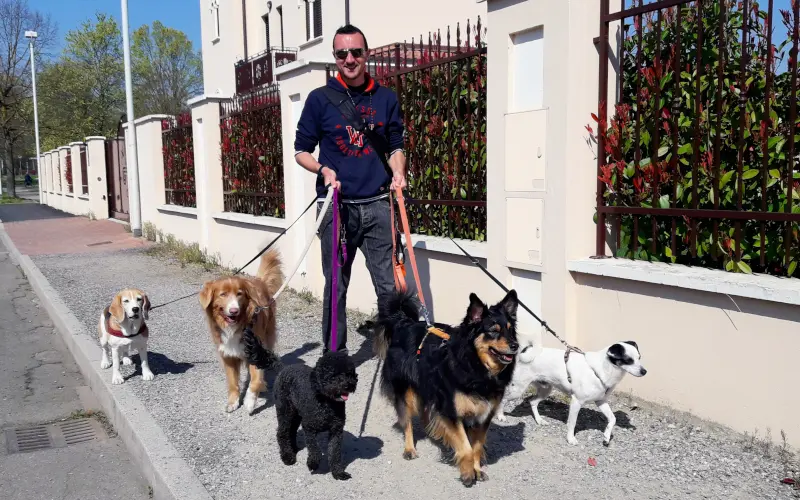
What started as manageable gradually became something I dreaded. Before each group walk, my mind would run through every possible disaster.
What if two of them went for each other? What if I lost control of the whole group? And… What if I wasn’t cut out for this at all?
The anxiety built until I was seriously considering stopping altogether. The tools I’ve shared in this post — borrowed, as I mentioned, from cognitive behavioral therapy — are the same ones that helped me work through that period. I’m not writing about this from the outside. I’ve been an anxious dog owner too, just in a different context. And things genuinely got better.
Like Any Skill, Interrupting Catastrophizing Gets Easier With Repetition
One practical habit worth building: keep a brief, informal record of the walks and interactions that actually went reasonably well. Not the perfect ones — just the ordinary ones where nothing terrible happened, where you and your dog navigated something and came home. Our brains have a well-documented negative bias — difficult moments stick more reliably than easy ones. Deliberately noting the ordinary successes builds a more accurate internal database to draw from when the catastrophizing starts.
And when things do go wrong — because sometimes they will — notice how that compares to what the catastrophizing version of you predicted. Usually the difficult moment was real but survivable, and the aftermath was far less catastrophic than the anticipation. That comparison, made consciously over time, is itself a form of training.
A Final Thought for an Anxious Dog Owner on Fear as Motivation
Many of us were taught — by parents, by coaches, by life — that the way to make ourselves try harder is to scare ourselves into it. If I don’t get this right, the worst will happen.
Fear works in the short term. But as a sustained motivator in dog ownership, it makes walks dread rather than pleasure. And it keeps both the anxious dog owner and the dog in a state of chronic low-level stress.
The alternative is to approach each walk not from the question “what if this goes wrong?” but from “what do I want for myself and my dog today?”. A short walk where both of you felt calm. A moment where your dog checked in with you voluntarily. One interaction that was unremarkable and fine.
These are not small things. They are exactly the conditions in which trust, between an owner and their dog, quietly grows.
If you’d like a structured, relationship-centered approach to building that trust across all the situations of daily life — one that works on the connection between you and your dog rather than just managing behaviors — the Total Transformation Masterclass by K9TI is the resource I recommend most.
Do you recognize any of these patterns in yourself? I’d genuinely love to hear — this is one of those things that’s rarely talked about openly in dog training spaces, and it should be. Leave a comment below.