
Disclosure: This post about “dog mental health” contains affiliate links. If you click through and make a purchase, I may earn a commission — at no extra cost to you. I only recommend products and courses I genuinely believe in, and all opinions expressed here are my own.
There’s a question I’ve been sitting with for a long time, one I rarely hear asked directly in the dog training world. Not “Does your dog eat well?” or “Does your dog get enough exercise?” — those conversations happen everywhere. The question I keep coming back to is simpler, and more uncomfortable: does your dog actually get to be a dog?
I’m not asking about commands or training routines. I’m asking about something more fundamental — whether your dog is free to express who they genuinely are. Whether their barking, their sniffing, their impulse to run toward something interesting, their need to pause, their individual quirks, their hesitations and enthusiasms are met with curiosity and respect. Or with correction and suppression.
Because what I’ve come to believe, after years of working with dogs and the people who love them, is that dog mental health depends less on what we give our dogs and more on what we allow them to be.
A Tool, Then an Ornament — The Dog’s Changing Role
Dogs have lived alongside humans for thousands of years, but what we expect from them has shifted enormously, and not always in a direction that serves them well. For most of history, dogs had working roles — hunters, herders, guardians. This sounds like “use” and in some ways it was. But there was something important embedded in that arrangement: a dog’s nature was given room to operate. A herding dog herded. A hunting dog hunted. Their instincts weren’t just tolerated — they were the whole point.
Something changed when dogs moved fully into domestic life and became what we now call “companion animals.” The phrase sounds kind, and the intention behind it usually is. But companion animals carry an implicit expectation that working dogs never did: they are supposed to be emotionally available, consistently calm, permanently non-disruptive, and quietly grateful for everything. They are supposed to make us feel good — and to do so reliably, without inconvenient needs of their own.
The dog who does all of this without complaint is praised as “well-behaved.” The dog who barks, pulls, hesitates, refuses, or communicates inconvenient things gets labeled “difficult.” Sometimes “dominant.” Sometimes just — broken.
Dog Mental Health and the Right to Expression
This matters more than most people realize. Because dog mental health is shaped in profound ways by whether a dog is permitted to express its natural behavioral repertoire. Sniffing, barking, moving, playing, exploring, signaling discomfort, choosing who to approach and who to avoid — these are not optional extras. They are the language through which a dog navigates the world and participates in it.
When these expressions are consistently suppressed — corrected, punished, ignored, or prevented — something shifts. The psychologist Martin Seligman, in his foundational research on learned helplessness, showed that animals repeatedly prevented from influencing their own environment eventually stop trying. Even when the possibility opens back up. They become passive and unresponsive. Not because they are content, but because they have learned that what they do doesn’t change anything.
I see this in dogs regularly. The dog who has stopped offering signals. The dog that sits quietly and watches, without engagement, without curiosity. Or the dog whose owner describes as “finally calm” — and who, when I look more carefully, isn’t calm at all. They’ve simply given up.
Dog Mental Health: What Suppression Looks Like in Everyday Life
It doesn’t always look dramatic. Most of the time, it looks like this:
- A dog who tries to sniff a fence post on a walk gets pulled away every single time, because the owner wants to cover distance.
- Or a dog who barks at a sound gets immediately silenced, day after day, without ever receiving an acknowledgment that something worried them.
- A dog who hesitates before approaching a stranger gets pushed forward because the owner is embarrassed by the hesitation.
- A dog who jumps up in greeting — a completely natural social gesture — gets only harsh correction, never understanding, never redirection toward something acceptable.
These are small moments. But they accumulate. And what they accumulate into is a picture of a dog whose attempts to communicate consistently produce nothing, or something unpleasant. That is not good for dog mental health. And it rarely produces the connected, cooperative animal the owner was hoping for.
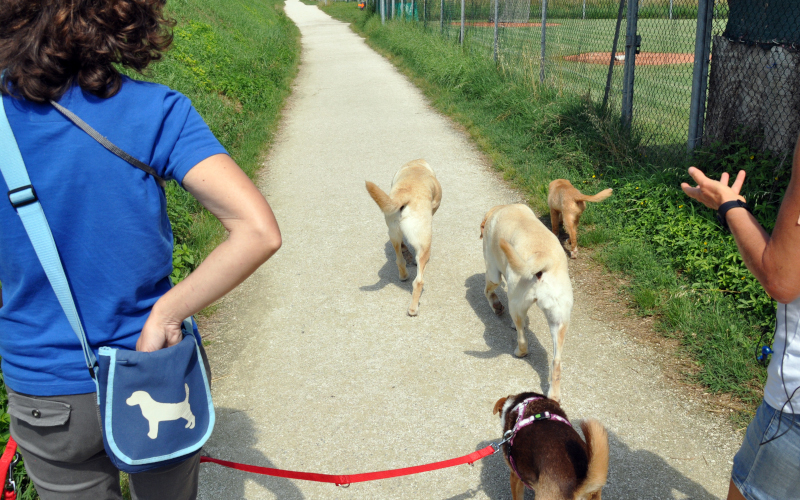
How Much Do You Actually Let Your Dog Be a Dog?
This is the question I want to place in front of you. Not as a judgment — I’ve worked with owners who deeply love their dogs and still, without realizing it, give them very little room to simply be themselves. It isn’t a matter of intention. It’s a matter of awareness.
A Few Questions Worth Sitting With
- Does your dog ever get to sniff freely on a walk, without being pulled, for at least a portion of the route?
- When your dog communicates something — a bark, a pause, a refusal to approach, a sudden alertness — do you take a moment to wonder what they might be saying? Or do you immediately try to override it?
- Does your dog have any time in the day when nothing is asked of them — no commands, no training, no redirecting — just genuine, unstructured time?
- When your dog approaches you, do you respond? Or does the contact almost always happen on your terms, at your timing?
- Is there anything your dog is allowed to do that is slightly inconvenient for you, simply because it matters to them?
There are no right answers here. The exercise is simply to look honestly at how much space your dog’s inner life actually occupies in your daily decisions.
Dog Mental Health: What Letting Your Dog Express Themselves Actually Looks Like
This doesn’t require extraordinary effort. It requires a different kind of attention — slower, more observant, genuinely interested in reading rather than directing. Here are the most practical places to start.
On Walks
The walk is one of the most powerful moments you have for your dog’s mental health. And one of the most commonly misused. A walk that truly serves your dog is not a walk that covers distance. It is a walk that involves sniffing. Deep, unhurried, nose-to-ground sniffing is the primary way a dog reads and processes the world around them. Allowing your dog to sniff freely — even if it means standing still for two full minutes at a spot that seems meaningless to you — is enrichment, decompression, and communication all at once.
Try building into every walk a stretch of time where your dog leads. No destination, no pace, no direction. You simply follow where the nose goes. This small reversal is quietly transformative for many dogs.
At Home
Give your dog genuine unstructured time — not “place” command time, not training time, just time when they can move around, make small choices, settle where they choose, approach or withdraw on their own initiative. Autonomy is not a luxury for a dog. It is a basic requirement of psychological wellbeing.
And when your dog brings you something — a toy, a nudge, a look that asks for contact — respond. Even briefly. Acknowledgment is not the same as giving in to every demand. It simply tells your dog: your signal reached me, and it mattered.
With Other Dogs and People
Dogs need to be allowed to sniff, circle, and assess before engaging. More importantly, they need to be allowed to decline — to move away, to look away, to signal that they’ve had enough. Overriding these signals, however natural the impulse to be polite to the other dog’s owner, teaches your dog that their social communication is irrelevant. Over time, this erodes both confidence and skill.
Let your dog vote on who they want to interact with. You can facilitate introductions without forcing them. Allowing that choice is one of the most respectful things you can do.
The Dog Who Has Gone Quiet
We have built a culture around the idea of the “good dog” — the one who doesn’t bark, doesn’t jump, doesn’t react, doesn’t ask for much. We call this “well-behaved” or “calm”. And sometimes it genuinely is.
But sometimes the dog who has gone quiet is a dog who has learned that there is no point in speaking. A dog’s mental health doesn’t announce itself the way a physical illness does. It lives in the quality of their engagement with the world — in how often they approach something new with curiosity, in the brightness behind their eyes, in whether they seem to be living or simply enduring.
The best measure of a dog’s inner life, in my experience, is not obedience. It is curiosity. A dog who is genuinely well is a dog who still wants to explore, who still communicates, who still comes to find you when something interesting is happening. Protecting that aliveness — not just their physical health, but their willingness to be present and engaged — is the real work of ownership.
If you’d like structured support in building this kind of relationship — one that puts genuine understanding at the center, rather than compliance — the Total Transformation Masterclass by K9TI is the best resource I know. It’s built on exactly this philosophy.
I’m genuinely curious: in an ordinary day, when does your dog actually get to just be themselves? Leave a comment — I’d love to hear what that looks like in your home.