

Disclosure: This post about the challenging question “why does my dog bark so much?” contains affiliate links. If you click through and make a purchase, I may earn a commission — at no extra cost to you. I only recommend products and courses I genuinely believe in, and all opinions expressed here are my own.
If you’ve ever asked yourself “why does my dog bark so much?”, you’re in very good company. It’s one of the most common frustrations dog owners bring to me. It’s also one of the most misunderstood.
Barking isn’t a flaw in your dog’s character. It’s one of the main tools your dog has for communicating with you and with the world around them.
Why Does My Dog Bark So Much? A Quick Answer First
Most excessive barking comes down to a handful of root causes: alerting you to something in the environment, boredom or pent-up energy, fear or anxiety, and attention that got accidentally reinforced along the way.
Some dogs bark for one of these reasons. Others bark for two or three at once, depending on the situation.
Figuring out which one (or which combination) applies to your dog is the real starting point. It’s exactly what we’ll walk through together in this guide.
Why Does My Dog Bark So Much More Than Other Dogs?
Dogs don’t bark for no reason.
It can feel that way at three in the afternoon, over what looks like nothing. But every bark carries information. Your dog might be telling you that something changed nearby. Or that a need isn’t being met. Or that a strategy has worked before and is worth trying again.
When barking becomes constant or hard to interrupt, it usually points to one of two things. Either your dog is dealing with something uncomfortable, like fear or frustration. Or barking has quietly become the most effective tool in their toolbox for getting a result they want.
Neither of those makes your dog stubborn or badly behaved. It just means there’s a cause worth understanding before you try to fix anything.
Alert and Territorial Barking
Many dogs bark to announce that something has entered their space.
That could be a person walking past the fence, a delivery truck, or another dog on the sidewalk. From your dog’s point of view, this works beautifully. They bark, the mail carrier eventually leaves, and the lesson lands hard: barking made the “threat” go away.
This pattern is tricky to break precisely because real life keeps reinforcing it, whether you’re involved or not.
Boredom and Pent-Up Energy
A dog who doesn’t get enough movement, sniffing time, or mental engagement often has energy with nowhere to go. Barking becomes an outlet.
It’s a way to self-soothe, or simply to do something with all that unused drive. This kind of barking tends to show up during quiet, uneventful stretches of the day rather than as a reaction to a specific trigger.
Fear and Anxiety
Some dogs bark because they genuinely feel unsafe. A loud noise, an unfamiliar visitor, or the stress of being left alone can all set this off.
Here, the bark isn’t a challenge or a demand. It’s closer to a request for safety. Reacting with frustration or punishment usually makes the underlying fear worse instead of better.
Attention and Accidental Reinforcement
This is the pattern I see most often with clients. Barking sometimes leads to a response: eye contact, a scolding, a treat tossed over to buy some silence, or someone simply walking over.
When that happens, the dog learns something powerful. Barking gets results.
Dogs repeat what works. Even a well-meaning “stop that!” can end up training the exact behavior you’re trying to eliminate.

Why Does My Dog Bark So Much? Start With What Your Dog Actually Needs
Before working on the barking itself, I always look at the bigger picture of a dog’s daily life.
A dog who gets to move, explore, and use their nose is generally calmer and more resilient across the board.
Walks shouldn’t just be bathroom breaks. They’re one of the best chances your dog has to read their environment and burn mental energy in a healthy way. Structured sniffing games and simple scent-based activities are especially useful here.
They tap into a dog’s natural drive in a way that leaves them satisfied instead of wound up. This is often the missing piece when people ask themselves “why does my dog bark so much?” and nothing else seems to help.
I’ve written a full guide on bringing more scent work into daily walks if you’d like to go deeper on that side of things.
Routine matters too. Dogs feel more secure when their day has a predictable rhythm.
A predictable dog tends to be a quieter one. None of this guarantees every bark will disappear overnight. It does mean you’re finally working with your dog’s biology instead of against it.
Why Responding to the Barking Can Backfire
One of the most common mistakes I see is responding to barking automatically.
That includes talking to the dog, offering a treat to “distract” them, or jumping in to scold. From a dog’s perspective, almost any reaction counts as attention.
Attention confirms the barking was worth doing again.
A more effective approach is to notice and reward the moments of quiet instead. When your dog pauses, even briefly, that’s your cue. Step in with a calm word or a small reward. Over time, this teaches your dog that silence, not noise, is what earns good things.
This is exactly the kind of subtle, evidence-based shift that’s covered in real depth inside the K9 Training Institute’s Total Transformation Masterclass, which walks owners through how to reshape everyday patterns like this one step by step. If you’re curious, you can check out the free workshop and see whether the approach clicks for you and your dog.
Teach Your Dog What To Do Instead
Telling a dog not to bark doesn’t give them an alternative, and dogs need one (this exact scenario — teaching your dog a calmer alternative to doorbell barking — is covered step-by-step in Module 6, “Barking at the Door” of the K9 Training Institute’s Total Transformation Masterclass).
Many owners have great success teaching their dog to go to a mat when the doorbell rings, to make eye contact on cue, or to grab a favorite toy instead of sounding the alarm.
When these alternative behaviors get reinforced consistently, dogs start offering them on their own. Not because they’re forced to, but because the new habit simply works better for them than the old one did.
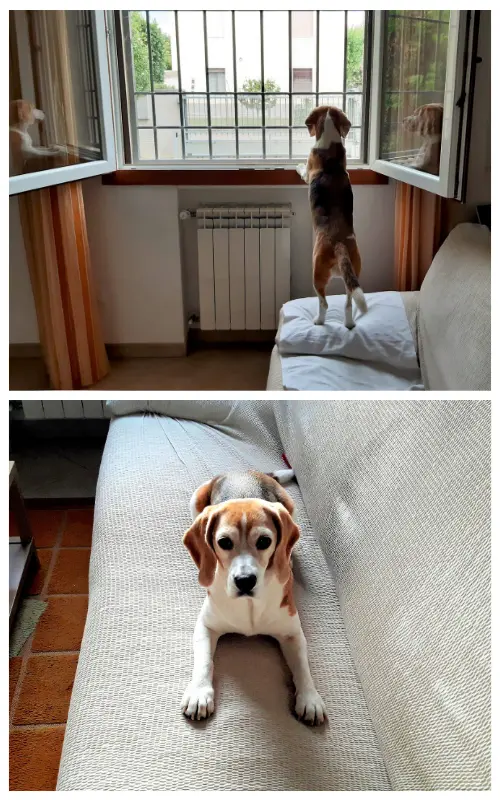
Why Does My Dog Bark So Much? When the Environment Feeds the Barking
Sometimes the fastest improvement comes from changing what your dog can see and hear, not from training alone.
Blocking a clear view of the street with a privacy film or curtain helps. So does moving a favorite resting spot away from a window, or playing soft background noise. All of these reduce the number of triggers your dog reacts to in the first place.
According to the ASPCA, territorial and alarm barking are both driven by fear and the anticipation of a perceived threat. That’s exactly why removing the visual trigger tends to work so well.
This becomes especially relevant if you live somewhere with shared walls or close neighbors, where barking can turn into a real source of tension fast. I’ve covered some of the specific challenges of managing a dog in tighter quarters in this piece on apartment living with a dog, if that sounds like your situation.
None of this is about avoiding the problem. It’s about creating the conditions where your dog can actually succeed while learning a new pattern.
Your Own Energy Is Part of the Equation
Here’s something that surprises a lot of my clients: your emotional state matters more than you’d think.
Dogs are remarkably good at picking up on human tension, frustration, and stress, even when we believe we’re hiding it well. Responding to barking with visible irritation raises the temperature of the whole interaction. It rarely lowers it.
The Cornell University College of Veterinary Medicine notes that identifying the true motivation behind a bark is the real key to reducing it long term, rather than simply reacting to the noise itself.
I go into this dynamic in much more detail in my article on emotional contagion between dogs and their owners, because understanding it changes how you show up in these moments.
Staying calm and consistent isn’t just good manners. It’s information your dog is constantly reading.

When It’s Time for More Support
Most barking responds well to a combination of meeting your dog’s needs, managing the environment, and reinforcing the behavior you actually want.
Some cases, especially ones tied to deep-rooted fear or separation-related distress, benefit from more structured, professional guidance. That’s part of why I recommend the K9 Training Institute’s Total Transformation Masterclass to owners who want a genuinely comprehensive, force-free framework rather than a pile of scattered tips. You can find more details through their free workshop and decide for yourself if it feels like the right fit.
I’d love to hear from you in the comments. What does your dog’s barking usually sound like, and have you figured out what’s behind it? Getting a real answer to “why does my dog bark so much” is the first step toward a calmer home for both of you 🙂