
Disclosure: This post about scent work for dogs contains affiliate links. If you click through and make a purchase, I may earn a commission — at no extra cost to you. I only recommend products and courses I genuinely believe in, and all opinions expressed here are my own.
Scent work for dogs starts with a moment every owner recognizes. You’re walking, you’re in a hurry, and your dog has stopped cold to spend thirty seconds sniffing a patch of sidewalk. It looks like nothing to you. You give a little tug. They barely notice.
What’s happening there isn’t stubbornness. It’s biology.
Understanding it will change how you think about your dog’s daily life — and what they actually need from you.
Why a Dog’s Nose Is in a Different Category Than Their Other Senses
Dogs have somewhere between 220 and 300 million scent receptors in their noses. Humans have around 6 million.
But the raw numbers only hint at the difference. In a dog’s brain, the area dedicated to processing smells is roughly forty times larger than the equivalent human area, proportionally speaking.
The result is a sensory experience we genuinely cannot imagine.
Where we smell soup in a kitchen, a dog smells the individual vegetables, the pot, the water source, and the person who cooked it. For dogs, scent is a primary means of communication — conveying information about their environment, other animals, and even emotions. Scent is how they read the world.
This matters for how we think about scent work for dogs because it means sniffing isn’t a distraction or a bad habit. It’s a dog doing the thing their brain was built for.
The Connection Between Scent and the Predatory Sequence
In the post on why dog breeds exist, I wrote about the predatory sequence — the chain of behaviors wolves use when hunting, from initial search to final kill.
Domestic dogs inherited this entire sequence from their wild ancestors. What changed through selective breeding is which pieces got amplified and which got quieted.
Scent work engages the very first link in that ancient chain: the seeking phase.
A dog actively searching for a hidden scent is doing what their brain was built to do, at the most fundamental level. Behavior professionals propose that nosework and scent work — along with scent activity variations such as sniff-focused walks and directed searches for food — enhance dog welfare and provide mental stimulation. This is why.
The act of seeking is more pleasurable to dogs than the act of obtaining.
Dogs in search are focused, mindful, and processing significant amounts of information. Seeking belongs alongside food, water, and sleep in the hierarchy of basic physiological needs. That’s a strong statement from a behaviorist. It lines up with what we see every day.
Dogs who get adequate sniffing time are calmer, more settled, and easier to live with.
What Scent Work for Dogs Actually Does to the Body
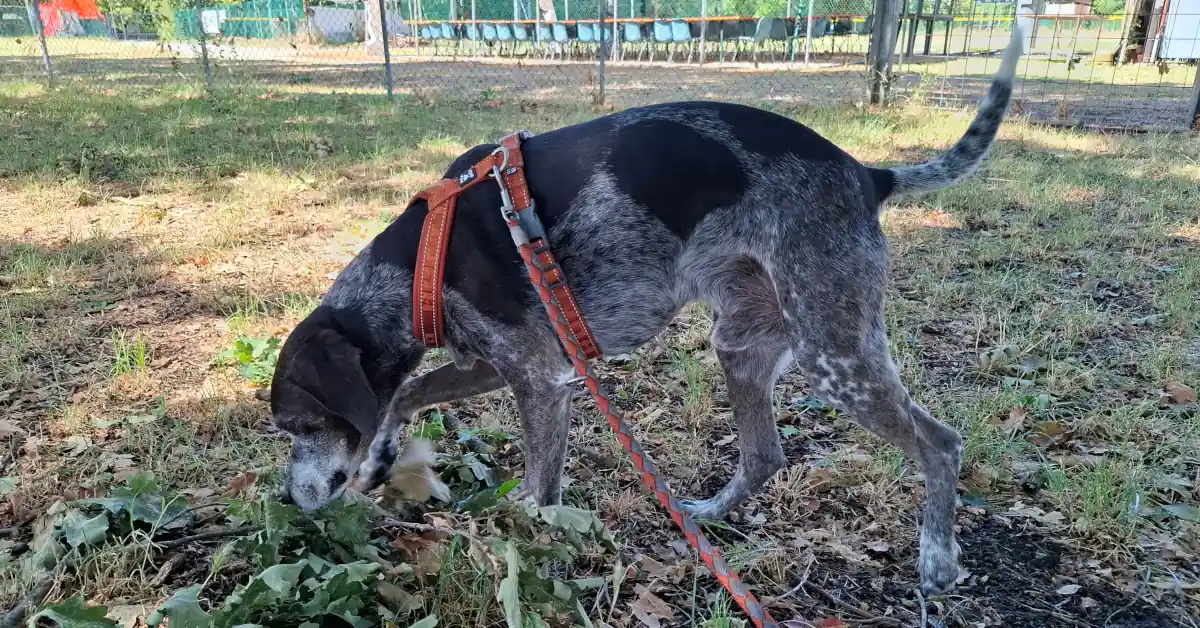
Here’s something most owners don’t know. Sniffing can decrease heart rate, lower blood pressure, and improve a dog’s optimism. Dogs build confidence and independence when they are allowed to sniff.
That physiological shift is real and measurable.
A dog who is actively sniffing engages their parasympathetic nervous system. That’s the one responsible for rest and calm, not fight-or-flight.
This is why a simple scent game after a chaotic or triggering environment — a crowded park, noisy traffic — can help a dog process and recover. The nose pulls them back to calm.
It’s also why a thirty-minute sniff walk can leave a dog more tired than an hour of physical running. Scent walks are just as effective as physical exercise at expending pent-up energy. Mental effort costs energy, and scent work is genuinely demanding mental effort.
Three Ways to Start Scent Work for Dogs Today
You don’t need equipment, a formal class, or any special training background to begin. These three approaches work for any dog, any age, any breed.
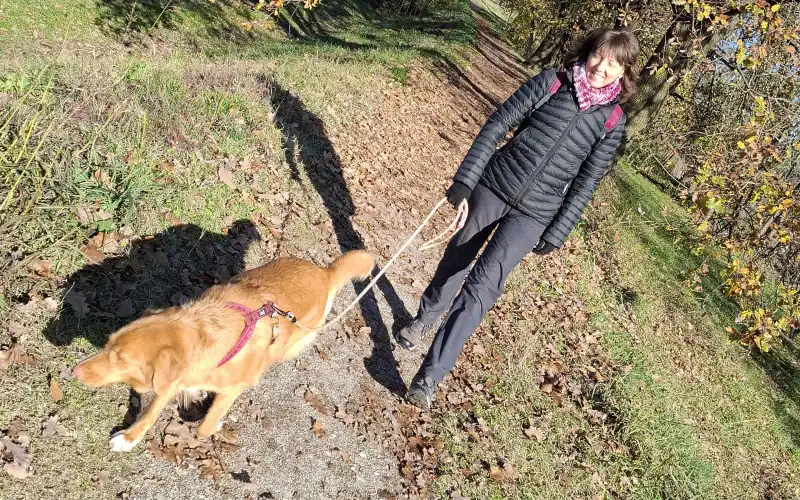
The Sniff Walk
The simplest form of scent work for dogs requires nothing except changing your intention on a walk.
Instead of moving from A to B, you let the dog’s nose lead. Follow their interest. Slow down when they slow down. Don’t rush them off a smell until they’re ready.
This is sometimes called a “sniffari,” and it genuinely transforms the purpose of a walk. It’s no longer just exercise. It’s exploration. A sniffari works beautifully as the quieter counterpart to structured enrichment walks with activities along the route.
Same time investment, completely different quality of experience for your dog.
One thing worth clarifying, though. Giving your dog more sniffing freedom doesn’t mean switching off as a handler and letting them lead you wherever they want. That’s a subtle but important distinction, especially if you’ve worked to address leash pulling.
The goal is to widen the margins, not hand over the map.
Think of it this way: you’re still the one deciding the general route and the boundaries of the walk. Within those boundaries, your dog gets real latitude to explore, pause, and sniff at their own pace. If they suddenly lock onto a scent trail and start pulling hard toward the horizon, that’s the moment to calmly redirect — no yanking, just a gentle invitation back within the space you’ve defined.
The loose leash relationship you’ve built stays intact. The sniffing opportunity sits inside it, not instead of it.
The Find-It Game
Scatter a small handful of treats across the grass or across a room. Tell your dog “find it” and let them go. Don’t help. Watch.
Watch your dog drop their head, begin working a pattern, and move through the area with real focus. When they find the last treat, they’ll look up at you with a specific alertness. It’s different from regular excitement. That’s the seeking system finishing its cycle.
This is the simplest version of structured scent work. It takes five minutes and works in any living room. For apartment dogs or dogs who can’t go outside easily on a given day, it’s one of the most useful tools you have.
The Hide-and-Seek Variation
As a trainer, this is one of my favorites for building both the seeking instinct and the dog-human bond simultaneously.
For this one, you’ll need a helper — a family member, a friend, anyone willing to hold your dog for a minute while you disappear.
Let your dog smell something belonging to you — an old T-shirt, a glove. Then have your helper hold them while you go hide somewhere in the house or yard.
Once you’re in position, give the release cue — “find me” works well — and let them go. When they find you, celebrate genuinely. Not a quick “good dog” — actually celebrate. Your dog just did something ancient and satisfying, and they did it for you.
Over time, you can add difficulty. Better hiding spots, different starting rooms, different scented objects. The game scales naturally with whatever your dog can handle.
When Scent Work Reveals Something Bigger
Some dogs introduced to scent work for the first time show an intensity that surprises their owners. The dog who seemed disinterested in everything suddenly has a project. The anxious dog who wouldn’t settle starts to decompress after ten minutes of searching.
Scent work builds confidence in shy or fearful dogs. It helps high-energy dogs learn to focus. Any dog can do it, including older dogs or those with physical limitations.
If scent work unlocks something in your dog — a calmer baseline, more focus, more genuine engagement with you — that’s not an accident. It means you’ve found an outlet that fits who they are.
Building on that foundation is exactly what the Total Transformation Masterclass is designed to help with. The structure and support there makes the difference between a good idea and a real habit.
If You Want to Go Further
What I’ve described here is enrichment-level scent work — informal, unstructured, immediately accessible.
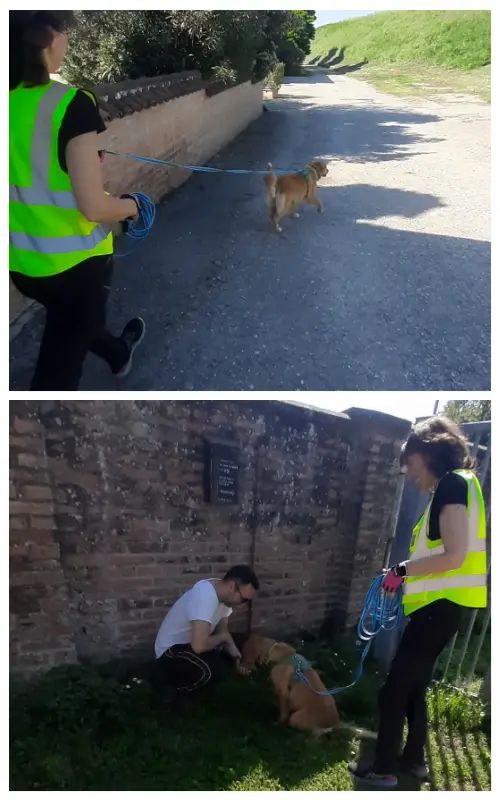
There’s also a whole world beyond informal play: formal nosework sports like AKC Scent Work and NACSW, mantrailing, tracking, and search and rescue. These are organized disciplines with formal rules, titles, and competitions.
You don’t need to go anywhere near that formal level to get everything the nose has to offer.
But if your dog lights up during the simple games above, exploring the more structured version with a certified trainer is worth considering — it’s a path I know firsthand, having completed my own mantrailing instructor certification alongside my partner Simona.
For now, the most useful thing you can do is start. Give your dog a sniff walk today, scatter some treats in the grass, and let them work. Watch what their nose does. Then watch what it does to the rest of them.
Has scent work surprised you with how much your dog responded to it? Or are you only just discovering that your dog has a whole extra dimension most people never see? I’d love to hear about it in the comments below 🙂