
Disclosure: This post about loose leash walking contains affiliate links. If you click through and make a purchase, I may earn a commission — at no extra cost to you. I only recommend products and courses I genuinely believe in, and all opinions expressed here are my own.
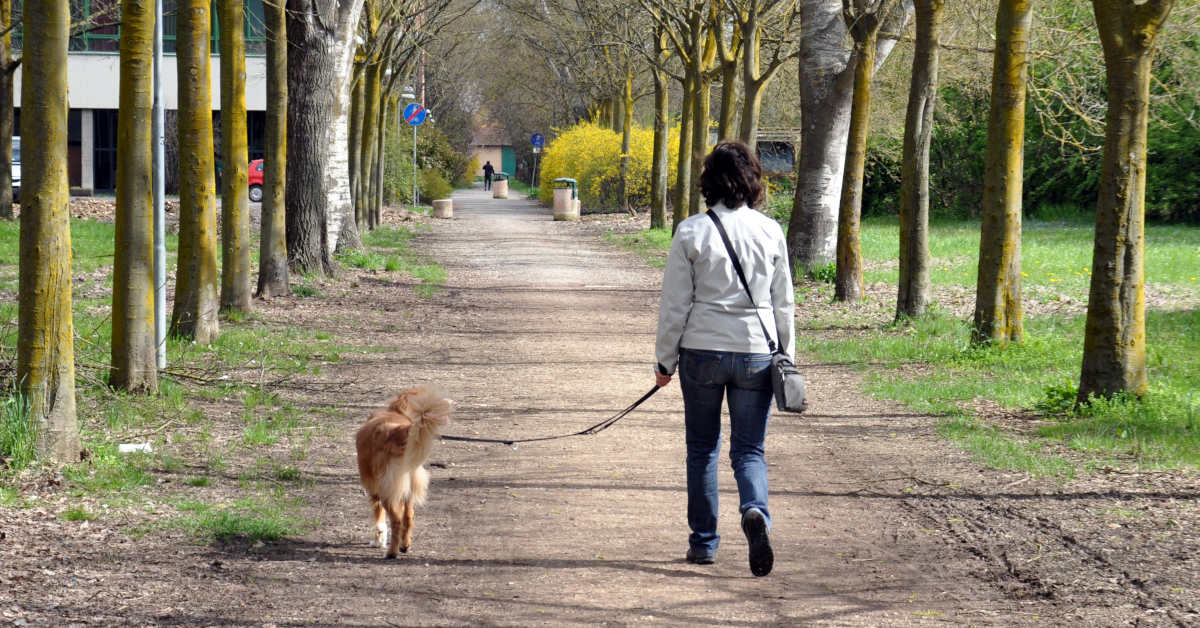
If your dog turns every walk into a tug-of-war, you’ve found the right guide. Loose leash walking — the skill of your dog moving calmly beside you with a slack leash — is one of the most rewarding things you can teach, and one of the most frequently misunderstood.
Most owners try to fix leash pulling by jerking back, stopping dead, or zigzagging randomly. These approaches aren’t entirely wrong, but they miss the real issue: your dog isn’t pulling to be difficult. He’s pulling because the world out there is enormously exciting, and nobody has shown him yet that staying close to you is more rewarding than sprinting toward that squirrel.
Once you understand that, everything changes.
Why Dogs Pull on the Leash in the First Place
Dogs don’t pull out of dominance, stubbornness, or spite. They pull because it works. The moment a dog leans forward and feels the leash go taut, he learns that pulling moves him closer to whatever he wants — the tree, the dog across the street, the fascinating smell on the lamp post. You may slow him down, but you rarely stop him completely.
This is operant conditioning at its simplest: the behavior produces a result, so the behavior gets repeated. Every walk where pulling pays off — even a little — reinforces the habit a little more.
The solution isn’t to overpower your dog. It’s to make the behavior stop working, and to make paying attention to you more rewarding than anything the environment has to offer.
What Loose Leash Walking Actually Looks Like
Before you can teach it, it helps to have a clear picture of what you’re actually aiming for.
Loose leash walking doesn’t mean your dog walks in a perfect heel position glued to your left leg— that’s formal obedience training, a whole different level of precision. What we’re after is simpler and far more livable: a dog who stays within a reasonable range, with a slack leash and periodic check-ins, exploring the world without dragging you along.
Your dog can sniff. He can move a little ahead or to the side. What he can’t do is pull. The leash stays loose — that’s the goal, and it’s completely achievable.
The Foundation of Loose Leash Walking: Start With Attention
Here’s the step most people skip, and it’s exactly why their training stalls: before your dog can walk nicely outside, he needs to learn to pay attention to you inside, where almost nothing is competing for his focus.
This is not optional groundwork. It’s the entire foundation.
Start by teaching your dog that making eye contact with you — just glancing up — pays off immediately and reliably. Use small, high-value treats. Stand still, wait for your dog to look at you, and the moment he does, mark it (with a clear “yes!” or a clicker) and reward. Repeat this tens of times across short daily sessions.
What you’re building is a habit: looking at my person is always worth doing. This is
classical conditioning working in your favor — you’re associating yourself with good things before the leash even enters the picture.
Teaching Loose Leash Walking Step by Step
Step 1: Start Indoors, With Zero Distractions
Begin in your living room, hallway, or backyard — anywhere quiet and familiar where your dog isn’t already excited. Clip the leash on, walk around the space, change direction often, and reward any moment your dog naturally stays near you or checks in with eye contact.
Keep sessions to five or ten minutes. End while things are still going well.
Step 2: Make Attention Worth More Than the Environment
Once your dog is reliably checking in with you in that calm space, start rewarding movement alongside attention. Take a step, reward. Three steps, reward. Build longer stretches of calm walking, always marking and rewarding the moments your dog is at your side with a slack leash.
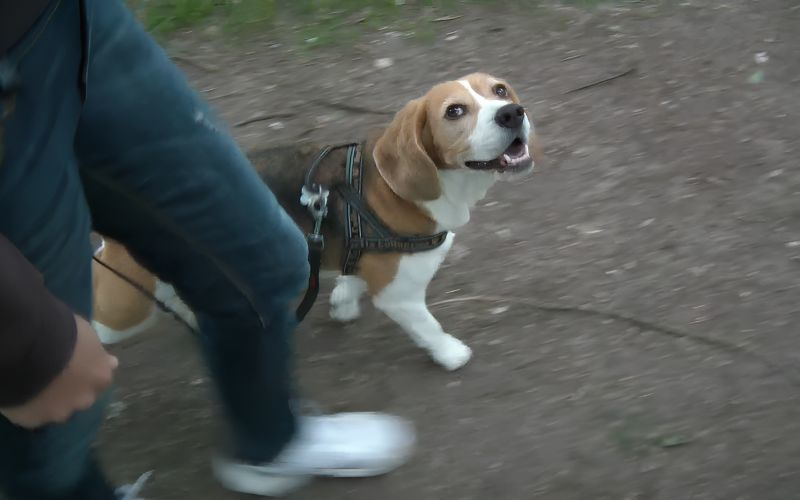
When the leash tightens — and it will — stop completely. Don’t pull back, don’t say anything, don’t react with frustration. Simply stop moving and wait. The moment your dog releases pressure and turns toward you, reward immediately and start moving again. The rule is clear and consistent:
pulling stops all forward motion; attention and a loose leash make everything happen.
Step 3: Practice Loose Leash Walking in Low-Distraction Outdoor Spaces
Once your dog is succeeding indoors, take the training outside — but carefully. Don’t head straight for the busy park or the street corner where the whole neighborhood walks their dogs. Start somewhere genuinely quiet: a calm residential block early in the morning, a low-traffic path, anywhere with few competing stimuli.
Expect regression. Your dog will be more distracted, less focused, and may pull again as if you’d never trained at all. That’s completely normal — it’s just the reality of a new environment. Drop your expectations back to where you were in week one, reward much more frequently, and rebuild from there.
If your dog can’t focus at all in a particular spot, the distraction level is simply too high for where he is right now in his training. That’s not failure — that’s useful information. Step back to somewhere quieter and get more repetitions under your belt before trying again.
Step 4: Increase Distractions Gradually — and Step Back When You Need To
This is where patience becomes the whole game.
Add new challenges so slowly it almost feels unnecessary. One dog visible in the distance. A slightly busier street. A familiar dog to pass at a distance of twenty meters. Each new level should feel like a very small step up from the previous one.
If your dog starts pulling again — if focus disappears and the old habits resurface — you’ve moved too fast. Turn around, walk away from the distraction, and return to a level your dog can actually handle. Two steps forward, one step back is not a sign of failure. It’s the normal shape of this process.
The Biggest Challenge in Loose Leash Walking: Calm, Consistent Patience
I want to be honest about this, because it’s the thing I see derail otherwise dedicated, caring owners.
The biggest obstacle in loose leash walking training isn’t technique. It’s staying calm, positive, and consistent — especially on a rainy Tuesday morning when you’re running late and your dog has just lunged at a cyclist for the third time.
Dogs read our tension brilliantly. If you’re tightening your grip, bracing for the pull before it even happens, or letting frustration creep into your voice, your dog feels all of it — and it makes focusing on you much harder, not easier.
Consistency across the whole household matters just as much. If one family member allows pulling and another doesn’t, the dog receives a mixed message and the behavior won’t improve reliably. Everyone walking the dog needs to be on the same page.
There’s no shortcut here. Calm, patient repetition — across every walk, every day, in gradually more challenging environments — is the actual method. The results show up slowly, and then all at once.
What About Daily Walks While You’re Still Training?
A practical question many owners don’t think to ask: if I’m actively working on loose leash walking, does my dog still get his regular walks?
Absolutely yes. Movement is a fundamental need for every dog, and keeping him cooped up while you perfect the technique isn’t the answer. But it is worth being thoughtful about how you handle those walks during the training period.
Choose quieter routes. A short, calm twenty-minute walk in a low-distraction area does more for your training — and your dog’s wellbeing — than a long, chaotic forty-minute walk where he’s pulling the entire time and practicing exactly the habit you’re trying to break. Shorter and better beats longer and chaotic every single time.
If you do need a longer outing, consider using a no-pull harness as a management tool for that specific walk only, keeping your structured training sessions separate and free of equipment. The harness isn’t training your dog — it’s just preventing the habit from being reinforced while you do the real work elsewhere.
The goal during this period is simple: meet your dog’s need to move, while giving the pulling habit as few opportunities to be practiced as possible.
One Resource Worth Bookmarking
The steps in this guide will take you a long way. But if you want a fully structured, step-by-step program — with expert trainers walking you through attention training, loose leash walking, and a range of other everyday skills — I’d encourage you to take a look at the free workshop from K9TI.
The approach is built entirely around positive reinforcement and understanding what motivates your individual dog, which is exactly the foundation I’ve described throughout this guide.
→ Access the Free K9TI Workshop Here
We’ve applied these principles in our day-to-day work with clients, and if you’d like, you can read my thoughts here.
Be Patient With Yourself — and With Your Dog
Leash pulling is one of the most universal complaints among dog owners, and one of the most
completely fixable problems out there. But it takes time, and it rarely moves in a straight line.
Your dog isn’t being defiant. He’s being a dog — curious, enthusiastic, built to explore. Your job isn’t to suppress that energy. It’s to redirect it: to make yourself interesting enough that choosing to walk beside you feels like the best option available.
With consistency and patience, it will.
How Is Your Leash Training Going?
I’d genuinely love to hear from you — whether you’re just getting started, somewhere in the middle of the process, or looking back at a dog who used to drag you down the street and now strolls along beautifully.
What has worked for you? What’s been the hardest part? Leave a comment below. I read every single one, and some of the most useful insights come straight from real owners sharing what actually happened in the real world.