
Disclosure: This post about “why do dogs dig” contains affiliate links. If you click through and make a purchase, I may earn a commission — at no extra cost to you. I only recommend products and courses I genuinely believe in, and all opinions expressed here are my own.
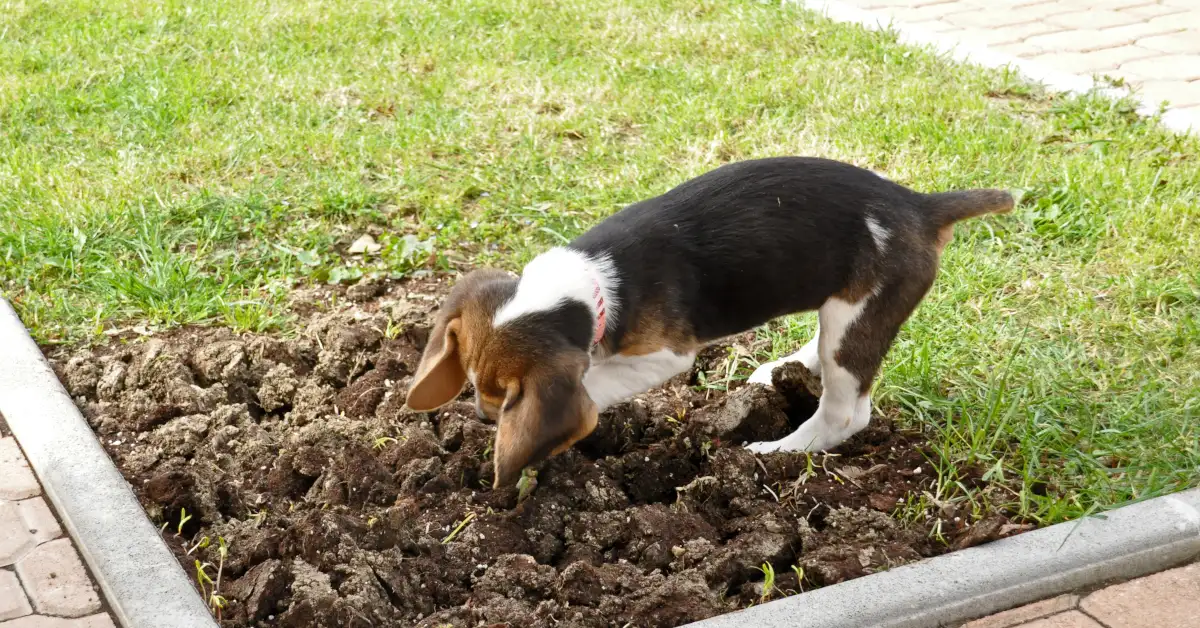
If your yard is starting to look like an archaeological excavation site, you’ve probably already asked yourself why do dogs dig — and more urgently, how do you get them to stop. Before we get to solutions, though, there’s one thing I want to clear up right away: your dog is not doing this out of spite. I know it can feel that way, especially when you find a fresh crater next to your most carefully tended flower bed. But spite requires a very specific kind of memory and cause-and-effect reasoning that dogs simply don’t have. They’re not replaying a grievance from this morning and choosing revenge.
What they are doing is responding to a need — and which need depends entirely on the individual dog and the situation. That distinction matters, because the most effective way to stop the digging is to address what’s actually driving it. A solution aimed at boredom won’t help if the real cause is anxiety. And a solution aimed at instinct won’t help if the dog is simply trying to get your attention.
Let’s go through the most common causes one by one — and what you can actually do about each of them.
Why Do Dogs Dig Out of Boredom — and What to Do
This is, by a wide margin, the most common reason dogs dig. A dog that isn’t getting enough physical exercise and mental stimulation is a dog sitting on a reservoir of compressed energy, and digging is a highly effective way to release it. It’s physical, it’s sensory, it’s satisfying. For a dog with nothing better to do, it’s genuinely one of the best options available to them.
The fix here isn’t just “walk them more” — it’s about the quality and consistency of how you meet their daily needs. A solid walk before your dog is left in the yard can make a significant difference: not a quick bathroom trip, but a real walk of at least 30–45 minutes that lets them sniff freely and engage with the environment. Sniffing, specifically, is mentally exhausting for dogs in the best possible way.
For yard time itself, scatter feeding is one of my favorite low-effort enrichment tools. Instead of feeding your dog from a bowl, hide their kibble across the yard before you open the door. This turns a patch of grass into a puzzle that occupies their nose and their brain for a good stretch of time — and a mentally tired dog has very little interest in digging.
A stuffed Kong or a lick mat left outside achieves a similar effect. The goal is to give them something worth doing before boredom has a chance to find its own outlet.
Why Do Dogs Dig for Attention — and How to Break the Cycle
This one surprises a lot of owners. The scenario usually goes like this: the dog digs, the owner reacts — calls their name, tells them off, goes over to intervene. From the dog’s perspective, all of that is attention, and attention is one of the things they want most in the world. It doesn’t matter whether the tone is warm or frustrated; what registers is that digging produced a response.
Once that association is established, it’s self-reinforcing. Every time you react to the digging, you make it slightly more likely to happen again.
The solution has two parts. The first is to stop reacting when the digging happens — and I mean completely. No eye contact, no verbal response, no moving toward them. This is harder than it sounds, especially when your herb garden is taking damage in real time, but any reaction resets the clock. If you need to intervene, do so calmly and without drama, redirect your dog to another activity, and disengage.
The second part, which is just as important, is to become more proactive with your attention. Attention-seeking behaviors often intensify when a dog feels their social needs aren’t being consistently met. Build in regular moments of calm, focused interaction throughout the day — brief training sessions, a few minutes of quiet play, a settle on the mat next to you — so your dog isn’t running a deficit that they feel the urge to fill by other means.
Why Do Dogs Dig to Hide Food — and How to Manage It
Food caching is an ancient instinct that predates domestication by thousands of years. When food was uncertain and competition was real, burying a surplus was a survival strategy. That wiring is still there in many dogs today, and it often shows up as burying bones, chews, or even kibble in the yard.
If this is what you’re seeing, the first practical step is to reassess portion sizes. A dog that regularly tries to bury food may simply be getting more than they need at one sitting. Slightly smaller, more frequent meals can reduce the urge to stash.
High-value items like bones or bully sticks are the most common triggers. If your dog tends to disappear with them and start digging, try giving those items only indoors where there’s no soil available. As an alternative, supervise outdoor chew time and remove the item after 15–20 minutes before the caching impulse kicks in. Also check whether your dog has access to a compost bin or organic waste. That kind of smell is irresistible to them and worth securing properly.
Why Do Dogs Dig When Something Is Underground
Sometimes the answer to why do dogs dig is the most literal one: there is actually something down there. Dogs have a sense of smell that is estimated to be between 10,000 and 100,000 times more sensitive than ours. They can detect the presence of moles, voles, insects, or earthworm activity well below the surface.
You can usually recognize this type of digging because it happens in specific, consistent spots rather than scattered across the yard. The dog seems focused and purposeful — nose close to the ground, not distracted.
If you suspect underground animals, a gentle inspection of the yard for mole runs or insect activity is the first step. Humane deterrents like castor oil granules or vibration stakes are widely available. They can make the area less appealing to burrowing animals without harming them or your dog. Once the scent source is gone, the digging motivation usually disappears with it.
Why Do Dogs Dig to Regulate Temperature
This cause often goes unnoticed, but it’s worth keeping in mind especially in summer. Dogs don’t sweat the way we do. They’ve learned that the soil a few inches below the surface is significantly cooler than the air above it. On a hot day, a dog left in direct sunlight may dig a hollow simply to lie in it and cool down.
If this is happening, the solution is practical and immediate. Make sure your dog has access to shade, fresh cool water, and a surface that doesn’t retain heat. A cooling mat placed in a shaded area often removes the need entirely.
One Strategy That Works for Almost Any Digger: the Designated Dig Zone
Whatever the underlying cause, there’s one practical intervention that consistently helps with dogs that have a strong digging drive: giving them a place where digging is allowed.
A designated dig zone is a defined patch of loose soil, a sandbox, or even a low wooden frame filled with dirt. It gives your dog a legitimate outlet for the behavior. Bury toys or treats in it to make it interesting, bring your dog over to it, and let them discover the rewards. When they start digging there, mark the moment with calm praise. When they dig elsewhere, redirect quietly to the zone without drama.
This isn’t surrender. It’s channeling — and it works far better than trying to suppress an instinct entirely.
What Not to Do
A few approaches you’ll find suggested online that I’d encourage you to avoid… Filling holes with rocks, using pepper or citrus sprays directly on soil, or physically correcting the dog in the act. Rocks can injure paws. Sprays provide a quick deterrent but do nothing to address the underlying cause, so the behavior migrates elsewhere. And physical corrections add stress to a situation that usually already has stress at its root.
The same goes for scolding after the fact. Dogs aren’t as good at connecting a correction to something that happened even a few minutes ago. You’re not teaching them that digging was wrong, you’re just teaching them that you’re unpredictable.
If your dog’s digging feels compulsive, is accompanied by other anxiety-related behaviors, or doesn’t respond to the approaches above, it may be worth looking at the bigger picture of how their daily needs are being met — movement, social contact, mental stimulation, and a sense of security. These are the foundations that everything else rests on. If you’d like structured help building exactly that kind of foundation, the Total Transformation Masterclass by K9TI is a course I genuinely recommend — it takes you through the relationship-based work that makes a real difference in everyday behavior.
Does your dog have a digging habit? I’m curious to hear what it looks like — where do they dig, and when? Leave a comment below, and let’s figure it out together.