

Disclosure: This post about the benefits of chewing for dogs contains affiliate links. If you click through and make a purchase, I may earn a commission — at no extra cost to you. I only recommend products and courses I genuinely believe in, and all opinions expressed here are my own.
The benefits of chewing for dogs go a lot deeper than keeping a bored dog busy for twenty minutes.
Give a dog something appropriate to chew, regularly. You’re handing him one of the simplest, most effective relaxation tools he has.
Let’s look at why this matters, and how to actually put it to good use.
What We’re Talking About (And What We’re Not)
This post isn’t about the problem of a dog destroying furniture or chewing things he shouldn’t. If that’s your specific situation, I’ve written a separate, deeper guide on redirecting that particular behavior.
Here, we’re talking about something different. Giving a dog full, guilt-free permission to chew something appropriate, on purpose, as a genuine wellness practice.
Not damage control. An actual gift.
The Benefits of Chewing for Dogs, Starting With the Physical
Chewing the right things does real, measurable work on a dog’s body.
The mechanical, abrasive action helps clean teeth and reduce plaque buildup over time. It also strengthens the muscles in the jaw and head. These are the same muscles a dog relies on for eating, carrying, and everyday exploration of the world through his mouth.
None of this requires anything exotic. A few short chewing sessions a day, with the right item, does most of the heavy lifting on its own. Over weeks and months, that small daily habit adds up to noticeably healthier teeth and gums, without a single extra trip to the vet.
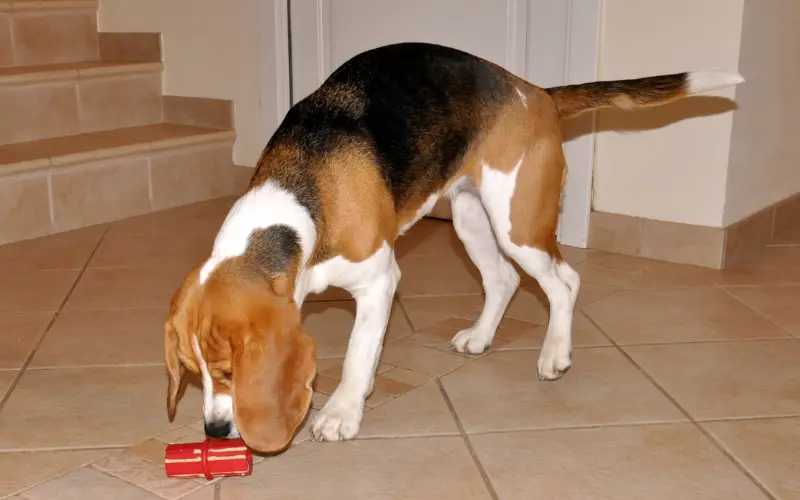
The Psychological Side: Chewing as Genuine Stress Relief
Here’s where it gets genuinely interesting.
Chewing triggers the release of endorphins, the same “feel-good” chemicals behind so many other calming behaviors. A 2025 review published in Frontiers in Veterinary Science found that chewing supports a dog’s psychological health and helps with stress management, alongside its dental and physical benefits.
In plain terms: a dog who gets to chew something satisfying, regularly, tends to be calmer overall. Not just in the moment. Across the whole day. This is really where the benefits of chewing for dogs go beyond a simple pastime and start looking more like an actual wellness routine.
A Natural Tool for Anxious Moments
This is one of the most practical, underused tricks I share with clients. A good chew, offered at the right moment, is often close to a natural tranquilizer for many dogs.
Car rides are a perfect example. A dog with something appropriate to chew during a drive is often visibly calmer. One with nothing to do but watch the world go by often gets more anxious. Never force it, though. If your dog isn’t interested in that moment, respect that and don’t push it.
The same principle applies to alone time at home. If separation anxiety is the deeper issue you’re facing, a chew alone won’t solve it, but it can be a genuinely useful piece of a broader plan.
The Mental Workout Hidden Inside a Good Chew
Chewing isn’t purely physical or purely calming. When a dog has to work a little to get to the reward, it becomes a small mental workout too. That’s true whether it’s a stuffed rubber toy or a treat wrapped inside a cardboard tube.
That effort teaches a dog to engage constructively with his environment, instead of waiting passively to be told what to do next. This broader guide to mental stimulation covers other ways to build this same kind of healthy independence into your dog’s daily routine.

Choosing Safe Chews to Get the Full Benefits of Chewing for Dogs
Not every chew is created equal. A few guidelines make this genuinely safe and worthwhile:
Go for real, natural options. Dried animal parts like tendons, ears, or trachea tend to be safer and more digestible than heavily processed alternatives. Traditional rawhide has come under real scrutiny in recent years for exactly this reason.
Consider fillable rubber toys. A durable rubber toy stuffed with something tasty combines the physical and mental benefits in one package. Choose one sized specifically for your dog, and check the quality of the rubber before microwaving, freezing, or dishwashing it.
Always size appropriately. Anything small enough to swallow whole is a genuine choking risk. When in doubt, size up.
Supervise, especially at first. Every dog chews a little differently. Watch how your dog handles a new item before leaving him alone with it.
The Benefits of Chewing for Dogs: Making It a Daily Habit
You don’t need to overthink this. A short chewing session, once or twice a day, is enough to start seeing the difference.
Some owners build it into a specific moment, like right after a walk or right before they leave the house. Others simply offer it whenever their dog seems restless or a little wound up.
Either way works. What matters is consistency, not perfection. A single great chewing session on a Tuesday won’t undo a stressful week, but a small, reliable habit repeated most days genuinely will, over time.
Think of it less as a treat and more as a small piece of your dog’s daily routine. The same way a short walk or a meal is.

Bringing It All Together
The benefits of chewing for dogs are easy to underestimate until you actually build the habit in.
Give your dog regular, appropriate opportunities to chew, and you’re offering something genuinely valuable: real stress relief, better oral health, and a bit of mental engagement, all wrapped into one simple daily habit.
It’s a small thing that adds up to a calmer, more content dog over time.
If you’re looking for a more complete framework for building calm, focus, and genuine wellbeing into your dog’s daily life, this is exactly the kind of foundation the K9TI Total Transformation Masterclass is built around. I recommend it often to owners who want to go beyond quick fixes and build something lasting.
What’s Your Dog’s Favorite Chew?
Every dog has his own preferences when it comes to chewing. What works for yours?
Tell me about it in the comments below, I’d genuinely love to know 🙂
And if you’re ready to build more calm and structure into your daily routine together, the K9TI Total Transformation Masterclass is a solid place to start.