
Disclosure: This post about “dog car safety” contains affiliate links. If you click through and make a purchase, I may earn a commission — at no extra cost to you. I only recommend products and courses I genuinely believe in, and all opinions expressed here are my own.
Every time you buckle up with your dog in the back seat, you’re making a decision about dog car safety. Most owners don’t even realize it.
A trip to the vet, a weekend at the lake, a quick errand together. These feel routine, so we treat them that way. But a dog riding loose in a moving car is closer to an unbuckled toddler than most people realize. The numbers behind that comparison are hard to ignore once you’ve actually seen them.
Why Dog Car Safety Deserves More Than an Afterthought
Physics doesn’t care how much your dog trusts you.
In a crash at 50 miles per hour, a ten-pound dog riding unrestrained hits the dashboard, the seat, or a passenger with roughly 500 pounds of force. A twenty-pound dog doubles that number.
Fewer than one in five dog owners actually restrain their pets in the car. That means millions of dogs are riding as loose projectiles every single day.
Research from the University of Pennsylvania looked at dogs involved in car accidents. Skeletal injuries showed up in the vast majority of cases, and many went well beyond minor scrapes. This is exactly why dog car safety belongs on the same list as leash manners and recall. It’s a skill and a setup, not just a hope that nothing goes wrong.
There’s a second risk that has nothing to do with crashes.
A dog bouncing between seats, climbing into your lap, or barking at something out the window is a distraction. Distraction is one of the leading contributors to crashes in the first place. Keeping your dog secured protects two lives at once, theirs and everyone else’s in the car.
What US Law Actually Says About Dog Car Safety
Here’s where it gets confusing for a lot of owners, myself included when I first researched the American market. There’s no federal law requiring dogs to be restrained in a vehicle. Only three states specifically require it: Rhode Island, New Jersey, and Hawaii. Fines range from under a hundred dollars to over a thousand, depending on the state.
Most other states don’t leave dogs completely unprotected, though. They rely on broader distracted driving laws or animal cruelty statutes instead. Both can apply if an unrestrained dog contributes to a crash or gets hurt in transit.
Some states also regulate dogs riding in open truck beds specifically, requiring a crate, a cage, or a secure tether. If you drive across state lines often, it’s worth a quick search for your home state and any state you pass through regularly.
NHTSA’s own research on distracted driving is clear on one point. Anything competing for a driver’s attention, including a loose pet, raises real risk on the road, regardless of what the specific law says.
The Three Ways to Restrain Your Dog in the Car, Ranked by Safety
Riding Loose: Still the Most Common, Still the Riskiest
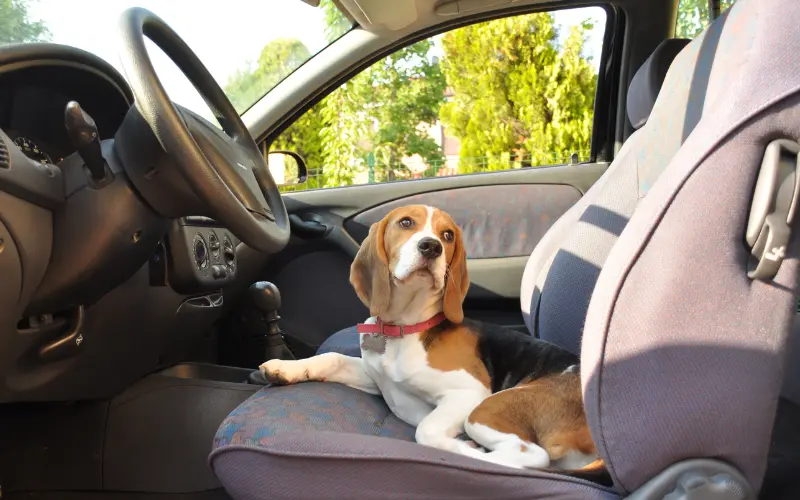
Letting your dog roam free in the car feels natural. It’s what most of us grew up seeing our own parents do. It’s also the option with no real upside.
A loose dog can climb onto your lap mid-turn or block your view of a mirror. A loose dog can get thrown across the cabin during a hard stop that isn’t even a real accident. If you take away one thing from this article, let it be this: “he’s fine back there” isn’t a safety plan.
A Crash-Tested Harness Clipped to the Seat Belt
A harness feels like the obvious solution. But not every harness sold as a “car harness” has actually been tested for a crash. The Center for Pet Safety is a nonprofit that runs independent crash tests using the same federal standards applied to child safety seats.
Its testing found that most products on the market fail under real crash conditions, sometimes catastrophically. A small number of harnesses have passed, including Sleepypod’s Clickit line for dogs up to 110 pounds.
Before you buy, look specifically for a product with published, independent crash-test results. A label that simply says “crash tested” isn’t enough on its own.
A Secured Crate or Carrier
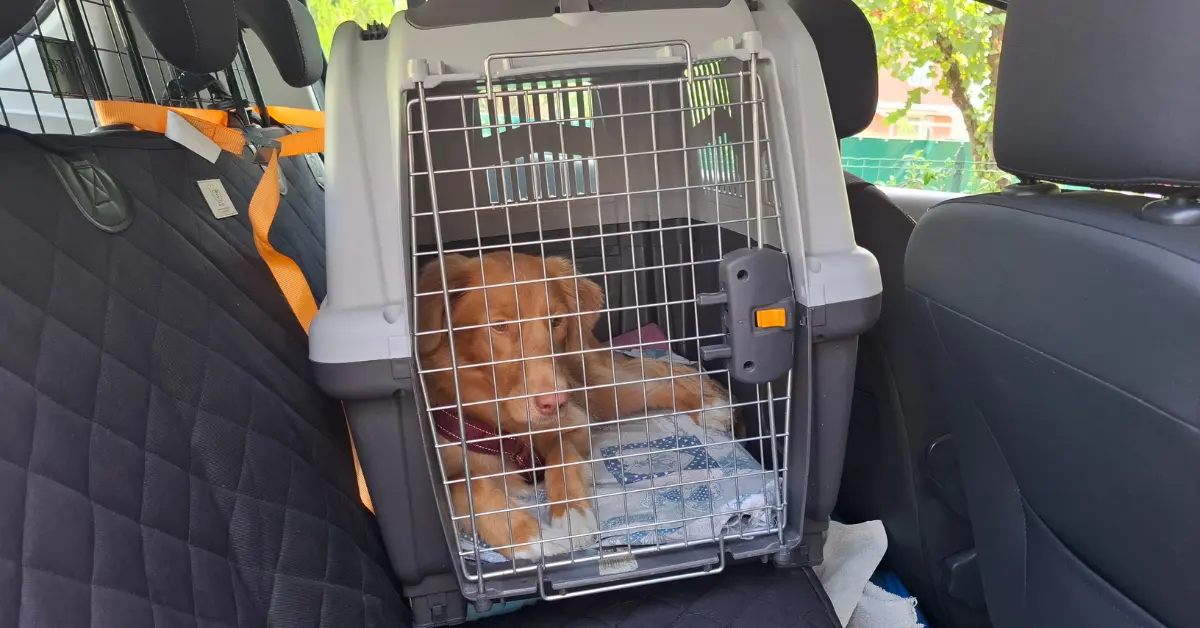
For a lot of dogs, especially anxious ones, a crate or carrier is the calmest and safest option of the three.
CPS testing found that a well-anchored, properly sized crate kept dogs contained through forces that caused several harnesses to fail.
Two things matter most here. Your dog should be able to stand, turn around, and lie down comfortably inside. And the crate needs rated anchor straps, not bungee cords, which can snap under load.
If your dog already sees a crate as a safe den at home, that same sense of security carries over into the car almost automatically. I cover exactly how to build that association in my guide to puppy-proofing your home.
Teaching Your Dog to Actually Enjoy the Ride
Buying the right gear solves half the problem.
The other half is how your dog feels about the car itself. Gear alone won’t fix a dog who drools, paces, or whines the moment the engine starts. That reaction is usually learned, and learned reactions can be unlearned.
I introduce car rides the same way I introduce a crate at night. Small steps, paired with something the dog genuinely enjoys, well before the first real trip happens.
If you’ve read my piece on why puppies cry at night, you already know that early experience with confinement shapes how calm a dog stays about it for years.
The same logic applies here. A dog rushed straight into a thirty-minute highway drive is far more likely to associate the car with stress. A dog built up gradually, one short positive ride at a time, usually doesn’t.
Your Energy Matters, Too
If you’re the kind of owner who white-knuckles the wheel and narrates every worst-case scenario out loud, your dog notices. I’ve written before about how that anxious-owner mindset shows up in other corners of training, and the car is no exception.
Dogs read tension well before anything actually happens. Staying calm and matter-of-fact while your dog settles in teaches them there’s nothing to brace for.
This step-by-step approach to car conditioning, along with the crate-training foundation that makes it easier, is exactly what K9TI’s Total Transformation Masterclass walks you through session by session.
It includes a specific protocol for taking a car-anxious dog from the driveway to a full trip without overwhelming them. If your dog currently dreads the car, that structured approach is worth checking out.
A Quick Dog Car Safety Checklist for Every Trip
A few habits matter no matter which restraint system you choose.
- Keep your dog in the back seat, never the front. Airbags deploy with enough force to seriously injure a small body.
- Never leave your dog alone in a parked car, even briefly and even with the windows cracked. Interior temperatures climb dangerously fast in almost any weather.
- Stop every two to three hours on longer trips for water and a bathroom break.
- Skip the fully open window. Flying debris causes real eye and ear injuries even at moderate speeds, and a few inches of fresh air is plenty.
- Bring something familiar. A blanket or a toy from home goes a long way toward keeping your dog settled in an unfamiliar space.
None of this needs to be complicated. Once it becomes routine, you’ll stop thinking about it entirely. That’s really the goal: a setup so automatic that dog car safety just becomes part of how you both get in the car, every single time.
I’d genuinely love to hear how your dog travels. Does he/she ride in a crate, a harness, or is this the nudge you needed to finally change that? Drop a comment below and let me know. I read every one.