

Disclosure: This post about false pregnancy in dogs contains affiliate links. If you click through and make a purchase, I may earn a commission — at no extra cost to you. I only recommend products and courses I genuinely believe in, and all opinions expressed here are my own.
I’m a certified dog trainer, not a veterinarian. Nothing here replaces a professional exam. False pregnancy in dogs can look alarming the first time you see it. But only your vet can rule out an actual pregnancy or a medical complication.
Your unspayed female suddenly has swollen nipples. She’s dragging a stuffed toy around the house like it’s her puppy. She’s digging at her bed, building a nest that doesn’t exist. If this sounds familiar, you’re likely watching a false pregnancy in dogs play out in real time. And no, she wasn’t secretly bred.
It’s more common than most owners expect. Somewhere between 50 and 70 percent of intact female dogs show at least some signs after a heat cycle, according to veterinary estimates reported by the American Kennel Club.
No breed is exempt, and no breed is more at risk than another. Any intact female with a healthy reproductive system can go through it.
What Causes False Pregnancy in Dogs?
After every heat cycle, a female dog’s body produces the same hormones it would during a real pregnancy. Progesterone rises for weeks, then drops. Prolactin, the hormone behind milk production, rises right after, as VCA Animal Hospitals explains.
Her body doesn’t know whether she actually conceived. It reacts the same way either way. That’s why the signs can look so convincing.
This typically starts four to nine weeks after her last heat. It can last anywhere from a few days to about a month. It tapers off around the point she’d naturally be producing milk if she really were pregnant.
Signs of False Pregnancy in Dogs
Symptoms vary quite a bit from one dog to the next. The most common ones include:
- Swollen, firm mammary glands, sometimes leaking a clear or milky fluid.
- Nesting behavior, like scratching at bedding to “build a den.”
- Adopting toys as surrogate puppies, carrying them around and guarding them.
- Restlessness, clinginess, or a drop in her usual playfulness.
- Loss of appetite, or the opposite: going after things that aren’t even food.
- Occasional vomiting or diarrhea.
Not every dog gets every symptom. Severity ranges from barely noticeable to genuinely distressing. Either way, the pattern above is a strong signal of what’s going on.
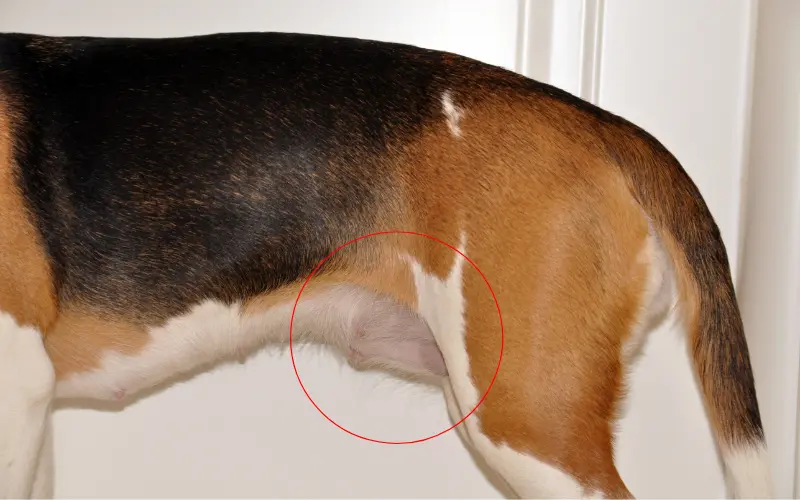
Why This Happens: An Old Wolf-Pack Habit
This isn’t some strange glitch. It’s a leftover survival mechanism from wild canids.
In wolf packs, usually only the “alpha female” breeds and gives birth. But other females in the pack often go through the same hormonal shift anyway. Researchers have documented this on a similar timeline across the group.
The advantage is real. If something happened to the mother, other females were already primed to nurse the pups.
Veterinary literature describes this as an evolutionary adaptation. It carried over from wild canid ancestors into today’s domestic dogs. Your dog dragging a stuffed animal around the living room is running that same ancient program.
When to Call the Vet
Mild cases usually resolve on their own within a few weeks. They don’t need treatment.
Call your vet if you’re not sure whether she could actually be pregnant. The two conditions can look nearly identical from the outside. A quick exam, and sometimes an ultrasound, settles that question fast.
Also call if you notice fever, painful or hot mammary glands, or lethargy that doesn’t improve. The same goes if she’s chewing and licking at her own nipples. That last one especially needs attention. It stimulates even more milk production and can lead to mastitis.
Your vet may prescribe medication to bring her hormones back down faster if symptoms are severe.
What You Can Do at Home
For mild cases, a few small adjustments go a long way.
Quietly remove toys she’s adopted as “puppies.” It’s best to do this while she’s distracted, not mid-guarding.
Never massage or express her mammary glands, even if it looks uncomfortable for her. That only tells her body to keep producing milk.
Extra activity genuinely helps here. A dog who’s mentally and physically occupied has less time to fixate on nesting and mothering behavior.
If you’re already building structured routines with her, that same calm, engaged energy applies well here too. It’s the same approach behind the K9TI Total Transformation Masterclass, and you can check out the free first lesson right here.
Keeping her walking schedule active matters too. It’s not just about physical energy — it helps her mental state during this hormonal swing. I’ve written a whole guide on why a big yard alone isn’t enough exercise for most dogs, with more specific ideas on making that time count.

False Pregnancy in Dogs and Spaying: Timing Matters
If your dog isn’t going to be bred, spaying is the only way to prevent this from happening again. But timing genuinely matters here, and it’s the part most owners get wrong.
Spaying during an active false pregnancy can actually make things worse. It sometimes prolongs the symptoms instead of ending them.
Vets generally recommend waiting until the episode has fully resolved. Then spay a few months later, once her hormones have settled.
I go into more detail on the behavioral side of spaying, plus the right general timing window, in my dedicated post on spaying and neutering. If this happened after her very first heat, it’s also worth reading up on what that cycle involves.
False Pregnancy in Dogs: The Bottom Line
A false pregnancy in dogs is unsettling to watch. But it’s rarely dangerous, and it’s not a sign that something is wrong with your dog. It’s an old hormonal echo, not a medical emergency, in the vast majority of cases.
Keep an eye on the warning signs above. Keep her busy, resist the urge to soothe those mammary glands by hand, and loop in your vet if anything drags on too long.
Has your dog gone through this before?
I’d love to hear how you handled it in the comments below.
Every owner’s experience with this one is a little different. Your story might be exactly what someone else needs to read right now.