
Disclosure: This post about how to be a better dog owner contains affiliate links. If you click through and make a purchase, I may earn a commission — at no extra cost to you. I only recommend products and courses I genuinely believe in, and all opinions expressed here are my own.
You love your dog. If you’re reading this, that much is almost certainly true.
But here’s something worth sitting with: how to be a better dog owner doesn’t start with a new technique, a better leash, or a different training method. It starts with a question that most dog owners never think to ask — one that gets at something older and more interesting than any practical tip ever could.
This isn’t a post about guilt. It’s about understanding why the gap between loving your dog and consistently showing up for their needs exists in the first place. Because once you see it clearly, you can actually do something about it.
Being a Better Dog Owner: Why Good Intentions Aren’t Always Enough
Most dog owners would describe themselves as dedicated. And they mean it. They buy quality food, they keep vet appointments, they take walks. They feel genuine affection for their dog every single day.
But when it comes to the consistent daily work that actually produces change — ten minutes of focused training in the morning, patient repetition across weeks, gradual progression rather than bursts of effort followed by long silences — something often gets in the way. Other things come first. The session gets pushed to tomorrow. Tomorrow becomes next week. The dog is loved, but the work gets quietly deprioritized.
This pattern shows up in my work as a professional dog trainer more than almost anything else. The owners who come to me frustrated — because their dog still pulls on the leash after months, still barks at the door, still can’t settle — are almost never indifferent people. They’re people who love their dogs deeply and genuinely want things to be different.
The disconnect isn’t about character. It’s about something far older than any individual person’s choices.
What the Language We Use Says About Dogs — and About Us
Language is one of the most revealing windows into what a culture collectively believes. And in the English language, the phrases involving dogs are striking once you start to notice them.
We say sick as a dog when we mean deeply unwell. We describe brutal, ruthless environments as dog-eat-dog. When something has deteriorated badly, we say it’s gone to the dogs. To be in the doghouse is to be in serious trouble. Working like a dog describes exhausting, thankless labor. Dog tired means complete depletion. And perhaps most telling of all: to treat someone like a dog means to treat them without respect or dignity.
These aren’t rare expressions. They surface in everyday speech, in headlines, in conversation — repeated thousands of times across a lifetime, absorbed without anyone consciously choosing to absorb them.
Collectively, they carry a consistent message: a dog is something associated with suffering, with degradation, with what is beneath us. Not something deserving of particular investment or care.
This isn’t coincidence. Language encodes the beliefs a culture has held long enough for them to become automatic. And the question worth asking is: how much of that encoding has settled into the way we actually think about our dogs — running quietly in the background, even while our conscious mind says something entirely different?
How History Made It Harder to Be a Better Dog Owner Than You Realize
The human-canine bond is ancient — estimates range from 15,000 to 40,000 years, depending on the research. But for most of that history, dogs were not companions in the contemporary sense. They were working animals: hunters, guards, herders, scavengers living at the margins of human settlements. Many had no individual owner at all. They survived on scraps and earned their place through function.
For the vast majority of human history, a dog was a resource. Plentiful, replaceable, valuable when useful. Individual dogs were not named for companionship, not trained for emotional reasons, not given particular investment of time or deliberate care. This was not cruelty — it was simply what the relationship was.
The idea of a dog as a family member, as an individual with emotional needs genuinely worth tending to, is a historically very recent development. But the older patterns — dog as tool, dog as expendable, dog as something that can wait — are not recent at all. They have had thousands of years of repetition to embed themselves into cultural common sense. They show up in idioms, they show up in inherited family attitudes, and they show up, quietly, in the moments when we know we should put in the work — and somehow find other things take precedence.
The Iceberg: The Part of Being a Better Dog Owner Nobody Talks About
Here is why this matters in a concrete, practical way.
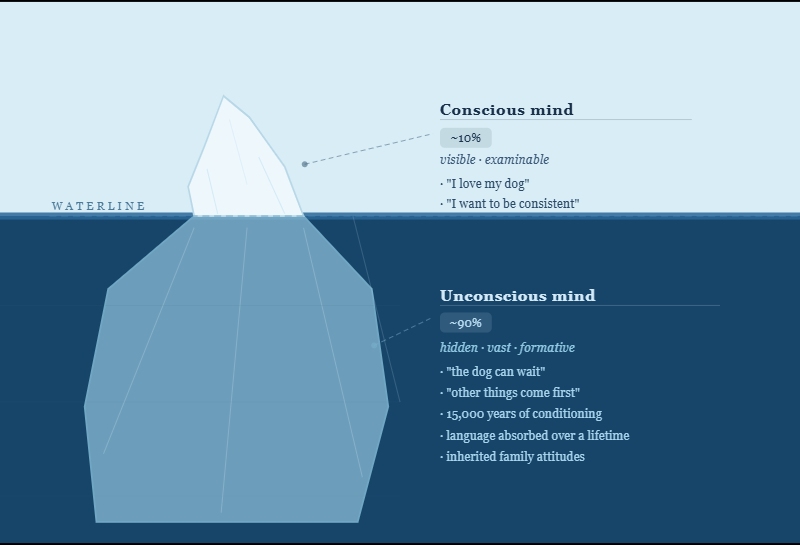
Think of the mind as an iceberg. The part visible above the water is the conscious mind: the part you can observe, examine, and direct through deliberate thought. This is where your stated values live. I love my dog, I want to train him well, I want to be consistent. It’s the part reading this post right now.
But the unconscious mind — the vast submerged portion, far larger than what’s visible — operates beneath awareness, shaping behavior without announcing itself. And it has been absorbing information far longer than your conscious attention has been active. It took in the idioms, it took in the cultural messages about dogs. It absorbed, perhaps, the way dogs were discussed and treated in your family growing up — the implicit lesson, never stated directly, that dogs are fine but they’re not as important as everything else.
None of this means you don’t love your dog. It means that underneath your conscious intentions, an older and quieter belief may be running in the background: that his needs can wait. That the training can start next week. That things will work out.
The conscious mind can override this. But only if it knows the belief is there. You cannot address what you cannot see.
What Better Dog Owners Actually Have in Common
The dog owners who see real, lasting change in their dogs — whose dogs are genuinely calmer, more attentive, more reliably well-behaved in actual real-world situations — share something that isn’t primarily about technique or knowledge. It’s about a shift in how they frame the investment.
Somewhere along the way, they stopped treating their dog’s training as something to get to when everything else was done. They started treating it as something worth scheduling — like anything else that genuinely matters to them. Not because they became different people. Because they brought the hidden priority gap into awareness, and then made a deliberate choice about it.
That’s not a dramatic transformation. It’s just an honest look followed by a decision.
The Real Starting Point for Every Better Dog Owner
So here is the question I want to leave you with. Not to answer out loud, not to defend or justify. Just to sit with quietly and honestly, for a moment:
Is your dog really important to you?
Not in the sense you’d assert in a conversation. Not in the sense of your feelings. But in the sense that actually determines what happens on an ordinary Tuesday morning, when you’re tired and behind on everything else.
If the answer is a clear yes — and you want a structured, well-designed program to help you turn that intention into consistent daily practice — the K9TI free workshop is a genuine place to start. It’s built around the kind of calm, patient, daily work that actually changes things. And it’s free.
→ Start With the Free K9TI Workshop
Something to Reflect On
I share this post not to make anyone feel inadequate, but because in my experience as a trainer, the moment an owner genuinely asks themselves this question — and answers it honestly — is often the moment things actually begin to shift.
If this post has sparked something for you, I’d genuinely love to hear it. A recognition, a memory, a question you hadn’t considered before. Leave a comment below. The most honest conversations I’ve had about dogs have started exactly this way.