
Disclosure: This post about how to potty train a puppy contains affiliate links. If you click through and make a purchase, I may earn a commission — at no extra cost to you. I only recommend products and courses I genuinely believe in, and all opinions expressed here are my own.
There are very few certainties when you bring a new puppy home, but here is one you can count on: there will be accidents. On the floor, on the rug, occasionally somewhere genuinely inconvenient. This is not a training failure. It is not a sign that you have a difficult dog. It is simply biology — and understanding that biology is the single most useful thing you can bring to the process of learning how to potty train a puppy.
This guide is not going to give you a seven-day miracle method. What it will give you is an honest picture of what your puppy is actually capable of at different ages, a clear step-by-step approach grounded in positive reinforcement, and a firm word about some methods that are still in circulation and that make everything harder — not easier.
Let’s start from the beginning.
How to Potty Train a Puppy: Start With the Right Expectations
The most common reason potty training becomes stressful is misaligned expectations. Owners expect a two-month-old puppy to “know better” — and when accidents keep happening, frustration builds on both sides.
Here is what is actually happening: a young puppy does not have full voluntary control over their bladder and bowels. The sphincter muscles that allow a dog to consciously hold elimination are not fully developed until around five to six months of age. This is not a training issue. It is a developmental one — as immovable as a baby’s inability to walk at two weeks old.
The Bladder Control Timeline
A useful general rule is that a puppy can hold their bladder for roughly one hour per month of age. So a two-month-old puppy needs a bathroom opportunity approximately every two hours during waking periods, and a three-month-old every three. Even these are guidelines, not guarantees. Large breeds develop bladder control more slowly than small breeds. Excitement, play, and feeding all accelerate the need to go.
Puppies have tiny bladders, and water runs right through them. You have to make sure you’re giving your puppy ample opportunity to do the right thing. This means structuring your day around their biology rather than hoping the biology will stretch to fit your schedule.
What NOT to Do First
Before we get to the practical steps, this needs to be said plainly.
There are methods still passed around by well-meaning neighbors, family members, and outdated corners of the internet that involve rubbing a puppy’s nose in their accident, shouting at them, tapping them with a rolled-up newspaper, or physically repositioning them by the scruff. These methods do not work. More importantly, they cause real harm.
A puppy who is punished for elimination cannot connect the correction to what they did — they experience only that something frightening happened near them, in connection with a completely natural bodily function. The result is not a puppy who learns to go outside. It is a puppy who learns that eliminating in front of you is dangerous, and who begins hiding to do it — behind furniture, in corners, anywhere out of your sight. In some cases, they begin eating their own feces to remove the evidence. These are not behaviors you want to create.
The science of learning is unambiguous here: behaviors that produce good outcomes get repeated, and behaviors that produce nothing simply fade away. Punishment doesn’t teach the right behavior — it only adds fear to the equation, and fear is never a useful ingredient in training a young puppy.
How to Potty Train a Puppy: The Step-by-Step Plan
Step 1 — Go Outside Early, and Go Often
The foundation of how to potty train a puppy is simple: create as many opportunities as possible for them to do the right thing in the right place. Take your puppy outside at a minimum every two to three hours during the day, and always at these specific moments:
- immediately after waking up
- within fifteen minutes of eating or drinking, and
- right after any period of active play
These are the windows when elimination is most predictable.
Go with them every time. Stand quietly, give them a chance to sniff and settle, and wait. This is not the moment for play or distraction — keep it calm and purposeful. If nothing happens within a few minutes, go back inside and try again shortly.
Step 2 — Always Return to the Same Spot
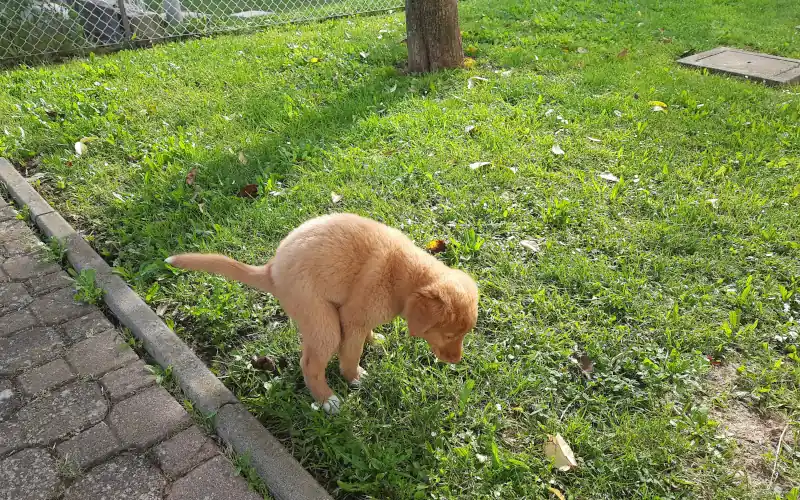
Choose one area outdoors and take your puppy there every single time. Dogs use scent marking as a navigational tool — the residual smell of previous eliminations signals “this is the right place” and actively encourages them to go. Returning to the same patch of grass or corner of the yard builds this association quickly and makes the whole process faster.
Consistency here also means using a verbal cue. Pick a simple phrase — “go potty” “do your business” whatever feels natural — and say it calmly as they begin to eliminate. Over time, this cue becomes a genuine prompt that tells your dog what you’re waiting for.
Step 3 — Celebrate Every Success Immediately
The most important word in potty training is timing. The moment your puppy finishes eliminating in the right spot, mark it with immediate, warm praise — a cheerful “good dog” a small treat, genuine enthusiasm. Not a second later. Dogs connect consequences to the action they just completed, and a reward that arrives ten seconds too late loses most of its value.
This is where the real learning happens. You are not simply rewarding an outcome. You are teaching your puppy that going outside in that spot produces something wonderful — and that lesson, repeated across dozens and then hundreds of repetitions, becomes a habit.
Step 4 — Ignore Accidents and Clean Them Invisibly
When an accident happens inside — and it will — do nothing. No reaction, no correction, no dramatic sigh. Simply wait until your puppy has moved away, then clean it up without them watching. This second part matters. Dogs are curious about human activity. And a puppy who watches you fuss over the spot they soiled may interpret the attention as a reward. Or at minimum as something interesting worth repeating.
Use an enzymatic cleaner, widely available at any pet store, to neutralize the odor completely. Dogs are drawn back to spots where they can smell previous elimination — removing the scent removes the invitation.
Step 5 — Use Puppy Pads as a Bridge, Not a Destination
Puppy pads have their place, particularly for apartment dwellers or during the first weeks before vaccinations are complete. But here is a trap worth knowing about. Puppies develop what researchers describe as a tactile surface preference — a tendency to seek out the type of surface where they first learned to eliminate. A puppy trained primarily on pads will actively seek a pad-like surface indoors, and may wait until they’re home to go rather than using grass outside.
If you use pads, use them as a temporary bridge toward outdoor training rather than a permanent system. Keep one near the exit door so it reinforces the direction of travel, and reduce their use gradually as outdoor reliability improves. The goal from the beginning should be outdoor elimination — the sooner you establish that pattern, the easier everything becomes.
How to Potty Train a Puppy: When You Can’t Supervise
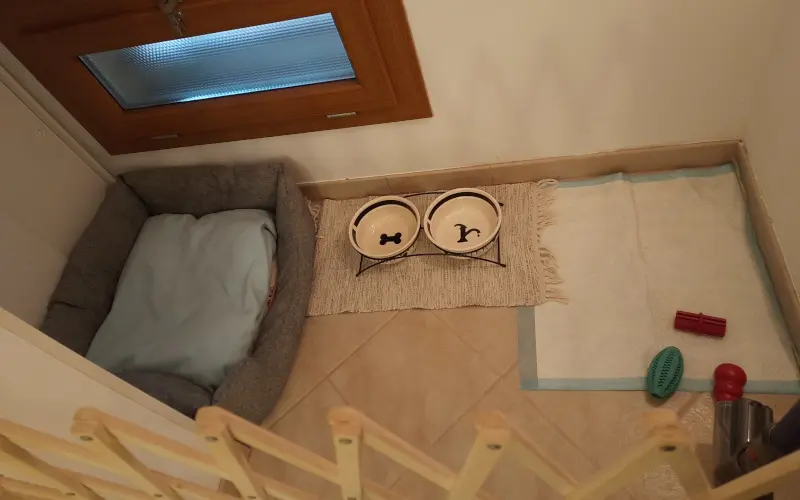
There will be hours when you genuinely cannot watch your puppy. During those times, the most effective approach is to limit their freedom to a manageable, easy-to-clean space. A puppy pen with their bed, water, toys, and a pad in one corner. Dogs instinctively avoid eliminating where they sleep, which makes a smaller, defined area much more successful than giving a puppy free run of the house while you’re occupied.
Keep these periods reasonable. No more than two hours at a stretch for a very young puppy. And always take them straight outside the moment you return. As I discuss in the post on consistency in dog training, the predictability of the routine is itself a teaching tool. When the same sequence happens every time, the puppy learns what to expect — and what is expected of them.
What About an Older Dog Who Was Never Properly Trained?
If you’ve adopted an adult dog who reliably goes indoors, or a dog whose previous training was inconsistent, the approach is essentially the same. Just slower and more deliberate. Go back to basics: frequent outings, a designated spot, immediate rewards for success, and no reaction to accidents. Adult dogs can absolutely relearn. But changing an established habit requires patience and the willingness to treat them as though they’re starting from scratch, regardless of their age.
The timeline will vary, but the principles don’t change. Patience, consistency, and reward — every time.
How to Potty Train a Puppy: One Last Thing
Potty training is the first extended exercise in communication between you and your dog.
How you handle the inevitable accidents — whether with frustration and punishment or with patience and redirection — sets a tone that the dog remembers, even if you don’t think of it that way. A puppy who learns that you are calm and steady in difficult moments is a puppy who is already beginning to trust you.
That trust is the foundation of everything else. If you’d like a structured path into building it — not just through potty training but across every area of your life with your dog — the Total Transformation Masterclass by K9TI is the resource I recommend most to new owners who want to get things right from the beginning.
How did potty training go with your dog? Was there a moment when something finally clicked? Leave a comment — new puppy owners especially will find your experience genuinely useful.