
Disclosure: This post about “puppy playpen setup” contains affiliate links. If you click through and make a purchase, I may earn a commission — at no extra cost to you. I only recommend products and courses I genuinely believe in, and all opinions expressed here are my own.
The first week with a new puppy is a particular kind of beautiful chaos. There is so much joy — and also so much vigilance.
You’re following this small creature around the house, pulling them away from electrical cords, intercepting them en route to the bathroom, wondering whether it’s safe to answer your phone for thirty seconds or whether that’s thirty seconds too long.
What most new owners don’t realize is that there is a simple, kind tool that makes this phase dramatically more manageable — for the puppy and for you. It’s called a puppy playpen setup, and done correctly, it isn’t a cage or a punishment.
It’s the closest thing to a gift you can give a puppy in the first weeks of their life.
What a Puppy Playpen Setup Actually Is — and What It Isn’t
A puppy playpen is a defined, enclosed area inside your home where your puppy has everything they need: a place to sleep, water, a few safe toys, and — during the early weeks — a potty zone.
It is not a prison and it is not a way of ignoring your puppy’s needs. It is a structured environment that works with your puppy’s natural instincts rather than against them.
The word “confinement” makes some owners uncomfortable, and I understand the instinct. But consider what the alternative looks like: a young puppy with free access to an entire house — full of hazards, too many choices, and no clear sense of where their boundaries are.
For a puppy, that isn’t freedom. It’s disorientation.
A smaller structured space helps your puppy learn calm habits first, feel more comfortable, and settle faster. As they mature and gain reliability, their freedom can gradually expand as they can be trusted more. More structure while they’re young means more freedom when they’re older.
Why Your Puppy Genuinely Needs a Space of Their Own
Dogs are “den animals” by nature. Their wild ancestors sought out enclosed, sheltered spaces for sleeping and raising young — spaces that were small enough to feel secure, predictable, and protected from the outside world.
That instinct doesn’t disappear in a domestic dog. It just goes unmet when we don’t provide for it.
A puppy arriving in a new home is navigating an enormous amount of novelty. New smells, new sounds, new people, new surfaces, new rules. A well-set-up playpen gives them a corner of that new world that is entirely theirs. Consistent, quiet, theirs to retreat to when the stimulation gets to be too much.
This psychological safety is not a minor detail. It is the foundation on which everything else — house training, learning boundaries, building confidence — rests.
A puppy who has a secure base learns faster, settles more easily, and develops a more stable character than one who has never had a space they could truly call their own.
And here is the other side of the same coin: the puppy’s den space is theirs. Nobody reaches in to disturb them when they’re resting there. Nobody pulls them out if they’ve retreated to it voluntarily.
Respecting that boundary is part of building the trust that will carry your relationship forward.
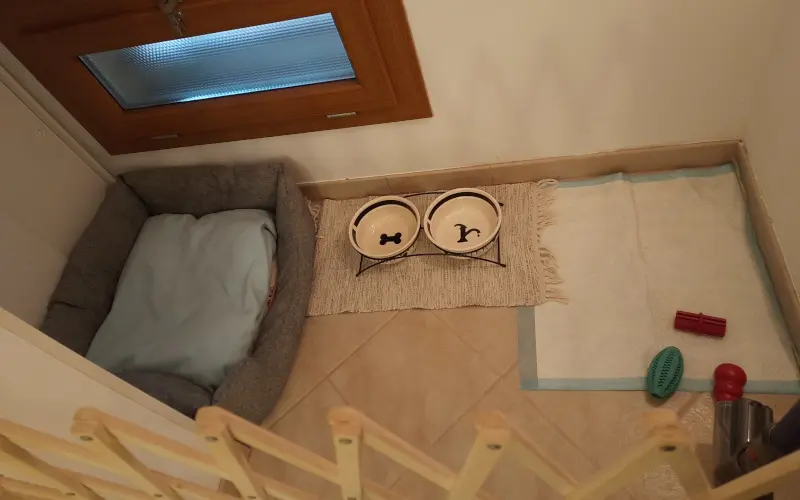
Puppy Playpen Setup: What to Put Inside — The Complete Setup
A good puppy playpen setup doesn’t require expensive equipment. It requires thoughtfulness about what goes where.
The Sleeping Area
The anchor of the whole setup is the sleeping zone: a comfortable bed or crate placed in one part of the pen.
If you use a crate inside the pen with the door left open, your puppy can choose to go in and out freely — which builds a positive association with the crate itself, useful for travel, vet visits, and quiet time later on. Position the sleeping area away from the exit of the pen, giving the puppy a sense of depth and security.
A blanket or item of worn clothing with your scent can be enormously soothing for a puppy in the early days. It is one of the simplest comfort tools available and costs nothing.
Water Access
Fresh water should always be available.
A tip worth knowing: clip-on water bowls that attach to the pen’s edge are significantly more puppy-proof than floor bowls, which get stepped in, knocked over, and occasionally treated as toys.
Keep the water station on the side of the pen away from the sleeping area.
The Potty Zone
During the early weeks of house training, one corner of the pen should have a puppy pad.
Place it on the opposite side from the sleeping area. Puppies instinctively avoid eliminating where they sleep, and this distance reinforces that healthy habit.
As outdoor house training progresses, the pad can be gradually reduced and eventually removed entirely. The goal was never for them to use it forever; it was to give them an acceptable option for the moments when they can’t hold on.
If your puppy consistently shreds or plays with the puppy pad, simply remove it. An empty corner with nothing there is better than a corner that has become a game.
A Few Carefully Chosen Toys
One or two appropriate chews and a toy that doesn’t have small removable parts.
Not a dozen things — novelty wears off quickly, and rotating a small selection keeps interest up better than providing everything at once.
Safe chews serve a dual purpose: they give the puppy something constructive to do with their mouth during quiet time, and chewing itself has a genuine calming effect on the puppy’s nervous system.
Puppy Playpen Setup: The Most Important Rule — Time Limits
This is the part of puppy playpen setup that most articles skip, and it is the part that matters most.
A puppy pen is a tool for the times when you genuinely cannot supervise your puppy — not a solution for the rest of the day.
During waking hours, the maximum reasonable stretch in the pen is around two hours. Overnight is different; with a proper sleeping area, puppies naturally rest longer and the pen becomes their night space.
During the hours when your puppy is in the pen, they still need you. They need to be taken out regularly for toilet breaks and exercise. They need social contact, play, and time with you outside the pen.
The pen doesn’t replace those needs — it simply makes it possible to manage the hours in between without either of you going out of your minds.
As I discuss in the post on how to potty train a puppy, the rhythm of “pen time, toilet break outside, quality time together, pen time” is one of the most effective structures you can build around a new puppy’s day — both for their house training and for their overall sense of security.
How to Introduce Your Puppy to Their Space
Don’t simply place the puppy in the pen and walk away the first time.
Spend a few minutes beside it, tossing treats in, letting the puppy explore in and out at their own pace. Feed a meal inside it. Let them discover that good things happen there.
Most puppies habituate to the pen quickly — often within a day or two — especially if they’ve associated it with rest, food, and calm. If there is significant protest, keep sessions very short at first and build up gradually.
A puppy who cries for a few minutes when you first close the pen and then settles is learning something important: that being alone briefly is manageable, and that you come back. That is a lesson worth teaching early.
One thing to absolutely avoid: don’t use the pen as a consequence or a punishment. The moment it becomes associated with something unpleasant in your puppy’s mind, its value as a safe space collapses. It should always feel like a retreat — never a sentence.
The Pen Grows With Your Puppy
As your puppy matures, becomes more reliable with house training, and demonstrates that they can be trusted with greater freedom, you gradually give them more of the house. A room at a time, always under supervision at first.
The pen doesn’t disappear — many dogs continue to use their sleeping area voluntarily as adults because it remains a place that feels genuinely theirs.
This gradual expansion is itself a form of training. The puppy learns, over months, that calm and reliable behavior results in more freedom — and that is a lesson with implications far beyond where they sleep.
The early months with a puppy lay the groundwork for everything that comes after — the habits, the communication, the relationship.
If you’d like a structured, relationship-centered approach to training your dog as they grow — one that helps you build real understanding and reliable behavior across all the situations of everyday life — the Total Transformation Masterclass by K9TI is the resource I recommend most.
It won’t replace the patience these first weeks ask of you, but it will give you a solid framework for everything that follows.
How did you handle the early days of space management with your puppy? Did you use a pen or a different approach? I’d love to hear what worked — and what didn’t. Leave a comment below.