
Disclosure: This post about resource guarding in dogs contains affiliate links. If you click through and make a purchase, I may earn a commission — at no extra cost to you. I only recommend products and courses I genuinely believe in, and all opinions expressed here are my own.
You reach for an empty bowl, and your sweet dog goes stiff. Maybe there’s a low growl. Maybe a look you’ve never seen before. It’s unsettling, and a little heartbreaking too.
What you’re seeing has a name: resource guarding. It’s one of the most common behaviors I meet as a trainer, and one of the most misunderstood. The good news? Resource guarding in dogs is usually easy to prevent and, in mild cases, very workable. The key is understanding what your dog is really telling you.
In this guide, I’ll share how I prevent guarding from the start and how to help a dog who already guards food or toys. I’ll also explain what I do when the “resource” is the couch or a person, and when it’s time to call in a professional.
What Is Resource Guarding in Dogs?
Resource guarding in dogs means any behavior a dog uses to keep others away from something they value. That “something” can be almost anything. In my experience, it usually falls into four groups:
- Spaces: a corner of the house, a spot in the yard, a doorway or hallway, the couch, a bed.
- Objects: a toy, a chew, food, the food bowl (even an empty one, because it means food), and sometimes even the water bowl.
- People: a family member, often someone the dog sees as more vulnerable, like a child or an elderly relative.
- Other animals: a housemate dog or cat that the dog seems to claim as their own.
The signs usually escalate in a predictable order. First the dog stiffens or freezes over the item. Then comes a hard stare, or “whale eye,” where you see the whites of the eyes. A lifted lip, a growl, a snap, and finally a bite can follow if nobody listens to the earlier signals.
Here’s the most important point in this whole post. A growl is not rudeness. It’s communication, and honestly, it’s a gift. Your dog is saying, “I’m worried. Please back off.” Punish that growl, and the worry stays. You only teach your dog to skip the warning next time.
Why Dogs Guard: Scarcity, Not Dominance
Guarding is a normal survival instinct. For a dog’s ancestors, a lost meal could mean real trouble. Our dogs will probably never go hungry, but the instinct is still there, ready to switch on.
What switches it on? Most resource guarding in dogs comes down to one word: scarcity. A dog should never feel that resources are scarce, or that someone might steal them. Picture a dog who gets a toy, and someone takes it away within seconds. Every single time. Soon that dog learns that owning something means losing it. Guarding becomes a perfectly logical answer.
That’s why the old advice to “take the bowl away mid-meal to show who’s boss” backfires. It creates the exact fear that drives guarding.
You may also read that guarding is a sign of a “dominant” dog. Modern behavior science disagrees. The American Veterinary Society of Animal Behavior has published a clear position statement against dominance theory as a way to explain or treat behavior problems. In my work, I see insecure dogs guard, not bossy ones. Stress, big changes at home, a new pet, or physical pain can all make guarding worse.
No Scarcity Doesn’t Mean Food All Day
Let me be clear about one thing, though. Avoiding scarcity doesn’t mean leaving a full bowl out all day. I still recommend set mealtimes. Put the bowl down, let your dog eat in peace, and pick it up after about twenty minutes, even if your dog hasn’t finished. A bowl that’s always full works against a healthy routine, a healthy weight, and a dog’s natural rhythm of hunger and rest. What prevents resource guarding in dogs isn’t endless food. It’s predictable meals that nobody ever interrupts.
How to Prevent Resource Guarding in Dogs
Prevention always starts from the same place for me: the four fundamental needs. A dog needs a clear organization of space, enough movement, good health, and healthy social contact. I wrote about all four in my guide on how to make your dog happy. When those needs are met clearly and reliably, a dog has nothing to defend. Here’s what that looks like in daily life.
Give Each Dog a Safe Space of Their Own
Every dog needs a den: a bed or crate where nobody bothers them. Not the kids, not the other dog, not you reaching in to tidy up. If you live with more than one dog, each one needs their own. A dog who knows that one spot is truly safe feels far less need to defend other places.
Feed Every Dog Separately
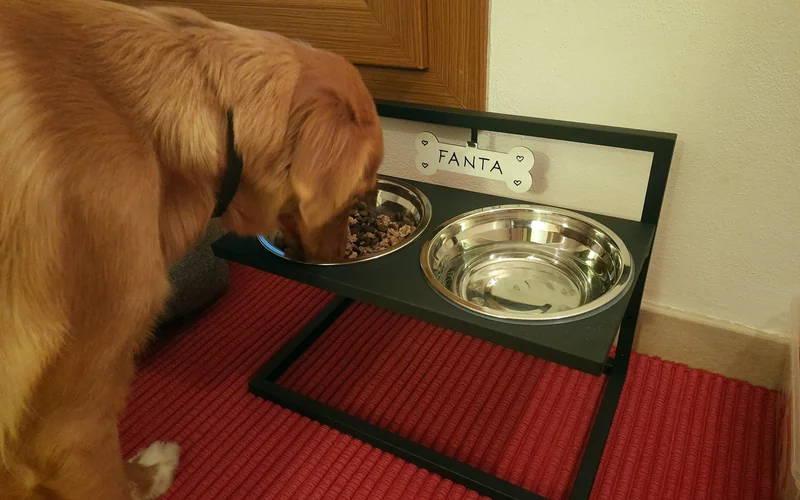
At mealtime, I separate dogs physically, even when they have always been friendly. A different room, a baby gate, or a crate works fine. It costs you nothing, and it removes the most common trigger for guarding between dogs. Fanta eats at her own stand, in her own quiet corner, and nobody walks past her bowl while she eats.
Manage Toys Without Creating Shortage
Special toys work best when you decide when they come out and when they go away. That’s not about control. It keeps those toys exciting and turns them into shared moments. At the same time, I always leave a few toys freely available. The goal is a dog who never feels short of things to enjoy.
When you do need something back, trade it for something good instead of grabbing it. My guide on how to teach a dog to drop it walks you through that skill step by step.
Sharing Can Start in the Litter, but Home Is Different
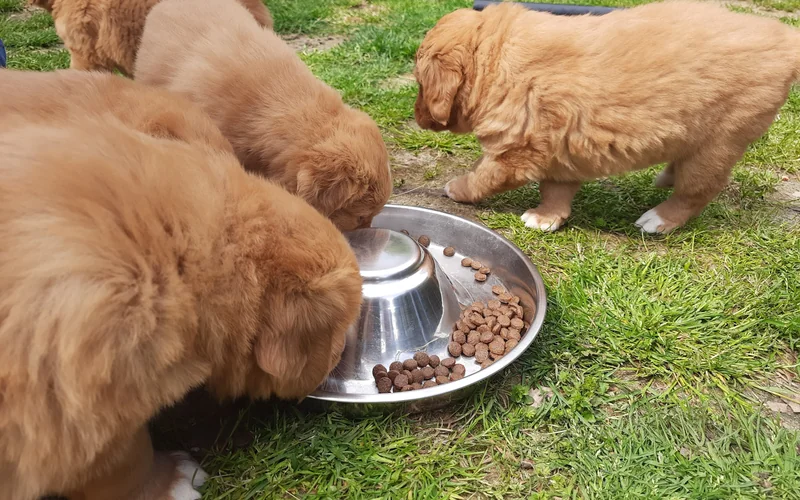
Early experiences matter. The photo below shows Fanta’s litter at the breeder’s, sharing one wide bowl. When food is plentiful and spread out, puppies learn that another dog nearby doesn’t mean less for them. That early lesson in abundance is valuable.
Once a puppy arrives in their new home, though, I switch to the rules above. Each dog gets their own space, their own bowl, and their own things. The litter teaches calm sharing. The new home teaches that nothing will be taken away.
Keep Play Calm and Supervised
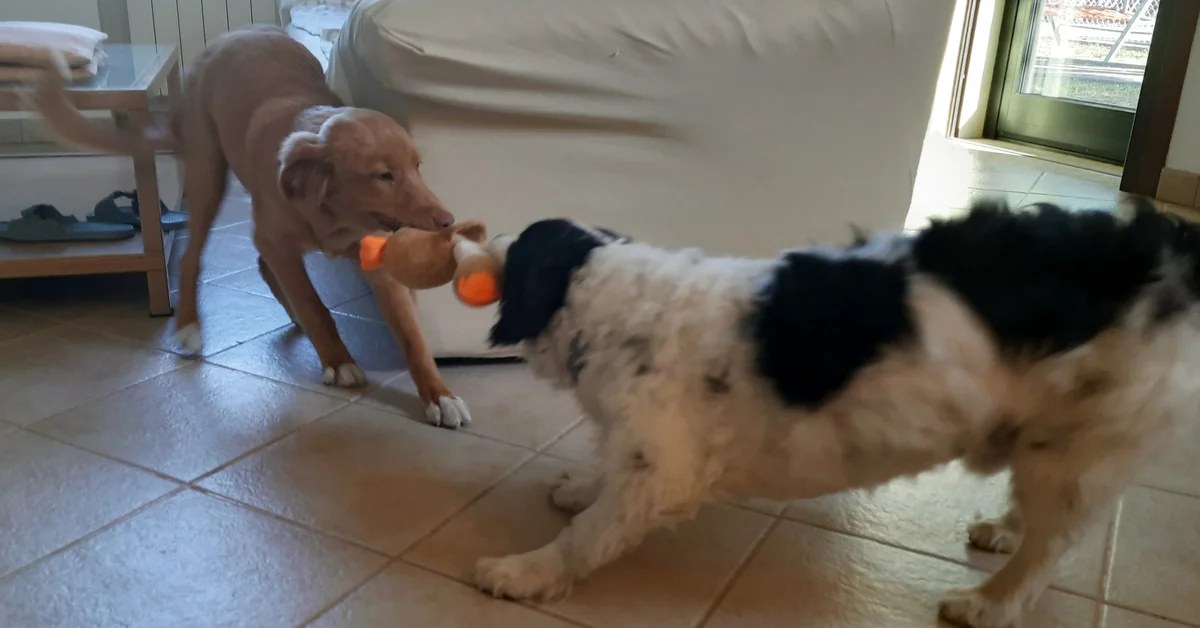
Play between dogs is wonderful. It can also teach that sharing a space or a toy isn’t the end of the world. The key is the level of excitement. When two dogs play with the same toy, as Fanta did as a puppy with a friend, I stay close. If I notice stiff bodies, freezing, or rising tension, I calmly call a break before things tip over.
With dogs who seem prone to guarding, I don’t recommend tug-of-war in any form. It turns holding on and winning into the whole game, and that’s the last thing these dogs need to practice. Gentler games work better. You’ll find plenty of ideas in my guide on how to play with your dog.
Teach That Closeness Is Safe
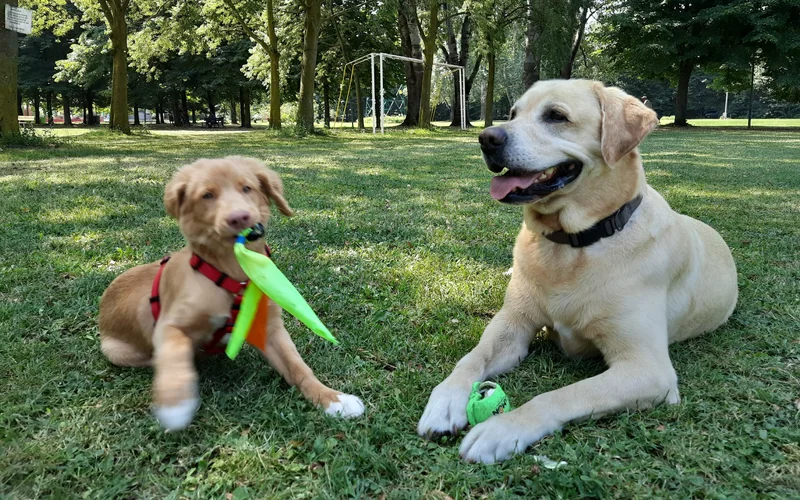
Healthy sharing also means healthy closeness. In the next photo, young Fanta holds her toy right next to a calm, older friend with his own ball. Nobody grabs, nobody stares, nobody stiffens. Moments like this teach a young dog something precious: another dog close by is just company, not a threat.
Breeds That Need Extra Care
Any dog of any breed can guard. Still, some breeds deserve extra attention from day one.
Protection breeds, like the Rottweiler and the Doberman, were selected to defend people. With these dogs, I make sure the whole family shares real experiences with them right away: walks, outings, training, quiet time together. The dog must never feel left out of family life.
Why does this matter so much? An excluded dog lives in another kind of scarcity, a scarcity of connection. That dog may cling to the few interactions he gets and defend them with his teeth. With protection breeds, I also watch how strangers approach. A person or dog moving too close, too fast, or unpredictably toward a family member can make a guarding dog tense.
Livestock guardian dogs need similar care. Think of the Maremma Sheepdog, the Great Pyrenees, or the Central Asian Shepherd. They were bred to watch over flocks, and they’re often less social with strangers. The same rule applies: show them that nobody threatens their spaces or their people.
How to Stop Resource Guarding in Dogs Who Guard Food or Toys
If your dog already guards, first take a breath. In mild cases, this is very workable. The approach I like most comes from the sixth class of K9 Training Institute’s Total Transformation Masterclass. It matches my own philosophy closely, so here’s how it works.
Start by honoring the fear. When your dog guards, don’t yell, don’t say “no,” and don’t snatch the item. Instead, step back. You’re telling your dog, calmly and kindly, “I hear you, and I’ll show you that you’re wrong about me.”
Next, manage the environment. Put away anything your dog guards until you’re ready to train with it. Every successful guarding episode makes the habit stronger. Then work on desensitization in small steps:
- Give your dog the guarded item and let them settle into enjoying it.
- Find the threshold: the distance where your dog starts to stiffen or growl.
- Turn your back and walk slowly backward toward your dog. A backward approach looks far less threatening than a frontal one.
- Before you reach the threshold, drop a few tasty treats and walk away.
- Repeat about ten times per session, in the place where guarding usually happens.
If your dog tenses at any point, stop the treats and simply retreat. Over the following days, the threshold shrinks.
Later you can approach face-forward, very slowly, without eye contact and without bending over your dog. Your approach slowly changes meaning, from “you’re about to lose something” to “good things happen when I’m near.”
When Your Dog Guards People or the Couch
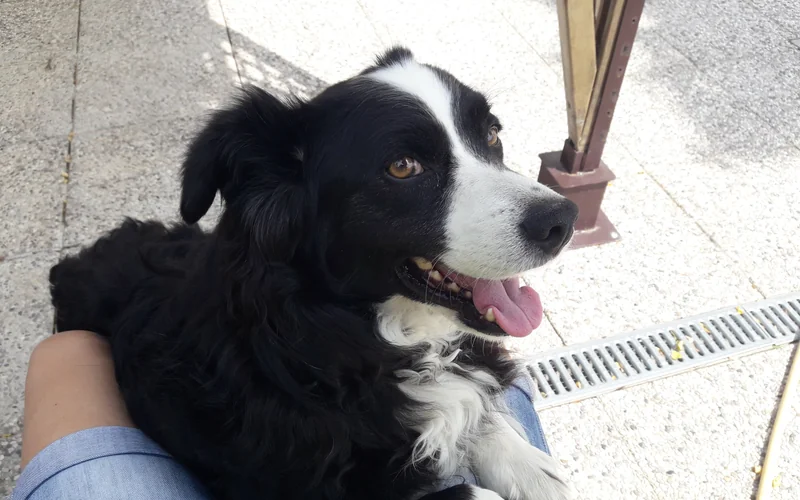
Guarding a person or a piece of furniture feels different, and it is a bit different. Let me tell you about Ozzie.
Ozzie was a client’s Border Collie (I’ve changed his name for privacy). He was a lovely dog, but he had started showing early signs of possessiveness. He claimed the couch and stuck close to his family, stiffening when someone else came near. Nothing serious yet, which is exactly the best time to act. Here’s what we did:
- During this phase, Ozzie wore a light leash at home. His family could move him without reaching for him, which keeps hands safely away from teeth.
- When he guarded the couch or a lap, someone calmly guided him off with the leash and a quiet “off.” No yelling, no anger, no rough gestures.
- The couch and laps were off-limits for a while, until things improved.
- Later, access came back by invitation only. Ozzie learned to wait on the floor until someone invited him up.
That last point mirrors the bed rules I describe in is it bad to let your dog sleep in your bed. The photo below came after the work was done: a relaxed Ozzie, up on a lap because someone invited him.
A Note on the Word “Dominance”
I want to be transparent about one thing. The Masterclass covers this situation too, and its practical steps are close to what we did with Ozzie. But that part of the course frames guarding of people and furniture as “dominance.” I leave that word out entirely. The method works just as well when you see your dog as worried, not power-hungry. I also replace firmly pulling the dog off with calm, gentle guidance.
When to Call the Vet or a Behavior Professional
Most mild resource guarding in dogs improves with the steps above. Guarding that appears suddenly in an adult dog, however, deserves a vet visit first. Pain and illness can make any dog more defensive, and no training plan can fix a sore tooth or an aching hip.
Please don’t try to handle advanced guarding on your own if you notice any of these:
- Your dog has bitten, or has snapped with real intent.
- Children live in your home or visit often.
- The guarding keeps getting worse, or spreads to new items and people.
- You feel afraid of your own dog.
In these cases, a professional needs to see your dog in person. In the US, the top specialists are board-certified veterinary behaviorists (DACVB). You can search the ACVB directory by state. Certified Applied Animal Behaviorists (CAAB) and certified behavior consultants who use reward-based methods are also good options.
Meanwhile, keep everyone safe with management. Put guarded items away, use baby gates, and never leave children alone with a dog who guards. My guide on kids and dogs has more on keeping those relationships safe.
The Real Goal: A Dog Who Never Feels Short
In the end, resource guarding in dogs is rarely about the toy, the bowl, or the couch. It’s about security. A dog whose needs are met, whose den is respected, and who feels part of the family has very little to defend.
If you’d like a structured, step-by-step program for guarding and the other house manners that make daily life easier, K9TI offers a free workshop that’s a great place to start. I went through the full Masterclass myself, and I appreciate how calm and gradual its approach to guarding food and toys is.
Has your dog ever guarded something unexpected, like an empty bowl or a favorite person?
Tell me about it in the comments.
I read every one, and your story might help another owner feel less alone.