

Disclosure: This post about the question “is it bad to let your dog sleep in your bed?” contains affiliate links. If you click through and make a purchase, I may earn a commission — at no extra cost to you. I only recommend products and courses I genuinely believe in, and all opinions expressed here are my own.
Some owners ask me almost like a confession. “Our dog sleeps with us. Is that a problem?” Others come with the opposite worry. They’ve just brought home a puppy, and they’ve heard two completely different stories.
A friend’s dog has slept under the covers for ten years without a single issue. Then a relative, a neighbor, or a stranger online insists that a dog on the bed will soon think he runs the house. No wonder people feel confused.
So, is it bad to let your dog sleep in your bed? Let me clear it up the way I do with the families I work with. There’s one simple principle behind my answer. Once you see it, the whole question gets much easier.
Is It Bad to Let Your Dog Sleep in Your Bed? The Short Answer
No. From a training point of view, there’s nothing wrong with sharing your bed with your dog. It won’t ruin their manners or make them disobedient. It won’t turn a sweet family dog into a tyrant, either.
If you love falling asleep with your dog curled against your legs, you can keep doing it. Plenty of calm, well-balanced dogs sleep with their people every single night.
There is one condition, though. Your bed can be a place your dog enjoys with you. It just shouldn’t become the place your dog depends on to feel safe.
That difference sounds small, but in practice it’s the whole story.
Where the “Never on the Bed” Rule Comes From
For decades, the standard advice was strict. Keep the dog off the furniture, and above all off the bed. The reasoning came from an old view of dogs built around rank. A dog sleeping at your level was supposedly claiming equal status in the pack.
Most behavior professionals have moved away from that model. Many problems we once blamed on “dominance” turn out to be about fear, insecurity, unclear routines, or simple habit.
A dog who hops onto your bed isn’t plotting a takeover. They want to be close to you, and that’s a pretty lovely reason.
So if someone told you that a dog on the bed is a training mistake in itself, you can let that worry go. The real risk exists, but it lives somewhere else.
What the Research Says About Sharing Your Bed
Sleep researchers have looked at this question too, mostly from the human side: is it bad to let your dog sleep in your bed if you want a good night’s rest? A Mayo Clinic study on dogs and human sleep followed healthy adults and their dogs with activity trackers. Having a dog in the bedroom didn’t hurt people’s sleep. Having the dog on the bed made sleep a little less efficient.
That’s useful to know, but it’s a question about your rest, not your dog’s behavior. If you both sleep well together, wonderful. If your dog kicks, snores, or wakes you at 4 a.m., a dog bed next to yours is a perfectly loving compromise.
Still deciding where your dog should sleep in the first place? My post on whether dogs should sleep inside or outside covers the bigger picture.
The Real Issue: Your Bed Shouldn’t Be Your Dog’s Den
Here’s the principle I share with every family. Each dog needs a den inside the home: a private, quiet space that belongs to them alone. It could be a crate with the door open, a covered bed in a calm corner, or a well-planned puppy playpen. Your dog should be free to go there whenever they want, to sleep or to step away from the bustle of the house.
I’ve written about this as part of the four needs that shape your dog’s wellbeing, because a healthy relationship with space is one of them. A dog with a reliable den has somewhere to retreat when life gets loud, tiring, or confusing.
Now picture a dog whose only real safe place is your bed. That works fine as long as the bed is always available. The trouble starts on the day it isn’t.
What Happens When the Bed Becomes the Den
Over the years, I’ve seen two patterns come up again and again.
The first is distress. A dog’s whole sense of security is tied to that mattress, and then life changes. Their person has surgery and can’t share the bed for weeks. A baby arrives, or a new partner moves in. Suddenly the dog loses the one spot that held everything together. Some dogs truly fall apart: they whine at the door all night, pace, and struggle to settle anywhere else.
The second pattern is possessiveness. Some dogs start treating the bed as a resource worth defending. It begins with a stiff body when someone approaches, then a hard stare, then a growl. In the most serious cases I’ve met, nobody could get into the bed anymore, not even the owners. VCA Animal Hospitals also notes that possessive dogs may try to take ownership of the bed.
Neither problem comes from the bed itself. Both come from a bed that slowly turned into the dog’s den, without anyone deciding it.
So, Is It Bad to Let Your Dog Sleep in Your Bed? Not With These Rules
If you want to share your bed, go ahead. These four guidelines keep it a happy habit instead of a future problem.
1. Set Up Your Dog’s Den Anyway
Even if your dog will spend most nights with you, give them their own den from day one. Make it comfortable and quiet, and never use it as a punishment. When your dog chooses to rest there during the day, leave them in peace. That space is what keeps them steady when your bed isn’t an option.
2. Make Your Bed Invitation Only
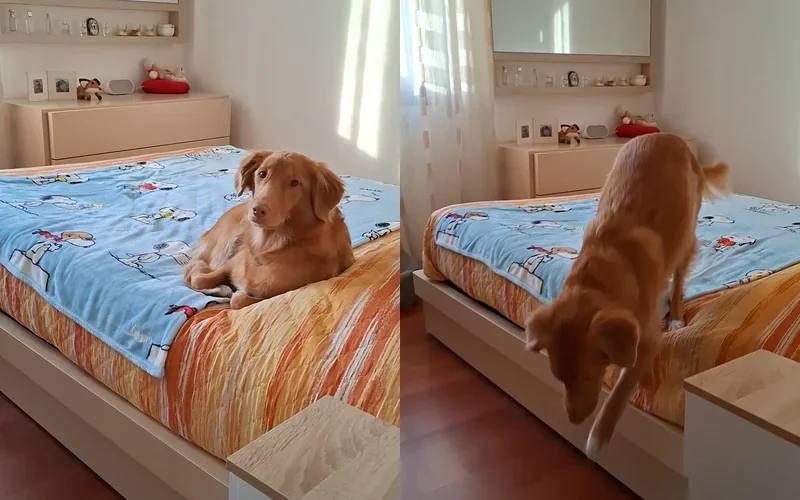
Access to your bed should always start with you. Call your dog up when you want to cuddle or sleep together. When you get up, or when you’d like your space back, invite them to hop down. Use a short, cheerful cue, and reward them for doing it.
A reliable “go to your bed” cue makes all of this much easier. Module 6 of the Total Transformation Masterclass from K9 Training Institute teaches it step by step. It also covers what to do if a dog starts guarding furniture. The course frames some of this in “leadership” terms I’d phrase differently, but the practical steps are clear and easy to follow.
3. Close the Bedroom Door When You’re Out
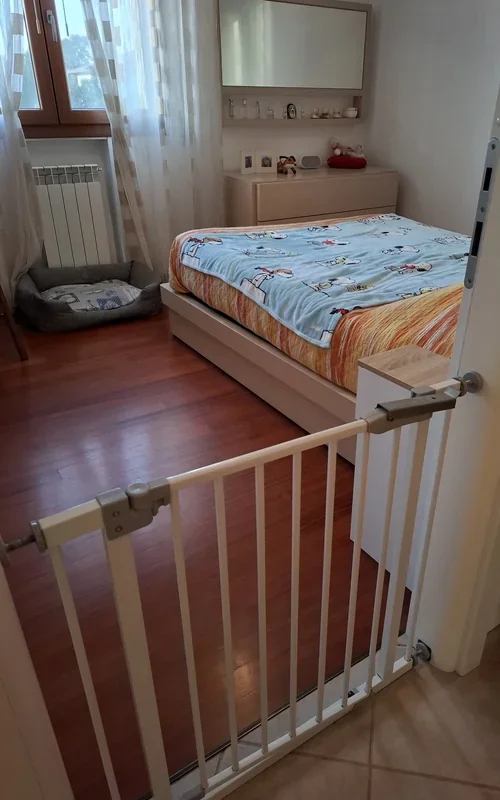
When you’re not home, your dog shouldn’t have free access to your bed. The easiest fix is a closed bedroom door. Otherwise your dog spends hours alone on your bed, wrapped in your scent. That’s exactly how a bed becomes a den without anyone noticing.
4. Be Clear With Puppies, More Relaxed With Adults
These habits are far easier to build with a puppy than to fix in an adult dog. So stay consistent in the first months. It pairs naturally with teaching your puppy to be comfortable alone, since both skills rely on a dog who feels safe in their own space.
Later, once your dog clearly understands how spaces work at home, you can loosen up. A grown dog with good habits and a solid bond with you has earned some flexibility.
When It’s Better to Keep Your Dog Off the Bed for Now
There are a few situations where I’d wait before sharing:
- Your dog already guards furniture, stiffening, staring, or growling when someone comes close. Work on that first, ideally with a qualified professional.
- Your dog struggles badly when left alone. Building independence in their own space comes first.
- You or someone in your home has allergies, asthma, or a sleep disorder.
- Your puppy isn’t fully house-trained yet.
None of these means the bed is off-limits forever. It just means the timing isn’t right yet.
Is It Bad to Let Your Dog Sleep in Your Bed? Final Thoughts
If you came here worried that you’ve been spoiling your dog, I hope you can relax now. Is it bad to let your dog sleep in your bed? Not when the bed stays a shared treat rather than a hiding place. Keep the den separate, keep the invitations yours, and keep the door closed when you’re out.
Your dog gets the closeness, and you both keep a sense of security. That’s a trade most dogs would happily accept.
If you’d like a structured way to build these house routines, the Total Transformation Masterclass is the program I recommend most to owners who want to get the foundations right.
Does your dog sleep in your bed, or do they have a favorite spot of their own?
I’d love to hear how it works in your home, so tell me about it in the comments below.