

Disclosure: This post about how to make your dog happy contains affiliate links. If you click through and make a purchase, I may earn a commission — at no extra cost to you. I only recommend products and courses I genuinely believe in, and all opinions expressed here are my own.
How to make your dog happy is the question every dog owner carries around — sometimes quietly, sometimes with real urgency. Why does he pace? Why is she so anxious when we leave? Why doesn’t he seem… content?
Most advice points toward training commands, expensive enrichment toys, or breed-specific exercise quotas. Those things have their place. But the real foundation of a happy, balanced dog goes deeper than any of them — and it starts with something that’s been true for over ten thousand years.
The Forgotten Agreement at the Heart of Every Dog-Owner Relationship
Long before there were training schools, dog parks, or breed standards, something remarkable unfolded between the early human and the wolf.
They shared the same territories. They hunted the same prey. For thousands of years, they kept their distance — a mutual wariness that protected both species.
Then, gradually, the distance began to close.
The human learned to use fire and build shelter. The wolf noticed that staying close to human camps meant access to warmth, leftover food, and safety. The human noticed that the wolf’s extraordinary senses — its nose, its awareness of the environment — made hunting and guarding vastly more effective.
An alliance formed. Not signed, not negotiated, but real. According to archaeological and genetic evidence, the domestic dog as we know it emerged from this slow, mutual approach somewhere between 10,000 and 15,000 years ago.
What matters for us today is what that alliance actually was: the dog offered its capacities; in return, the human met its fundamental needs. This is not a metaphor. It’s the structural basis of the human-dog relationship, still operating right now, in your home.
And here’s the part most people don’t know: the dog always honors this agreement. It doesn’t have a choice — the arrangement is encoded in its biology. Your dog will always try to give you what he can do.
What you choose to provide in return determines everything.
Forget “Pack Leader” — Here’s What the Science Actually Says
For decades, the dominant advice for dog owners was to establish themselves as the “alpha” — to project dominance, assert rank, and make sure the dog knew who was in charge.
This idea originated in studies of wolf behavior conducted in captivity in the late 1970s. The researcher behind much of this work, L. David Mech, went on to spend decades studying wolves in their natural environment. What he found looked nothing like the captivity studies. Wild wolfpacks don’t function like competitive hierarchies of individuals struggling for dominance. They function like families — parents providing for offspring, structure maintained through guidance and relationship rather than intimidation.
Mech spent years publicly refining his earlier conclusions. The dominance model, he argued, was an artifact of studying wolves in unnatural, stressful conditions. It didn’t reflect how dogs actually work.
The implication for dog owners is significant: you don’t need to play power games with your dog to earn his trust and become his reference point. You need to provide for him. Reliably, calmly, consistently. That’s what actually signals to a dog that you’re someone worth orienting toward.
What Makes Your Dog Happy: Four Pillars, Not Ten Tips
Most “how to make your dog happy” articles give you a list of tips — socialize early, use positive reinforcement, buy a Kong. Fine advice, all of it. But tips without a framework are like furniture without a floor plan: you might get the pieces right and still end up with chaos.
The framework is this: every dog has four fundamental needs. When these are met regularly, the vast majority of behavioral problems reduce or disappear on their own. When they’re chronically unmet, no amount of training will create the calm, connected dog you’re hoping for.
Here they are.
The 4 Needs That Make Your Dog Happy
1. Health — The Foundation Everything Else Rests On
“Health” includes everything in the veterinary sphere, including nutrition. A dog who is in pain, nutritionally deficient, or dealing with an undiagnosed medical condition cannot behave well — not because he’s stubborn, but because the physiological floor isn’t there.
Finding a trusted vet and following their guidance consistently is non-negotiable. But there’s an important nuance here: try not to project your own anxieties onto your dog. Many caring, well-intentioned owners over-medicalize their dogs — running unnecessary tests and requesting treatments for issues that are, at root, behavioral or emotional, stemming from unmet needs. Always ask whether a problem might have psychological roots before reaching for a pharmacological solution.
On nutrition: once your vet has established an appropriate diet, one seemingly small detail carries more weight than you might expect. Your dog should understand that food comes through you.
Avoid leaving food available all day. Instead, create a brief feeding ritual — let your dog settle calmly, then offer the bowl. This quiet, daily repetition signals that you are a reliable provider. Over time, it builds exactly the kind of trust you’re looking for.
2. Space — Your Dog Needs a Den
Research on wolves in their natural environment identified four spatial zones that wolves occupy throughout their lives: an innermost safe space (the den), a broader play and learning area, the pack’s shared territory, and the wider world beyond. Dogs carry the same spatial needs.
In practical terms, this means every dog needs a “Space A” — a dedicated resting place that belongs entirely to them. A bed or crate in a quiet corner of your home, away from high traffic, where they’re never disturbed and never sent as punishment. This is their den: the place they can decompress, feel completely safe, and restore themselves.
Dogs without a clearly defined safe space often become persistently anxious — because there is nowhere in their world where the demand for vigilance actually stops. A dog who has a proper den is more settled everywhere else, precisely because they know where home base is.
Space B is a slightly larger area for play and eating. Space C is the shared living space of the household — the apartment, the garden, the spaces you inhabit together. Space D is the outside world, where your dog should ideally not feel territorial, because it belongs to everyone.
Getting this structure right — especially establishing that safe den — resolves behavioral issues that no command training can touch.
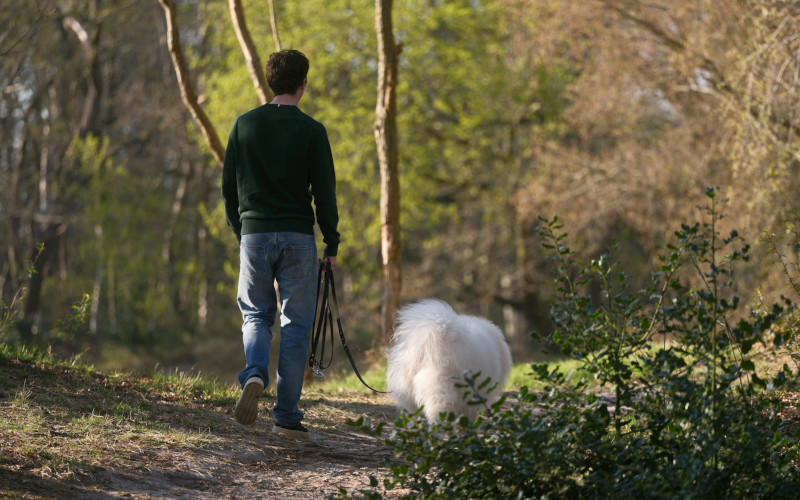
3. Movement: The Kind That Makes Your Dog Happy and Settled
Movement for dogs means two distinct things, and most owners only provide one of them.
The first is pure physical exercise, and ideally this includes time genuinely off the leash. The leash creates a constant low-level constraint on a dog’s body and movement. Time in a safe, enclosed area — running freely, sniffing without direction, moving according to his own impulses with no requests from you — is genuinely restorative in a way that leashed exercise simply isn’t.
The second is spatial orientation. Wolves in the wild travel up to 25 miles a day, navigating and mapping their environment constantly. Your dog’s nervous system carries that same drive. This
is why walking the identical route every day, even for an hour, leaves something missing. Rotating between four or five different paths keeps the brain engaged in the way it was built to function.
A good daily routine looks something like this: a brisk hour-long walk on a varied route, followed by fifteen minutes of genuinely free exploration in a safe space. No commands during the free time. No fetch, no direction. Just your dog, his senses, and the world.
A dog who starts the day this way is measurably more settled, more focused, and far more capable of handling alone time calmly.
4. Sociality: Why Connection Makes Your Dog Happy
Sociality is not optional enrichment. It’s a core biological need, as essential as food and movement.
Dogs need meaningful contact with people and with other dogs. They need to interact with humans of different ages, sizes, and temperaments. They need opportunities to communicate freely with other dogs — not through a fence, not on a taut leash, but in genuine, unmanaged interaction where their body language can work as intended.
For the relationship with you specifically, one thing matters above everything else: clarity. Your dog needs to know clearly what the structure of his “group” looks like and where you fit in it. Not because rank needs to be established through dominance, but because ambiguity is genuinely stressful for a social animal. When the rules of the household are inconsistent — when one family member does one thing and another does the opposite — dogs often respond with behaviors that look like disobedience but are actually anxiety.
Consistency is the most underrated form of kindness in dog ownership. Consistent expectations, consistent routines, consistent responses. This is what tells your dog, day after day, that you know what you’re doing — and that they can relax.
How Consistently Meeting These Needs Makes Your Dog Happy — and Makes You Their Person
Here’s what ties everything together.
When a dog’s four fundamental needs are met consistently — by you — something changes in how they relate to you. The boundary-testing reduces. The check-ins increase. They come when called more reliably. They look to you when something is unfamiliar or confusing.
This is what it actually means to become your dog’s person, their anchor, their trusted reference point. It isn’t achieved through techniques designed to assert dominance. It’s earned through the daily, unglamorous work of showing up as a reliable provider.
No tricks required. Just the pact, honored.
If you’d like a structured program that builds on exactly these principles — expert guidance on developing a positive, meaningful relationship with your dog through everyday interactions — the free workshop from K9TI is a resource I genuinely recommend.
→ Watch the Free K9TI Workshop Here
We’ve applied these principles in our day-to-day work with clients, and if you’d like, you can read my thoughts here.
Every Dog Is an Individual — And That’s Worth Exploring Together
The four pillars apply to every dog. How they look in practice varies enormously. A high-drive working breed needs a very different kind of movement than a companion breed. A rescue dog with a difficult history may need a more patient, gradual approach to sociality than a puppy raised in a stable environment. Your dog’s breed, history, and individual personality all matter.
You know your dog in ways no article ever fully can.
What’s more, these four pillars form the foundation for meeting the needs of a specific breed — the starting point for building a wonderful and fulfilling relationship with our dogs.
What does your dog’s routine look like right now? Is there one of these four areas where you feel you could do more — or where you’ve already found something that really works? I’d genuinely love to hear about it in the comments below. These conversations are always richer than a single post can be, and sometimes the most useful insight comes from a real owner describing what actually happened in their living room.