
Disclosure: This post about “signs your dog loves you” contains affiliate links. If you click through and make a purchase, I may earn a commission — at no extra cost to you. I only recommend products and courses I genuinely believe in, and all opinions expressed here are my own.
People ask me this more than almost any training question. Not technically, not as a behavioral problem — just plainly, and a little vulnerably: does my dog actually love me?
And I understand why it’s hard to know. Because the signs your dog loves you don’t always look the way we imagine they should. Dogs can’t say it. They don’t hug the way humans do, and they occasionally eat your shoes. So it’s natural to wonder whether what you’re seeing is genuine attachment or just convenient habit.
What I’ve come to understand through years of working with dogs is this: the answer is almost always yes, your dog loves you. The challenge is learning to read a language that isn’t designed to look like ours.
Why We So Often Get This Wrong
The biggest obstacle between dog owners and genuine canine affection is anthropomorphism — the deeply human habit of projecting our own emotional expressions onto animals and expecting the same signals back.
We associate love with demonstration: kisses, exuberant greetings, constant closeness. So we misread the dog that jumps all over us as profoundly devoted, and we worry about the one that quietly settles across the room as perhaps indifferent. Very often, it’s the other way around.
A dog that is anxious or insecure can be clingy, frantic at greetings, persistently demanding of attention. A dog that is genuinely secure in its bond with you might simply rest near you. Quietly. Without making a show of it.
Dog communication is a sophisticated system built on body posture, proximity, eye contact, and behavioral cues — none of which map neatly onto human emotional vocabulary. Once you understand that, the whole picture shifts.
Signs Your Dog Loves You — What Dog Affection Actually Looks Like
They choose to be near you when they don’t have to be
This is the most honest signal of all, and the easiest to overlook because it isn’t loud. Watch your dog when it’s fully relaxed and free to go anywhere in the house. Where does it settle? Does it migrate toward whatever room you’re in — even when nothing is happening, even when there’s no food involved? That voluntary proximity is a statement. It isn’t need. It’s preference. And preference, in a dog’s world, is everything.
The muzzle on the knee
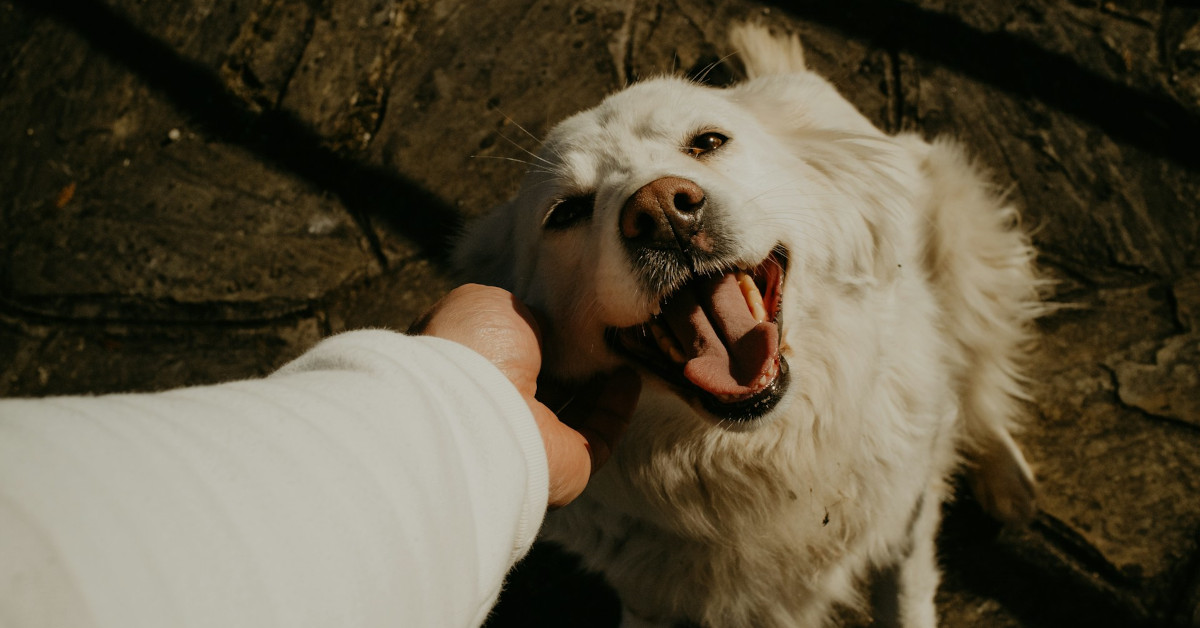
In my years of training work, this is one of the purest expressions of canine affection I know — and one of the most underrated. When a dog comes over unprompted, says nothing, demands nothing, and simply rests its chin on your leg, it is offering maximum trust with minimum noise. No performance, no request. Just contact.
For a dog, this kind of quiet physical touch carries more weight than almost anything else it could do. It isn’t the frantic licking or the jumping. It’s the gesture that says: I want to be close to you. This is enough. If your dog does this regularly, pay attention. It isn’t nothing.
Something similar happens when a dog invites you into its own sleeping space — the den that, under normal circumstances, belongs entirely to it. A dog that calls you over, shifts to make room, and settles close to you in its space is extending something it doesn’t offer lightly.
They check back on walks
On a good walk, notice where your dog’s attention actually goes. A dog that glances back at you periodically — not because you called, not because you’re holding food — is performing what trainers call a check-in. It’s monitoring where you are. It’s keeping you in its awareness. This is anchoring behavior rooted in genuine attachment, and it’s the same instinct that kept ancient canine groups oriented around their most trusted members.
The dog that never looks back isn’t necessarily less bonded — some dogs are simply more independent by nature — but the dog that checks in freely, consistently, and without being prompted is telling you something real: you are part of my map.
The body near yours is soft, not stiff
When a dog feels truly safe with you, its body changes in your presence. The muscles loosen. The tail moves freely. The breathing slows. It lies down without scanning the room. There is a quality of settled-ness in a bonded dog resting near its person that’s entirely different from tension or hypervigilance. A dog that chooses to be close to you and is relaxed in that closeness is showing you two things simultaneously: trust, and affection.
Signs Your Dog Loves You — They ask you for help
This one catches people by surprise the first time they really see it. Your dog has something stuck between its teeth, or a small stone wedged in a paw pad, and instead of managing on its own — or panicking — it comes to find you. It plants itself in front of you and presents the problem.
I was out on a trail once with my dog Diana when she walked over, sat down right in front of me, and quietly lifted her paw. There was a small rock caught in the pad. No fuss, no drama — just a clear, calm gesture that said: I have a problem, and you’re who I came to. That kind of thing doesn’t happen with a stranger. It requires a specific trust: the belief that this particular person might actually understand, and actually help. When your dog brings you its difficulties, it has already decided something important about you.
They choose you in a crowd
Put your dog in an unfamiliar place with many people around and just watch. When it needs to orient, when it feels a moment of uncertainty, when it wants to check in — who does it move toward? When a dog surrounded by strangers threads its way through the people and comes back to press against you specifically, that’s a deliberate choice. Not trained, not habitual. Chosen.
Signs Your Dog Loves You — They share their joy with you
This is probably the most overlooked signal on the whole list, and it’s the one I find most moving. Your dog has discovered something wonderful — a perfect smell, a stretch of trail it loves, an open field — and in the middle of that private happiness, it turns back to you. Not because it needs anything. Just to include you.
Sometimes it’s a glance. Sometimes it’s a brief touch of a cold, wet nose against your hand or your leg — just enough contact to say: this is good, and I wanted you to know it.
On that same trail with our beloved Diana, she would do this regularly on the stretches she loved most: run ahead, stop, and then come back for a second just to bump her nose against my hand before taking off again. I started thinking of it as a gift — the smallest, most honest kind. A wet nose is not much, materially speaking. But as a gesture, it’s everything.
The Sign Most People Miss: You’re Their Reference Point
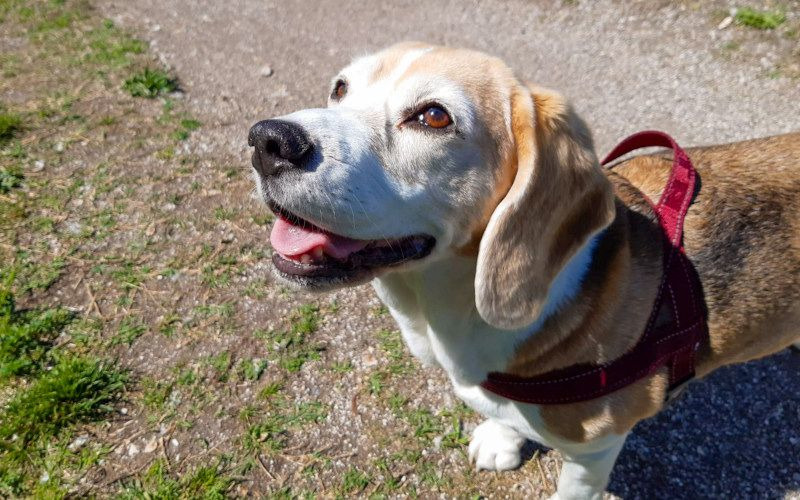
Of all the signs your dog loves you, this one is the most significant — and it has nothing to do with greetings or physical contact.
Watch what your dog does when it encounters something uncertain. A strange sound, an unfamiliar person, a new environment, a slightly worrying situation. Does it look to you? Not in panic — but in that quiet, almost casual way of checking what the current situation calls for? That small reorientation toward you, as the source of reliable information about the world, is what genuine attachment looks like in practice.
A secure base
A dog that trusts you uses you as what psychologists call a “secure base”. It ventures out, explores, takes on the world — and then touches back to you when it needs to calibrate. That isn’t dependence. That’s a relationship that’s functioning exactly as it should.
When I’m trying to understand whether a genuine bond exists between a dog and its owner, this is where I look first. Not at the exuberance of the greeting — that can be excitement, habit, or anxiety. But at the quieter, more consistent pattern: does this dog orient toward this person? Do they share a language they’ve built together over time? When something unexpected happens, who does the dog look at first?
There’s one more version of this that I’ve seen only in extreme circumstances, and it stays with me. A dog coming out of anesthesia after surgery — trembling, disoriented, not yet fully back — will often calm down most quickly in the arms of one specific person. Not just someone. Not just anyone familiar. You. That recovery, happening in your arms and almost nowhere else, is the most unguarded version of everything I’ve tried to describe here: in the moment when a dog has no capacity to perform or manage impressions, it still orients to the person it trusts most.
More Demonstrative Doesn’t Mean More Love
This is worth saying plainly, because it causes a lot of unnecessary worry. Some breeds and individual dogs are simply more expressive — they greet loudly, lean hard, follow closely, demand more direct contact. Others are more contained: present but quieter, affectionate in their own particular way.
The most genuine signs your dog loves you rarely involve volume. I’ve met dogs that would flatten a person with enthusiasm at the front door but showed almost no real attachment beyond that performance. And I’ve met dogs who seemed nearly indifferent on the surface but were so finely tuned to their person that they noticed a shift in mood before the human had consciously registered it themselves.
The quality of a bond doesn’t live in how loud it is. It lives in that mutual attunement — that almost wordless understanding between a dog and a person who have built something real together, consistently, over time. I touched on how that gets built in my post on how to make your dog happy — it starts with the basics, but it grows into something much deeper.
Signs Your Dog Loves You — Building the Bond That Makes These Signs Possible
If you’re reading this and still not quite sure whether your dog really loves you, my honest answer is: almost certainly more than you realize, and in ways you haven’t fully learned to see yet.
What I’ve found is that the depth of a dog’s attachment grows directly from how consistently its needs are met, and from the quality of presence its person brings to their everyday interactions. Not dramatic gestures. Not expensive equipment. Just consistency, calm attention, and genuine engagement over time.
If you want to understand that process more deeply — how to become the person your dog orients toward, checks back to, and genuinely trusts — the free workshop from K9TI is one of the clearest, most practical resources I’ve come across. It lays out the whole foundation of the relationship in a way that makes everything, including these quiet daily signs of affection, suddenly make a lot more sense. You can find it here.
The Signs Your Dog Loves You Have Always Been There
They’re usually not dramatic. They’re the chin settling on your knee while you’re reading. The glance back at you halfway through a morning walk. The choice to come lie near you when it could be anywhere else in the house. The soft, loose body that leans slightly in your direction without asking for anything.
Your dog has probably been saying all of this for a long time. Learning to hear it — in the language it was meant in, not the one we wished for — is one of the most worthwhile things you can do for both of you. And among other things, these signs can motivate us to be better owners.
Have you noticed any of these signs in your dog? Or something I haven’t mentioned — a particular moment that made you certain the bond was real? Leave a comment below. I’d genuinely love to hear it.