

Disclosure: This post about “why hitting your dog doesn’t work” contains affiliate links. If you click through and make a purchase, I may earn a commission — at no extra cost to you. I only recommend products and courses I genuinely believe in, and all opinions expressed here are my own.
A few years ago I watched the same scene play out, evening after evening, with a neighbor of mine. He had a sweet older mixed breed — let’s call her Lilly. Every time a cat strolled past the fence, Lilly barked. He told her to stop. She didn’t. He walked over and smacked her on the thigh. She went quiet, tucked her tail, and retreated to the corner.
“See?” he’d say. “She gets it.”
But hitting your dog hadn’t taught Lilly anything at all. The next evening: same cat, same bark, same smack. For years. That decade-long loop was all the evidence anyone needed. If it worked, you’d only need to do it once.
Why Hitting Your Dog Doesn’t Actually Work
The logic looks convincing in the moment. The dog goes quiet. The dog moves away. It looks like understanding. But what’s actually happening is something called suppression — the behavior is temporarily frozen, not changed.
Suppression and learning are two completely different things. The internal trigger — the excitement at seeing a cat, in Lilly’s case — is still there. Nothing has resolved it. The dog has simply learned that when this person is watching, it’s better to freeze. The moment the owner leaves? Same old dog, same old barking.
Here’s a reliable test: if a training method genuinely works, you shouldn’t need to use it over and over for the same behavior. Every owner who relies on physical corrections will admit, if they’re honest, that they do exactly that — the same correction, the same behavior, for months or years. That repetition is the proof.
What Science Confirms: The Four Quadrants
Modern dog training is grounded in operant conditioning, a framework developed by psychologist B.F. Skinner. It describes four possible ways to change behavior, depending on whether you’re adding or removing a stimulus and whether the goal is to increase or decrease the behavior.
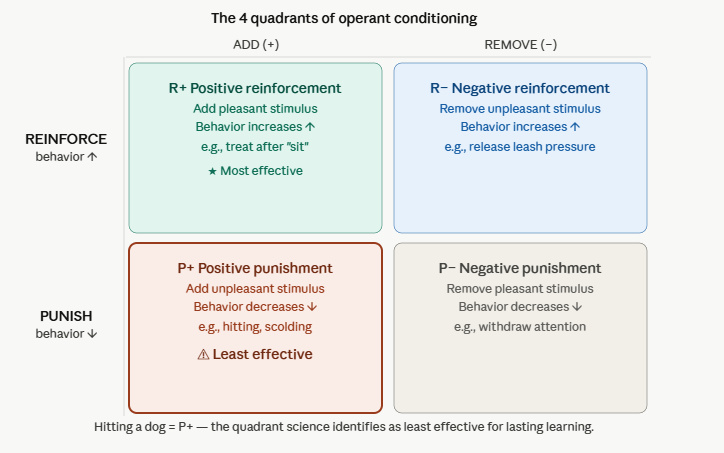
Hitting your dog falls in the worst quadrant
Physical correction — hitting, smacking, swatting — falls in Positive Punishment (P+): you add an unpleasant stimulus to try to reduce a behavior. And according to decades of behavioral research, P+ is the least effective of all four quadrants for creating lasting change.
Why? Because P+ only tells a dog what not to do. It gives zero information about what the dog should do instead. Without that information, there’s nothing to learn. The dog can’t build a new behavior out of pain and confusion.
Positive reinforcement (R+) does the opposite. It clearly marks what works, motivates the dog to repeat it, and builds durable habits. The difference in long-term results is not subtle.
The Hidden Damage — What Hitting Your Dog Really Teaches
There’s a long list of documented side effects that come with regular physical punishment, and most owners who rely on it don’t see them coming.
The person doing the punishing becomes a signal for fear. The dog learns to behave differently depending on who’s present — not because they’ve internalized a rule, but because they’ve learned to avoid a threat. Take the owner out of the equation and the unwanted behavior comes right back.
Repeated punishment also increases general anxiety and insecurity. I’ve seen this pattern many times in my work: a dog that starts out with one annoying habit develops secondary problems — excessive reactivity, difficulty settling, unpredictable responses — that are far harder to address than the original issue.
Most importantly: hitting your dog can promote aggression. A dog who is regularly made to feel cornered or unsafe will eventually reach a threshold. The dog that “bit out of nowhere” almost always has a history of accumulated stress and fear — if you know what to look for.
There’s one more thing worth naming, even if it’s uncomfortable to say out loud.
Psychology has a term for what happens when someone can’t — or won’t — confront the real source of their frustration and redirects it onto a weaker substitute instead: displaced aggression. First described by Freud and later formalized in the frustration-aggression hypothesis, the mechanism is unconscious and lightning-fast. The brain runs a split-second calculation: is this target safe to strike back? If the answer is yes — because the target is smaller, dependent, unable to retaliate — the impulse moves forward. If the answer is no, the impulse quietly retreats.
A dog qualifies on every count. Which means that someone who regularly hits their dog is not just using an ineffective training method. They are, at some level, choosing a target they know can’t truly fight back. That’s not dominance, not discipline. That’s the oldest, most transparent form of cowardice there is — dressed up as correction.
Fear Is a Castle Built on Sand
Beyond the science, there’s something more fundamental at stake. The ancient alliance between humans and dogs — which has been developing for at least 15,000 years — was never built on fear. It was built on mutual benefit: we met their needs, they offered their capabilities. That’s the pact.
When you introduce systematic fear into that equation, you don’t create a dog that respects you. You create a dog that tolerates you when things are calm and becomes unpredictable under pressure, because the relationship has no solid foundation.
Think of it this way: every walk, every cuddle, every game you play together now exists under the shadow of the unpredictable hand that sometimes strikes. The dog can’t separate “the hand that pets me” from “the hand that hits me.” That ambiguity corrodes trust slowly but completely.
A relationship built on intimidation is a castle built on sand. It holds together until a genuine challenge arrives — a frightening situation, an unexpected trigger, a high-stress moment — and then it gives way all at once. I covered the full picture of what dogs actually need from us in my post on how to make your dog happy — this piece fits directly into that bigger story.
One Honest Exception
I want to be straightforward here, because black-and-white thinking doesn’t serve anyone.
There is exactly one context where physically stopping a dog may be the right call: immediate, genuine danger. Your dog is about to run into traffic. Another dog has launched a real attack. In those moments, you do what you have to do to prevent harm.
But notice what that is: an emergency interruption, not a training tool. It stops the action in the moment. It teaches the dog nothing — and it’s not meant to. Using physical force as a regular system for interacting with your dog is a completely different thing. That’s where the damage lives.
The Better Path
If hitting your dog sits at the bottom of the effectiveness scale, positive reinforcement training sits at the top. Not just because it’s kinder — but because it produces behavior that genuinely holds up in the real world, with real distractions, over time.
Building that kind of relationship — one where your dog genuinely wants to work with you rather than just avoid you — is exactly what I focus on in my training approach. If you’re ready to go deeper and see how this works in practice, I recommend the free workshop from K9TI: it’s a clear, science-based method that makes the whole picture click into place. Check it out here →
Final Thoughts
Lilly never stopped barking at cats. Not because she was stubborn, or slow, or disobedient. But because no one ever showed her what to do instead.
That’s what hitting your dog fails to provide: direction. It removes behavior by adding pain. It never replaces it with anything. And in the process, it quietly hollows out the trust that makes everything else possible.
Have you ever dealt with an owner — or been one yourself — who relied on physical correction before discovering a better way? I’d genuinely love to hear your story in the comments below.