
Disclosure: This post contains affiliate links. If you click through and make a purchase, I may earn a commission — at no extra cost to you. I only recommend products and courses I genuinely believe in, and all opinions expressed here are my own.
You’ve probably heard it said that the body is an amazing machine. It’s a well-meaning phrase — but it leads somewhere quietly wrong. Because if the body is a machine, the logical conclusion is that you protect it the way you’d protect a classic car: keep it in a climate-controlled garage, minimize the miles, avoid unnecessary wear. Leave it untouched, and it’ll stay in good shape.
The problem is that living beings don’t work that way at all. Not humans. Not dogs. For a living organism, the rule runs in exactly the opposite direction: what you don’t use, you lose.
This isn’t philosophy. It’s biology — and understanding it changes everything about how you think about your dog’s daily life.
Dog Mental Stimulation and the Science of “Use It or Lose It”
Your dog’s brain contains roughly 2.2 billion neurons. Like any biological structure, it doesn’t stay static — it responds to what it’s asked to do. Scientists call this neuroplasticity: the brain’s lifelong ability to form new connections, strengthen existing ones, and reorganize itself in response to experience.
When a dog moves through new environments, works their nose, solves a problem, or navigates a social interaction, the brain gets signals to grow, adapt, and stay sharp. Physical exercise triggers the release of BDNF — brain-derived neurotrophic factor — a protein that supports the growth of new neurons and the maintenance of existing ones. Movement, in other words, is not just good for the body. It’s directly fertilizing the brain.
The reverse is also true. A dog whose days are repetitive, unstimulating, and socially thin is a dog whose brain is receiving very few signals to maintain itself. Not immediately, not dramatically — but over time, capabilities that aren’t used begin to fade. The dog becomes less curious, less adaptable, less emotionally resilient. What looks like laziness or stubbornness is often simply the result of a nervous system that hasn’t been given enough to work with.
What Happens When a Dog’s Abilities Go Unused
This is the part that surprises most owners, because the effects are gradual and easy to misread. A dog that isn’t receiving sufficient dog mental stimulation doesn’t necessarily look distressed. They may look quiet. Calm, even.
But look more carefully. A dog that has stopped approaching new things with curiosity, a dog that reacts with anxiety to environments or experiences that should be manageable. A dog that barks excessively, destroys things, digs, or paces — not out of malice, but because a brain with nothing to do will find something, one way or another. These are the signals of a nervous system running on empty.
The good news is that the same neuroplasticity that allows decline also allows recovery. A dog’s brain responds to enrichment at any age. It’s never too late to start — and the earlier you build these habits into daily life, the less work it takes to maintain them.
The Four Things Your Dog Needs to Keep Thriving
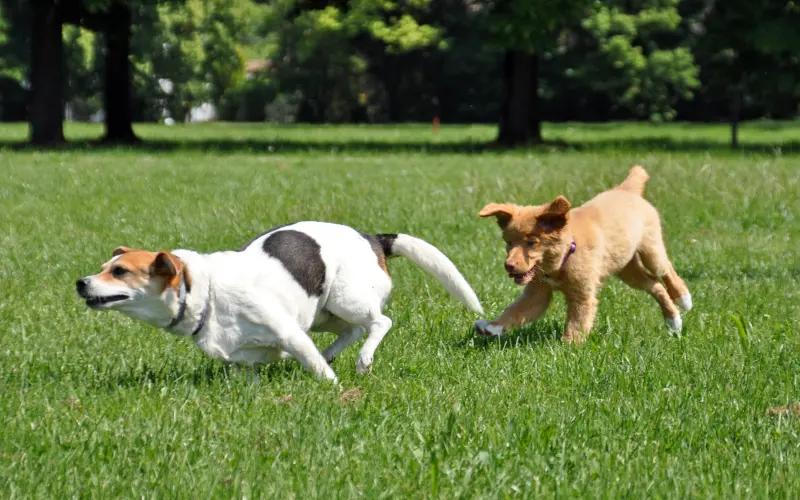
Movement in real space, using all the senses, genuine social contact, and shared experiences. These aren’t four separate categories — they overlap constantly — but thinking about them individually helps you see where the gaps might be.
Movement in Real Freedom — Not Just Distance
A walk on a tight leash, covering distance at the owner’s pace, is exercise in a narrow sense. What a dog actually needs is movement that involves choice, exploration, and genuine physical engagement with the environment. That means off-leash time in safe spaces whenever possible, or at minimum a loose leash and the freedom to move at their own rhythm.
In practice: find a fenced field, a quiet trail, a safe stretch of park. Let your dog run, sniff, investigate, double back, choose their own direction. Even 15–20 minutes of this kind of unstructured movement has a different quality than an hour of structured walking. The brain is engaged the whole time because the body is making real decisions.
Using All the Senses — Especially the Nose
A dog’s sense of smell is their primary way of reading the world — estimated to be tens of thousands of times more sensitive than ours. Sniffing is not a distraction from the walk. It is the walk, from your dog’s perspective. A walk that includes genuine free sniffing time is dramatically more stimulating than one at a brisk human pace with the nose kept off the ground.
Beyond walks, nose work is one of the most powerful and accessible forms of dog mental stimulation available to any owner. Hide your dog’s kibble in small portions around a room before meals. Hide a toy and let them find it or… hide yourself. The nose-to-ground, problem-solving engagement this creates is mentally exhausting in the best sense. A dog who has worked their nose for twenty minutes is a dog who is genuinely, contentedly tired.
Social Contact That Actually Counts
Dogs are social animals, and social interaction is not a luxury add-on to their lives. Meeting other dogs, spending time with different people, navigating the small negotiations of a social encounter. These experiences keep the social brain active and flexible. A dog who rarely interacts with anyone outside their immediate household becomes progressively less equipped to handle those interactions when they do occur.
Seek out calm, positive encounters with other dogs whose owners you trust. Let your dog greet people who approach respectfully. The quality of these interactions matters more than the volume — one good meeting is worth more than ten stressful ones.
Shared Experiences — Being Part of Something
There is something specific and important about a dog who is brought along into life rather than left at home at the edges of it. The car ride to a new town. The hike on a trail they’ve never been on. The afternoon sitting outside a café while the world moves around them. The errand that becomes an outing. These experiences don’t need to be extraordinary. They need to be varied and shared — moments where your dog is with you in the full sense, encountering something new together.
This is what canine enrichment ultimately points toward: not a list of toys and games, but a quality of life in which the dog’s brain is continuously receiving input worth processing.
What Dog Mental Stimulation Actually Looks Like Day to Day
You don’t need a structured program or a cabinet full of puzzle feeders. You need a consistent commitment to variety and presence. Here’s what that can look like across an ordinary week:
Scatter feed breakfast in the yard or across a snuffle mat instead of using a bowl. Change your walking route regularly — even small variations introduce new smells and sights. Build in one session per week of intentional nose work: hide three small portions of food in a room and let your dog find them. Make time for at least one outing per week that goes somewhere new, even briefly. During training, teach something your dog has never been asked to do before — the learning process itself is enriching, independent of the specific skill.
None of this is expensive or time-consuming in isolation. What makes it effective is doing it consistently, over weeks and months — understanding that you are not just keeping your dog entertained today, but actively maintaining the health of their brain over their lifetime.
If you’d like a structured approach to building this kind of enriching daily life with your dog — one grounded in how dogs actually think, learn, and thrive — the Total Transformation Masterclass by K9TI is the resource I point people to when they want to go deeper.
What does your dog’s week look like right now in terms of variety and stimulation? I’d genuinely love to hear — leave a comment below, and let’s think about it together.