
Disclosure: This post about the question “are dog doors bad for dogs?” contains affiliate links. If you click through and make a purchase, I may earn a commission — at no extra cost to you. I only recommend products and courses I genuinely believe in, and all opinions expressed here are my own.
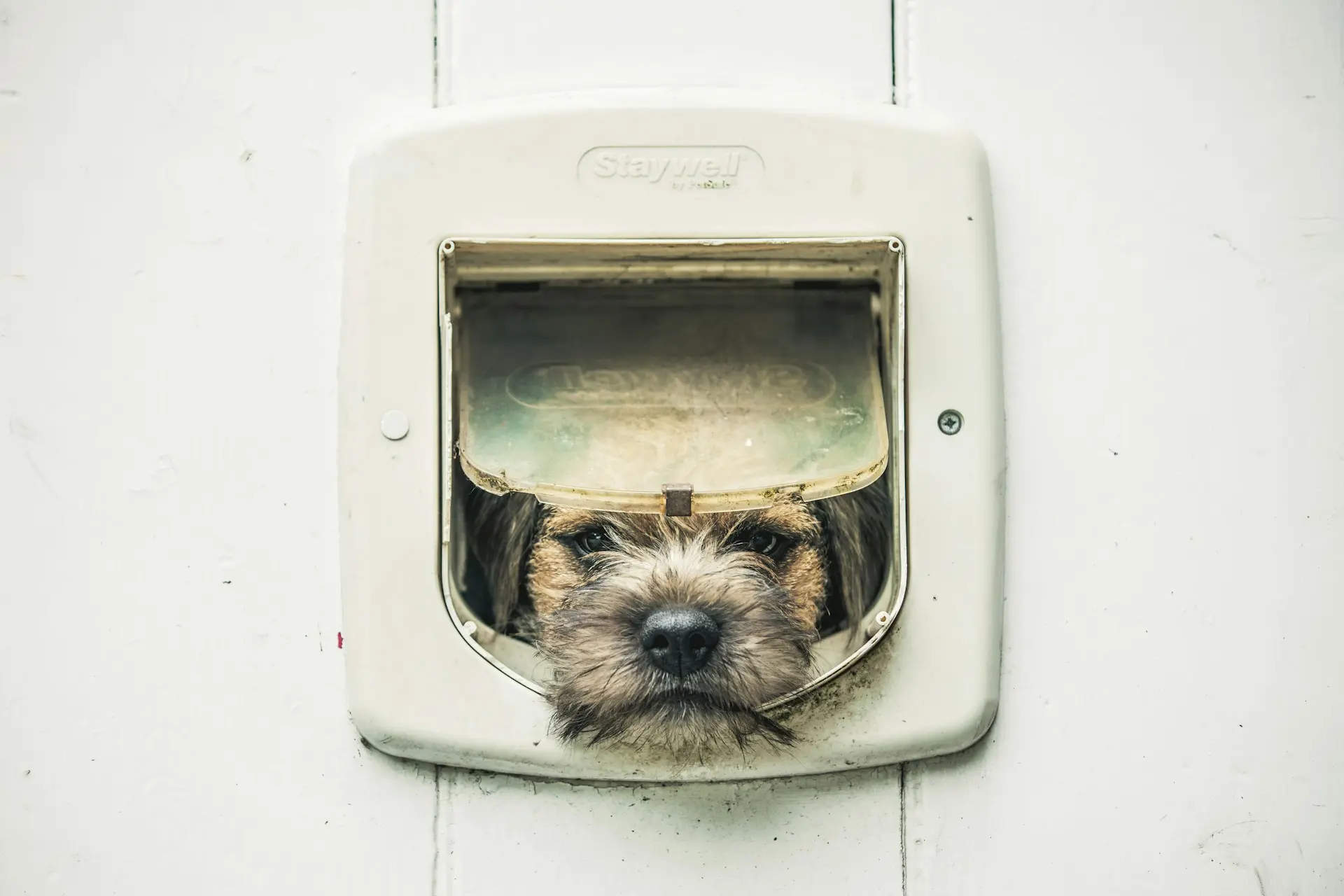
Are dog doors bad for dogs? Dog doors get sold as the ultimate convenience. Your dog gets freedom. You get a break from constantly opening and closing the back door. Everyone wins.
At least, that’s the pitch.
I want to push back a little. In my experience as a trainer, a dog door usually solves a human problem more than a dog problem.
In many dogs, especially the ones who are already anxious or easily wound up, it quietly creates a new one: a confused sense of where home actually ends.
Who Is the Dog Door Really For?
Be honest with yourself for a second. Is the dog door mainly there so your dog feels more comfortable? Or is it there so you don’t have to get up from the couch fifteen times a day?
For most households, it’s the second one, dressed up as the first.
That’s not a moral failing. Convenience matters, and I’m not here to make anyone feel guilty for wanting fewer interruptions during dinner.
But a dog door’s main selling point is convenience for you, not enrichment for your dog. Once you’re honest about that, it’s easier to weigh the downside fairly.
How Dogs Actually Organize Their World
Here’s the part that rarely comes up in dog door reviews. Dogs, like their wild relatives, naturally divide their world into different zones.
Each zone carries a different meaning.
There’s the den, the small, secure spot that’s truly theirs. There’s the shared living space where the family eats, plays, and spends time together. Then there’s the wider outside world, which follows a completely different set of rules.
This isn’t just a cute theory. Behaviorists who study canine spatial behavior have found that dogs recognize an outer home range but don’t defend it. Tighter zones closer to home get treated very differently.
A dog door collapses some of that structure. It turns two zones that should feel distinct into one continuous space the dog can drift through at will.
A door that opens onto a hallway doesn’t confuse a dog about where the bedroom ends and the kitchen begins. The dog still has to choose to walk through it, and the transition feels deliberate.
A flap that’s always swinging open works differently. The inside and the outside blur into a single, undifferentiated space over time. That blurring is exactly where the trouble tends to start.
Why Are Dog Doors Bad for Dogs Who Are Already Anxious?
A dog who isn’t sure where one space ends and another begins doesn’t usually tell you right away. It shows up sideways: as restlessness, as a dog who seems to be everywhere and nowhere, as a level of background alertness that never quite switches off.
That confusion might stay mostly invisible for a calm, settled dog. For a dog who’s already prone to anxiety, hyperactivity, or reactivity, free access through a dog door tends to amplify the very tendencies you’re hoping to manage.
The dog isn’t pacing and bolting outside because they’re badly behaved. The line between resting space and the rest of the world has basically disappeared, and nothing in their environment helps them tell the difference anymore.
Potty training is the clearest everyday example.
A puppy who can wander in and out at will never gets the clean, repeated pattern of being brought outside, doing their business, and coming back in to a calm welcome. That pattern is what actually teaches reliable house training. A dog door quietly removes it from the equation.
Are Dog Doors Bad for Dogs in Every Case?
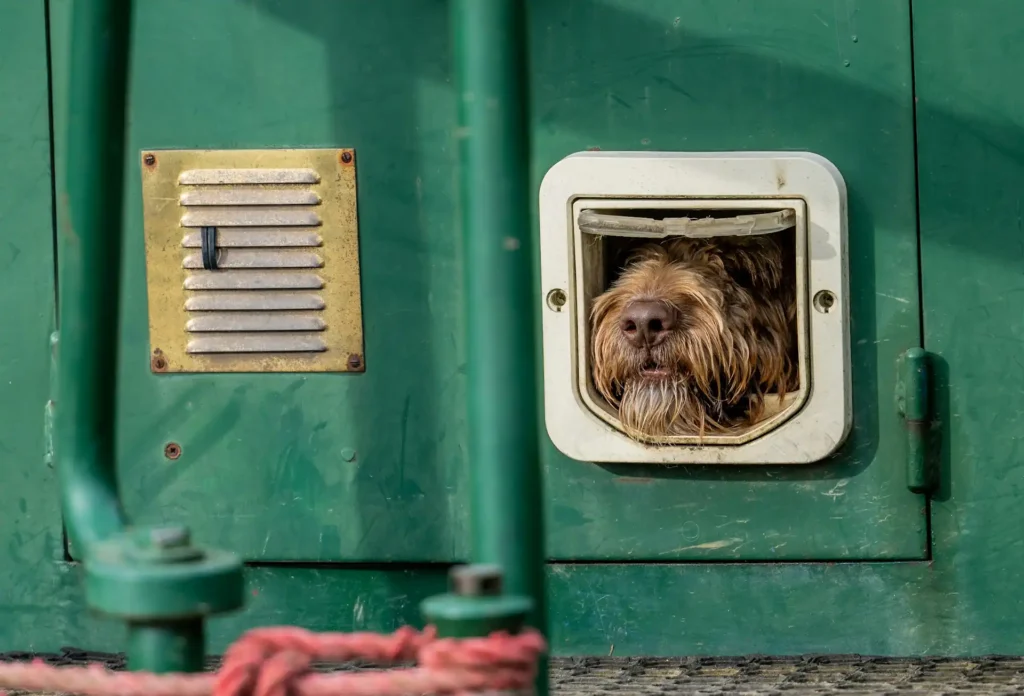
None of this means a dog door is automatically bad for dogs in every household.
If you’re set on using one, the fix isn’t necessarily to rip it out. It’s to manage it with real intention instead of letting it run on autopilot.
A lockable flap that you open and close at specific times keeps the structure intact while still saving you some trips to the door.
Pairing outdoor access with a consistent potty cue helps your dog keep that clear association between place and behavior, even after the door is installed. For dogs who are already anxious or wound up, limiting free access while you’re away to supervise is often the single most useful change you can make.
The goal isn’t to eliminate every bit of independence your dog has. It’s to make sure that independence doesn’t come at the cost of a clear, organized sense of space.
That sense of space is one of the more fundamental things every dog needs to feel secure. My piece on whether dogs should sleep inside or outside walks through a related piece of that same puzzle.
If Your Dog Already Seems Confused or Restless
Maybe you’re reading this and recognizing your own dog in it.
Are dog doors bad for dogs who already seem restless? Often, yes, at least until the structure around the door changes.
The goal isn’t to feel bad about a purchase you already made. It’s to notice the pattern early enough to do something about it.
A dog who paces by the door, who can’t settle even in their own bed, or who treats the whole house like one space worth patrolling is telling you something useful. That’s often the same kind of restlessness I talk about when discussing an anxious dog owner’s effect on their dog.
Here, though, the source is structural rather than emotional. Either way, the fix starts with rebuilding clearer boundaries between your dog’s space, your shared space, and the outside world.
This is exactly the kind of foundational structure work that gets glossed over in most generic training advice. The Total Transformation Masterclass spends real time on how a dog’s environment shapes their behavior. That’s a piece most owners never think to look at until something’s already gone wrong.
What I’d Actually Recommend Instead
If your main reason for wanting a dog door is convenience, a consistent potty schedule paired with a predictable routine gets you most of the same benefit, without dissolving your dog’s sense of space.
It takes more of your time upfront, but it keeps the structure your dog’s brain quietly relies on every day.
If you do decide a dog door is right for your home, treat it as a tool you control, not a permanent fixture that runs itself.
Lock it during the hours you’re away, pair it with the same potty cues you’d use otherwise, and watch whether your dog seems calmer or more unsettled in the following weeks. Their behavior will tell you which way it’s going.
Has your dog ever seemed more restless after getting more freedom of some kind, whether that’s a dog door, an off-leash yard, or anything else? I’d genuinely like to hear how it played out for you in the comments below!