
Disclosure: This post about the emotional contagion in dogs contains affiliate links. If you click through and make a purchase, I may earn a commission — at no extra cost to you. I only recommend products and courses I genuinely believe in, and all opinions expressed here are my own.
There’s a classic scene in Western movies that I’ve always found useful for thinking about emotional contagion in dogs and dog training.
Two cowboys start arguing in a saloon. Voices rise. Someone throws a punch. Within seconds, the entire room erupts. People who had nothing to do with the original argument are suddenly brawling and throwing chairs. A shared chaos spreads through the room that no one planned and no one can fully explain.
That’s emotional contagion. And it applies directly to the way you and your dog move through the world together.
What Emotional Contagion in Dogs Actually Means
Emotional contagion is the automatic, largely unconscious transfer of emotional states from one being to another.
Researchers have documented this extensively between dogs and their owners. Studies measuring heart rate variability and cortisol levels show that a dog’s physiological stress markers track closely with their owner’s. The longer the two have lived together, the stronger that synchronization becomes.
In plain terms: your dog catches your mood. Not in a vague, metaphorical sense. Measurably and physically. The cortisol in your dog’s bloodstream rises and falls in response to what’s happening in yours.
This is why understanding emotional contagion in dogs matters so much for anyone building a calmer, more connected relationship.
We talk a lot about training behaviors. We talk far less about the invisible emotional weather we bring into every interaction.

The Question Most People Don’t Ask
When people learn about emotional contagion, they immediately think about their own effect on their dog. That’s the right first step.
But there’s a second layer that almost nobody addresses: how much do you absorb from the world around you, before you even interact with your dog?
Here’s what I mean.
Imagine your morning went like this. You checked the news over coffee and read something infuriating. On your way out, a neighbor said something cutting in passing. Two blocks into the walk, someone’s loud motorcycle revved past you at close range.
By the time you’re halfway through the walk, you’re carrying a low-grade tension that has nothing to do with your dog. It has everything to do with accumulated input from the world.
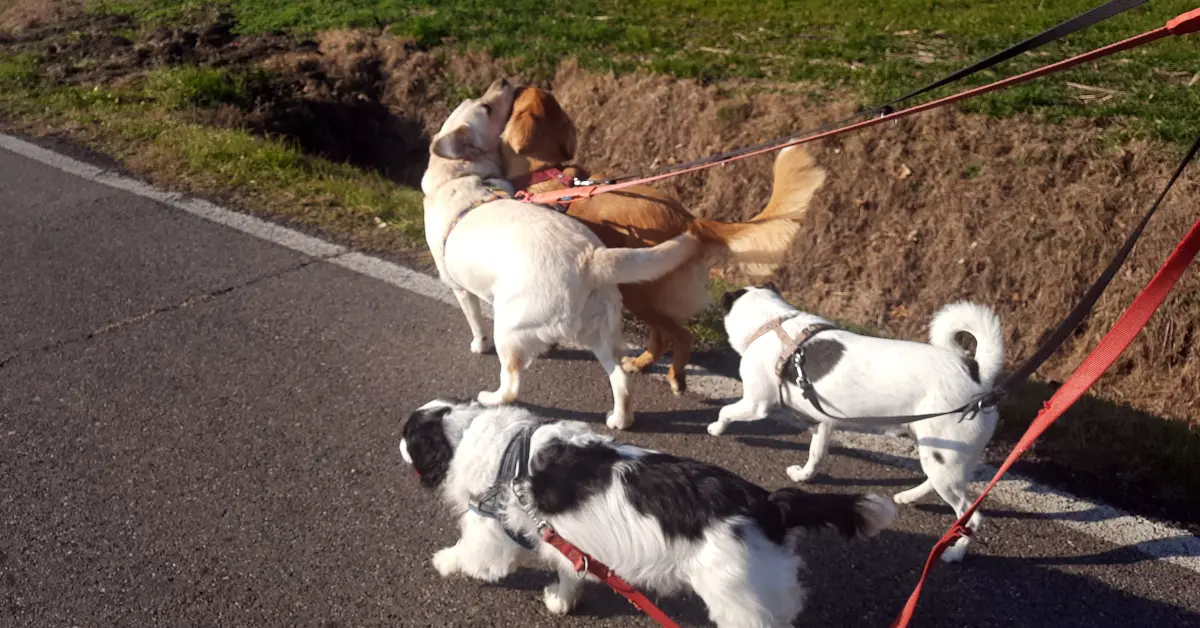
Your dog doesn’t know any of this. They just know that the human at the other end of the leash is taut and not fully present. Because of how emotional contagion in dogs works, they begin to adjust accordingly.
This is what I’d call “emotional permeability” — how easily external stimuli seep into your emotional state before you can consciously choose how to respond. Some people absorb a stranger’s bad mood, a news headline, or a sudden loud noise and it stays with them for an hour. Others are naturally more buffered. Most of us are somewhere in between.
Stability is one of the most important things you can offer your dog, especially in an environment that wasn’t built for them.
Emotional Contagion in Dogs: Everyday Moments Where This Shows Up
Think about the situations that tend to spike your emotional state during a walk.
Someone cuts you off in traffic on the way to the trail. A stranger comments on your dog in a tone that rubs you the wrong way. You walk past a group playing loud music. You pass a building with a blaring alarm. A political conversation you overhear at the coffee shop before the walk is still playing in your head twenty minutes later…
None of these things are aimed at your dog. But each one is a small transfer opportunity. A moment where your nervous system gets activated, and your dog, tuned in to exactly that signal, picks it up.
I’ve seen this play out in my work as a trainer. A dog who handles a specific situation perfectly on one day becomes reactive on another day, in the same spot, with the same trigger.
The dog hasn’t changed. The owner has walked in carrying something. And the dog responds to that, more than to anything external.
How to Lower Your Emotional Permeability
This is a skill, not a personality trait, which means it can be developed deliberately.
Build a Transition Ritual Before Walks
A brief, consistent pause between the last stressful thing you did and the moment you pick up the leash works surprisingly well.
It doesn’t need to be long. Thirty seconds of slow breathing, a conscious decision to leave what you were dealing with inside the house, a moment of noticing how your body actually feels right now.
The goal isn’t to manufacture fake calm. It’s to interrupt the automatic carrying-over of accumulated tension.
Another useful habit is practicing noticing without absorbing.
When something external activates you, the first step is simply recognizing it. The motorcycle startled me. That comment irritated me. Noticing it clearly, without letting it color the rest of the walk, is a learnable skill.
Think of it as a pause between stimulus and response, a space where you choose your next move deliberately rather than reactively.
Manage What You Take In Before Important Sessions
Before a training session or an unfamiliar environment, the hour prior isn’t the time to scroll through charged content or have a tense phone call. Your emotional baseline going in shapes your dog’s starting point. A little upstream management makes a real difference.
Also worth building: awareness of your body, not just your thoughts.
Emotional contagion happens largely through physical channels — posture, breathing, muscle tension, pace.
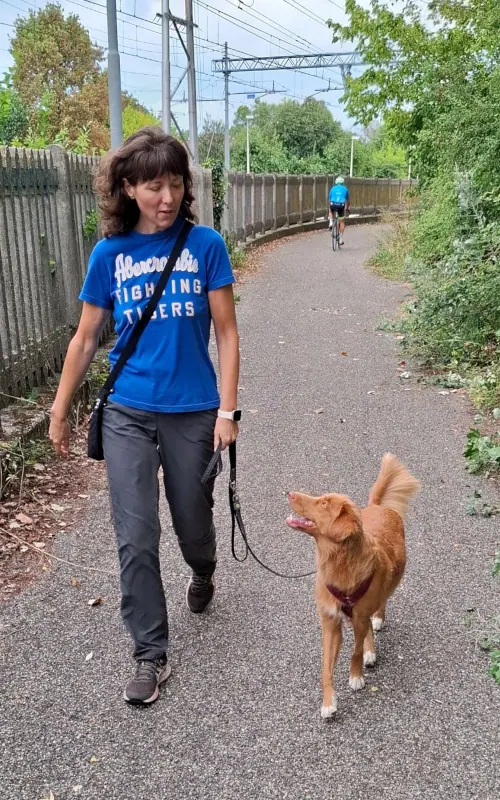
Your dog reads your body directly. A tight grip on the leash, a slightly accelerated pace, a forward lean into uncertainty — these are the actual signals being transmitted. Softening them physically, even before you’ve resolved what triggered you mentally, genuinely changes what your dog receives.
Emotional Contagion in Dogs Goes Both Ways: Choose What You Transmit
None of this is about performing calm you don’t feel.
Dogs are perceptive enough to detect the difference between real groundedness and a brittle surface calm stretched over tension. What they respond best to is genuine emotional stability, the kind that doesn’t require everything outside to be perfectly controlled.
That stability is what makes you a reliable anchor.
When something unexpected happens during a walk, your dog glances at you for information. If what they read is my person noticed that thing, assessed it, and kept moving, the message is clear. If what they read is my person is activated and I don’t know why, the natural response is heightened vigilance.
This is the heart of what it means to be a real reference point for your dog, not just someone who holds the leash.
Your dog is reading you constantly. The question isn’t whether emotional contagion in dogs is already happening in your relationship. It is. The question is what’s being transmitted, and how much of it you’re actively choosing.
Where to Go From Here
You might also find it useful to explore my piece on what empathy really means in dog ownership, and an earlier post on how anxious owners can unknowingly amplify the very behaviors they’re trying to reduce. Both connect directly to this.
For the practical side of this kind of owner-side foundation work, the Total Transformation Masterclass addresses it directly. There’s a free webinar as a starting point if you want to explore before committing.
Has a difficult moment earlier in your day ever clearly influenced how a walk or training session went with your dog? If you’d like to share your personal experience with this topic, we’d love to hear about it. You can leave a comment below — we’ll be happy to read it and reply 🙂