

Disclosure: This post about how to get a puppy used to a collar and leash contains affiliate links. If you click through and make a purchase, I may earn a commission — at no extra cost to you. I only recommend products and courses I genuinely believe in, and all opinions expressed here are my own.
Want to get a puppy used to a collar and leash without a daily wrestling match?
Skip straight to the walk — that’s where most of the fighting starts. A puppy feels something unfamiliar around its neck. It panics, or freezes, or spins like a corkscrew trying to get free.
None of that means your puppy is stubborn or difficult. It just means nobody showed him there was nothing to be afraid of yet. That’s what these two exercises are for.
How to Get a Puppy Used to a Collar and Leash Without a Fight
Put yourself in your puppy’s place for a second. One day, there’s a strange strip of material around his neck that wasn’t there before. He can’t see it. He can’t predict when it will move or tighten. To a young animal, that’s exactly the kind of thing worth fighting.
Most of us make the same well-meaning mistake. We clip on a full collar and leash for the first time, then head straight out the door.
We expect calm behavior from a puppy who’s never felt either object before. It rarely goes well. The fix isn’t a stronger collar or a firmer hand. It’s a slower introduction, done in small, boring, repeatable steps, well before the leash ever leaves the house.
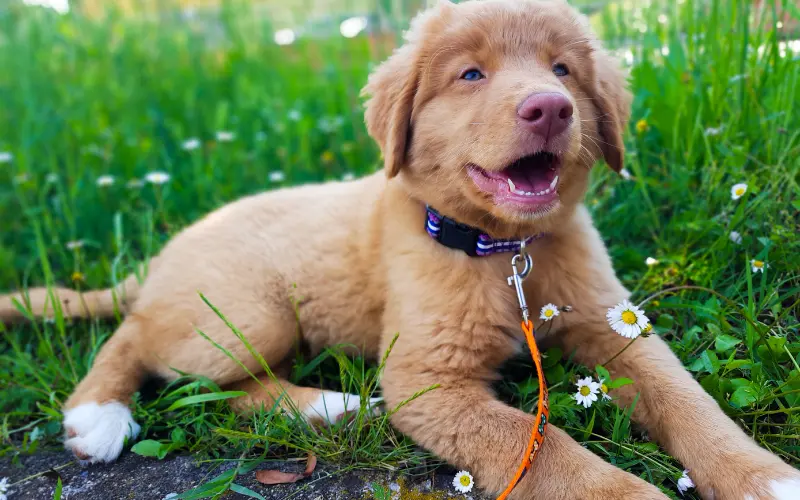
Two Exercises to Get a Puppy Used to a Collar and Leash
Both exercises below take just a few minutes a day. Most puppies get comfortable within a week or two; a more sensitive puppy might need a bit longer, and that’s completely fine. Go at your puppy’s pace, not the calendar’s.
Exercise One: The Collar
Skip the real collar at first. Grab something much lighter instead.
A thin ribbon or a soft strip of fabric works well, about half a centimeter wide. Tie it loosely around your puppy’s neck. Leave enough room to slide two fingers underneath easily. Make sure no loose ends are dangling for him to chew.
Now just play. Keep treats in your pocket.
Every so often, apply the gentlest possible tension to the ribbon — just enough for your puppy to notice it’s there. You’re not restraining him. You’re only teaching him that the feeling isn’t dangerous.
If he pulls away or freezes, stop the tension immediately. Wait for him to relax, then reward calm behavior generously. If he comes toward you without a fuss, treat that like a jackpot. Repeat this for a few minutes a day, in a quiet room or a fenced yard. Keep going until the ribbon stops registering as anything unusual.
Once your puppy shrugs the ribbon off completely, move up to a real, properly fitted collar.
You should still be able to fit two fingers between the collar and his neck, snug but never tight. If you haven’t stocked up on the basics yet, my guide on what to bring when picking up a new puppy covers exactly what’s worth buying, collar included.
Exercise Two: The Leash
Once the collar is old news, it’s time for the leash.
Use something light — a basic flat collar and a lightweight nylon or leather leash. Skip retractable leashes for this stage entirely. I’ve written a full breakdown of why retractable leashes cause more problems than they solve. It applies just as much to adult dogs who already know how to walk politely.
Clip the leash on and stand next to your puppy. Don’t call him, don’t lead him — just wait.
Let him move first. Follow along with the lightest possible tension, just enough for him to feel the leash is there. He should feel like he’s the one deciding where you’re both going, at least for now.
Every so often, stop walking for a few seconds. Don’t tug, don’t look at him, don’t say his name.
If he stays calm and checks in, start moving again. Gently guide him toward the direction you’d like to go. Instead of repeating his name to call him over, try something more interesting. A funny noise, a little crouch, a few playful steps backward all work well. Puppies chase curiosity far more reliably than they chase their own name.
If he plants his feet and won’t budge, don’t force it. Give him a moment, then try again. If he lunges toward something exciting, follow gently rather than snapping him back. Only step in and redirect, as softly as you can, if he’s headed somewhere actually unsafe.

The One Type of Collar I’d Never Recommend
You may hear that a choke or prong collar is the fastest way to stop a puppy from pulling. It isn’t. I’d steer you away from both, especially on a young dog whose neck and trachea are still developing.
These tools work through discomfort, not understanding. A puppy that stops pulling because it hurts hasn’t learned to walk politely — it’s learned that movement causes pain.
The American Veterinary Society of Animal Behavior recommends against choke chains, prong collars, and other aversive tools entirely. They cite increased stress and no real training advantage over reward-based methods.
A soft, flat collar and a little patience get you further, without any of the risk.
This Works for Rescue Dogs Too
Everything above was written with a puppy in mind, but none of it is puppy-exclusive. I’ve used these same two exercises to get a puppy used to a collar and leash. They work just as well to help an adult rescue dog get comfortable, just at a slower pace.
An adult dog with a rough history might flinch at the sight of a leash. That’s especially true if a leash once meant something frightening for him.
Give that dog more time at every stage. Don’t rush the ribbon exercise just because he’s already full-grown. The goal is still the same: a collar and leash that mean safety, not stress.
How Diana and Fanta Learned to Love Their Leash
Diana was the pickiest of the two when it came to her first collar. She’d freeze mid-step and stare at me like I’d betrayed her. The ribbon trick is what finally got her past it. A few short sessions a day, treats in my pocket, patience over pressure — that’s all it took.
Fanta takes to almost everything faster, and the leash was no exception. Within a few days, she was the one leading the exercise. She dragged me toward whatever smelled the most interesting in the yard.
Both of them got there. Neither got there by being forced. That’s really the whole method in one sentence: get a puppy used to a collar and leash with patience, not pressure, and the rest tends to fall into place.

How to Get a Puppy Used to a Collar and Leash: Turning “Leash” Into Your Dog’s Favorite Word
All of this really comes down to one thing. You’re showing your puppy, one calm rep at a time, that he can trust you. You’re the person who keeps him safe, not the one who traps him. That’s the same idea at the heart of how to make your dog happy. It’s worth carrying into everything else you teach him.
Do this patiently enough, and something interesting happens. The leash stops meaning something uncomfortable is about to happen. Instead, it starts meaning a walk is coming. For a lot of dogs, just hearing the word is enough to start the tail going.
None of this happens overnight, and that’s fine. A few minutes a day is plenty.
What matters is that your puppy never learns to associate his gear with fear in the first place. That’s a much easier problem to prevent than to fix later. Once outdoor walks become part of the daily routine, loose-leash walking is the next skill worth tackling — I’ve written a complete guide on how to stop your dog from pulling on the leash.
What Comes Next: Calm Leashing
This kind of patient, reward-based foundation is exactly what the K9 Training Institute’s Total Transformation Masterclass builds on.
One of its early lessons is called “Calm Leashing.” It picks up right where this post leaves off. Instead of bouncing off the walls the second the leash comes out, your dog learns to wait. He sits quietly while the collar and leash go on. Your puppy might be easygoing about the gear itself, but turn into chaos the moment you reach for it. If so, that’s the next skill worth building.
What was your puppy’s first reaction to a collar? I’d love to hear about it in the comments.
Ready to build a calmer daily routine from the ground up? The K9 Training Institute’s Total Transformation Masterclass is a solid place to start.