
Disclosure: This post about how dogs see the world contains affiliate links. If you click through and make a purchase, I may earn a commission — at no extra cost to you. I only recommend products and courses I genuinely believe in, and all opinions expressed here are my own.
How dogs see the world is nothing like how you see it. The old idea that they see in plain black and white isn’t even close to the truth. Their reality is genuinely different.
Colors shift. Distance blurs. Motion practically jumps off the page.
None of this is a downgrade from human vision. It’s a completely different set of tools, built for a completely different job. Once you understand what your dog’s eyes are actually doing, a lot of everyday moments start making more sense.
How Dogs See the World Starts With a Different Kind of Eye
Think of an eye like a camera. Light enters through a lens, passes through an opening, and lands on a light-sensitive surface at the back. A dog’s eye works the same way. Light comes in through the cornea and lens, passes through the pupil, and lands on the retina. The retina then sends the signal on to the brain.
Here’s where dogs pull ahead. Relative to eye size, a dog’s pupil opens wider than yours does. A wider pupil lets in more light. More light means better vision at dawn and dusk.
That’s exactly when wild canine ancestors did most of their hunting. It also lines up with your dog’s energy levels. Most dogs get their biggest bursts of playfulness early in the morning and again in the evening, with a calmer stretch in between.
Dogs also have a genuine advantage humans don’t: a layer of tissue called the tapetum lucidum. It sits behind the retina and reflects light back through it a second time. That squeezes extra use out of every available photon. That reflection is exactly what causes the eerie glow you see in a dog’s eyes under flash photography. You’ll see the same glow in a flashlight beam at night.
Puppies don’t start with any of this working yet. They’re born with their eyes sealed shut, opening only around two weeks later. Full visual maturity takes a couple more months. A young puppy is genuinely still learning how to use the eyes he’s got.

The Color Myth: Dogs Don’t See in Black and White
This particular myth refuses to die, and it’s simply not accurate. According to VCA Animal Hospitals, dogs absolutely perceive color. They just perceive far fewer of them than you do.
Human eyes are trichromatic, built around three separate color receptors. Dogs are dichromatic, working with just two.
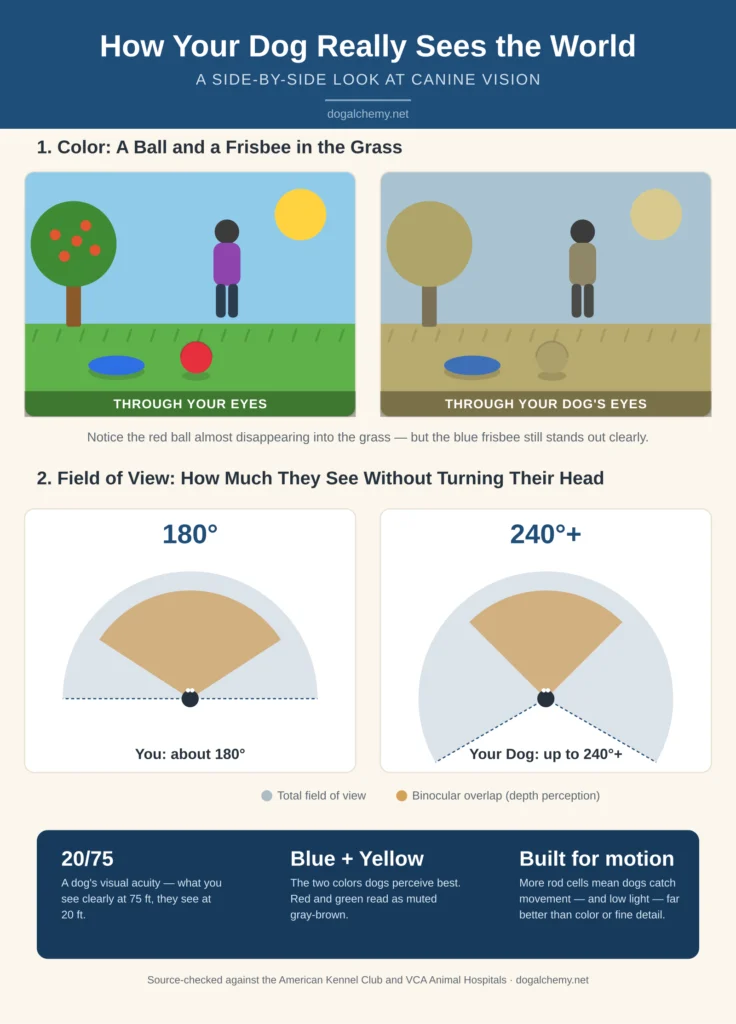
In practice, that means dogs see the world mainly in shades of blue and yellow. Red and green, the colors that pop the most for us, read to a dog as a muted, grayish brown.
A classic red ball on green grass isn’t vivid for your dog at all. It’s closer to a dull gray shape sitting in slightly different dull gray surroundings. Dullness camouflages it more than distance ever could.
This has a genuinely useful, practical side. Want a toy your dog can actually spot at a glance? Reach for blue or yellow over red or orange. It’s a small switch, and it makes a visible difference on every single throw.
A Wider World: Field of View and Depth Perception
Eye position changes everything about what you can see without moving your head. Human eyes sit fully on the front of the face, giving us a field of view of around 180 degrees.
According to the American Kennel Club, a dog’s eyes sit further to the sides. That pushes their field of view out to somewhere between 240 and 280 degrees. The exact number depends on breed and skull shape.
That wider view comes with a real trade-off, though. Depth perception depends on binocular overlap, the zone where both eyes’ fields of view combine into one image. Human eyes overlap heavily, which is exactly why we’re so good at judging distance and depth.
A dog’s more side-set eyes overlap less. Your dog genuinely sees more of the world at any given moment. But the middle-distance picture right in front of his nose isn’t quite as sharp as yours.
[Insert here: “How Your Dog Really Sees the World” infographic — color and field-of-view comparison]
Sharper on Motion, Softer on Detail
Visual sharpness works differently for dogs too. Human vision with no correction needed is typically rated 20/20. A dog’s average visual acuity comes in closer to 20/75. In plain terms, something clear to you at 75 feet isn’t nearly as clear to him. He needs to be about 20 feet away for that same crispness.
Where dogs pull far ahead of us is motion. Dog eyes and brains catch the smallest shift in a scene, especially at the edges of their vision. A squirrel darting across the yard registers almost instantly. That same squirrel sitting perfectly still might barely register at all.
This isn’t a flaw. It’s exactly the skill a predator that hunts moving prey actually needs.
Why Evolution Built Your Dog’s Eyes This Way
None of these traits happened by accident.
Wild canine ancestors were crepuscular hunters, most active at dawn and dusk. They chased prey that was very much alive and moving. Every adaptation in this post points straight back to that job.
Wide pupils and a tapetum lucidum handle low light. Sharp motion detection tracks a fleeing target. A broad field of view catches anything approaching from the side.
Human vision evolved to solve a different problem entirely.
Our early ancestors needed to judge distance and depth precisely. That helped them avoid becoming prey, and helped them track down food accurately. That’s really the whole story behind how dogs see the world.
Not worse than us — just built for an entirely different job.
How Dogs See the World Changes What You Do Next
Once you understand how dogs see the world, a few everyday habits start to make more sense.
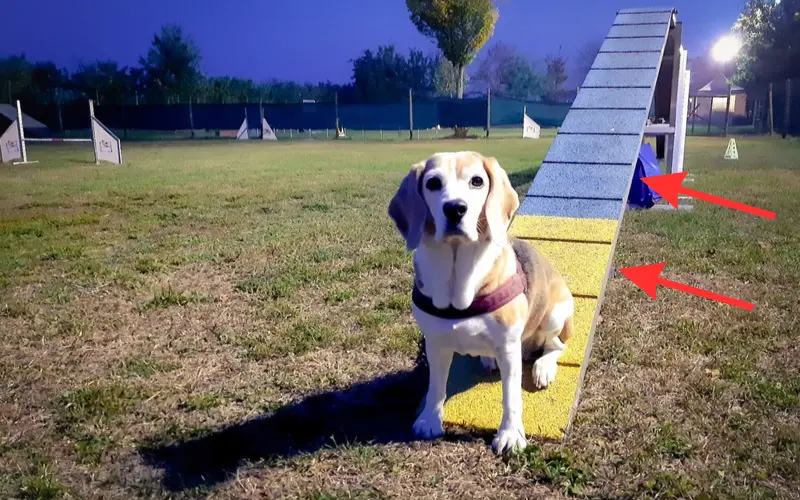
Toss a treat and watch it land. Your dog may glance right past it if it’s sitting still and roughly the color of the ground beneath it. Motion is what catches his attention, not stillness. A slight nudge or a second toss usually solves it instantly.
Play benefits from this too. High-contrast toys in blue or yellow are simply easier for your dog to track and find. Red or green ones tend to blend into outdoor grass instead. I’ve written a full guide on how to play with your dog. It includes more on picking toys that actually work with his vision instead of against it.
The same logic applies indoors. A dark-colored toy dropped on a dark rug or wood floor can vanish from view almost as completely as a red ball on grass. Brightness and contrast end up mattering just as much as color, sometimes more.
A World That’s Different, Not Lesser
It’s tempting to feel a little sorry for your dog once you know his colors look muted. His close-up world stays a little blurry too.
Resist that instinct. Vision is just one channel out of several, and it’s nowhere near your dog’s strongest one.
This ties into something I’ve written about before: perception and intelligence don’t come with one universal ruler. If that idea interests you, I’ve gone deeper into it in is my dog dumb? what science actually says.
What a dog’s eyes give up in color and detail, his nose more than makes up for.
I’ve written a deeper look at why the nose comes first for dogs. It’s genuinely worth reading for the fuller picture. Between that nose and a visual system built for motion and low light, your dog isn’t missing out on richness. He’s simply tuned into a different kind of richness than the one you happen to notice first.
Understanding a dog this well, right down to how he perceives the world, is real groundwork.
It’s exactly the foundation the K9 Training Institute’s Total Transformation Masterclass is built on. Training gets a lot easier once you’re working with your dog’s real senses. That beats assuming he experiences everything the way you do.
Has your dog ever completely missed a treat sitting right in front of him?
I’d love to hear about it in the comments.